Alahdab Fares, Firwana Belal, Hasan Rim, Sonbol Mohamad Bassam, Fares Munes, Alnahhas Iyad, Sabouni Ammar, Ferwana Mazen
University of Damascus, Damascus, Syria.
BMC Res Notes. 2012 Aug 12;5:431. doi: 10.1186/1756-0500-5-431.
Teaching evidence-based medicine (EBM) should be evaluated and guided by evidence of its own effectiveness. However, no data are available on adoption of EBM by Syrian undergraduate, postgraduate, or practicing physicians. In fact, the teaching of EBM in Syria is not yet a part of undergraduate medical curricula. The authors evaluated education of evidence-based medicine through a two-day intensive training course.
The authors evaluated education of evidence-based medicine through a two-day intensive training course that took place in 2011. The course included didactic lectures as well as interactive hands-on workshops on all topics of EBM. A comprehensive questionnaire, that included the Berlin questionnaire, was used to inspect medical students' awareness of, attitudes toward, and competencies' in EBM.
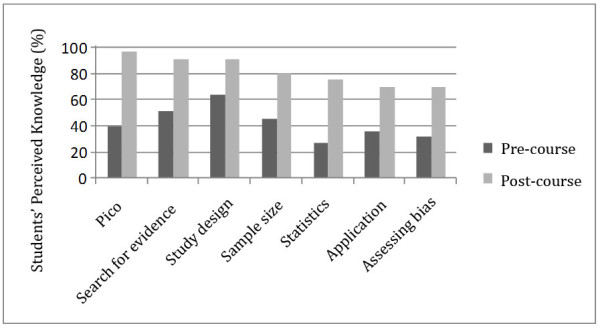
According to students, problems facing proper EBM practice in Syria were the absence of the following: an EBM teaching module in medical school curriculum (94%), role models among professors and instructors (92%), a librarian (70%), institutional subscription to medical journals (94%), and sufficient IT hardware (58%). After the course, there was a statistically significant increase in medical students' perceived ability to go through steps of EBM, namely: formulating PICO questions (56.9%), searching for evidence (39.8%), appraising the evidence (27.3%), understanding statistics (48%), and applying evidence at point of care (34.1%). However, mean increase in Berlin scores after the course was 2.68, a non-statistically significant increase of 17.86%.
The road to a better EBM reality in Syria starts with teaching EBM in medical school and developing the proper environment to facilitate transforming current medical education and practice to an evidence-based standard in Syria.
循证医学(EBM)教学应以其自身有效性的证据进行评估和指导。然而,尚无关于叙利亚本科、研究生或执业医师采用循证医学的数据。事实上,循证医学教学在叙利亚尚未成为本科医学课程的一部分。作者通过为期两天的强化培训课程对循证医学教育进行了评估。
作者通过2011年举办的为期两天的强化培训课程对循证医学教育进行评估。该课程包括理论讲座以及关于循证医学所有主题的互动实践工作坊。一份综合问卷,包括柏林问卷,用于考察医学生对循证医学的认识、态度和能力。
据学生反映,叙利亚循证医学实践面临的问题包括以下方面的缺失:医学院课程中的循证医学教学模块(94%)、教授和教员中的榜样(92%)、图书馆员(70%)、医学期刊的机构订阅(94%)以及足够的信息技术硬件(58%)。课程结束后,医学生在循证医学步骤方面的感知能力有统计学显著提高,即:提出PICO问题(56.9%)、寻找证据(39.8%)、评估证据(27.3%)、理解统计学(48%)以及在医疗点应用证据(34.1%)。然而,课程结束后柏林评分的平均提高为2.68,非统计学显著提高17.86%。
叙利亚实现更好的循证医学现实之路始于医学院的循证医学教学,并营造适当的环境,以促进将当前的医学教育和实践转变为叙利亚基于证据的标准。