Abdulahad Deena A, Westra Johanna, Bijzet Johannes, Dolff Sebastian, van Dijk Marcory C, Limburg Pieter C, Kallenberg Cees G M, Bijl Marc
Arthritis Res Ther. 2012 Aug 14;14(4):R184. doi: 10.1186/ar4015.
Lupus nephritis (LN) is a severe and frequent manifestation of systemic lupus erythematosus (SLE). Its pathogenesis has not been fully elucidated but immune complexes are considered to contribute to the inflammatory pathology in LN. High Mobility Group Box 1 (HMGB1) is a nuclear non-histone protein which is secreted from different types of cells during activation and/or cell death and may act as a pro-inflammatory mediator, alone or as part of DNA-containing immune complexes in SLE. Urinary excretion of HMGB1 might reflect renal inflammatory injury. To assess whether urinary HMGB1 reflects renal inflammation we determined serum levels of HMGB1 simultaneously with its urinary levels in SLE patients with and without LN in comparison to healthy controls (HC). We also analyzed urinary HMGB1 levels in relation with clinical and serological disease activity.
The study population consisted of 69 SLE patients and 17 HC. Twenty-one patients had biopsy proven active LN, 15 patients had a history of LN without current activity, and 33 patients had non-renal SLE. Serum and urine levels of HMGB1 were both measured by western blotting. Clinical and serological parameters were assessed according to routine procedures. In 17 patients with active LN a parallel analysis was performed on the expression of HMGB1 in renal biopsies.
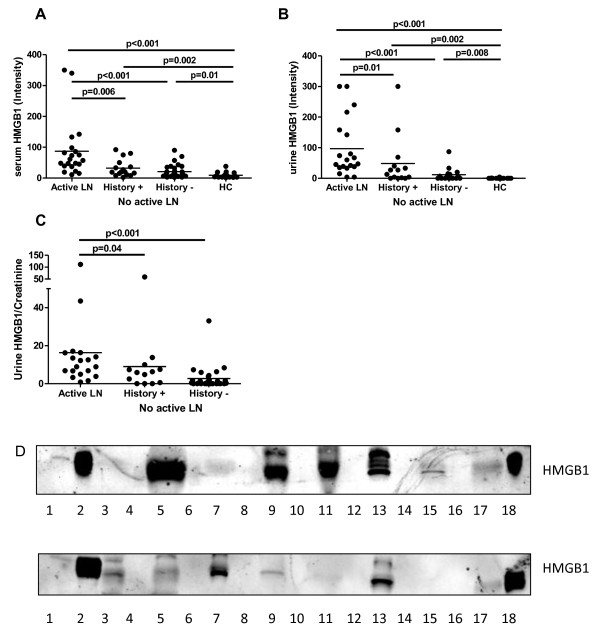
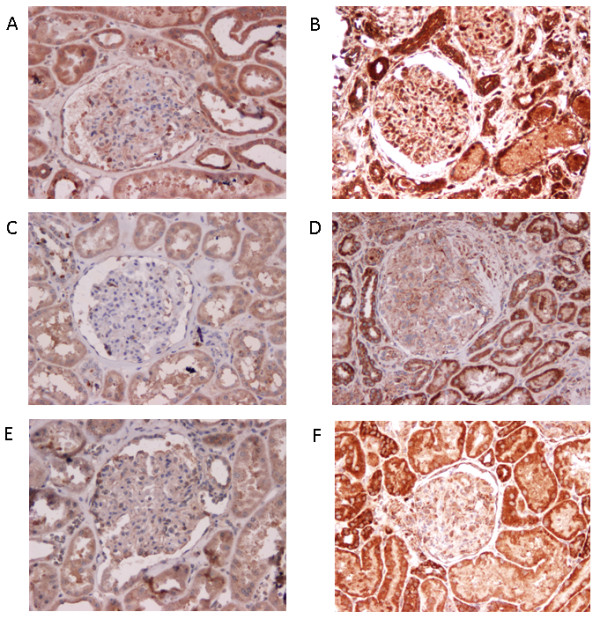
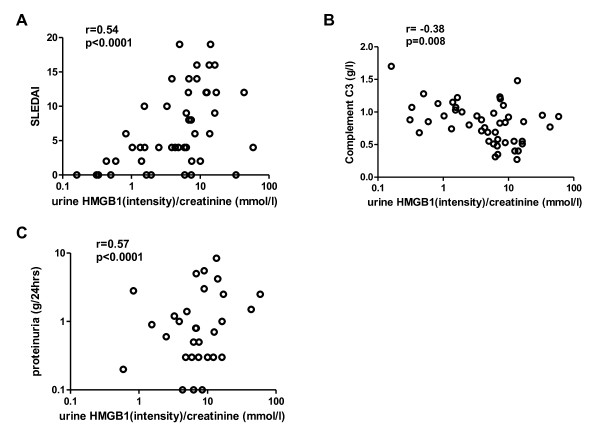
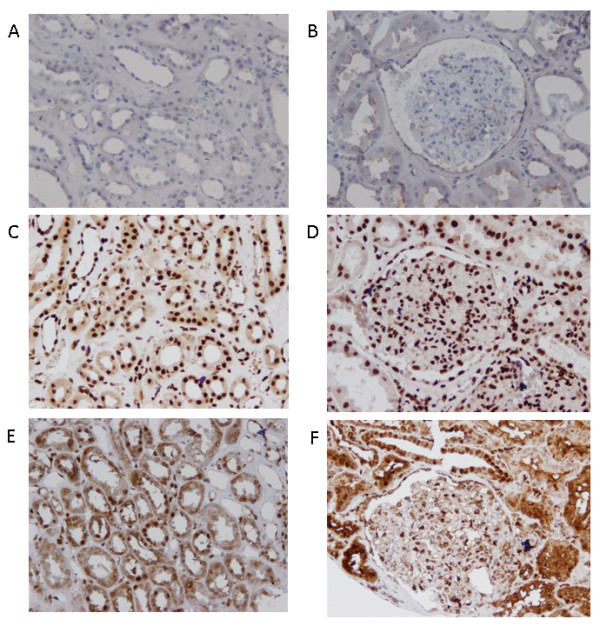
Serum and urinary levels of HMGB1 were significantly increased in patients with active LN compared to patients without active LN and HC. Similarly, renal tissue of active LN patients showed strong expression of HMGB1 at cytoplasmic and extracellular sites suggesting active release of HMGB1. Serum and urinary levels in patients without active LN were also significantly higher compared to HC. Urinary HMGB1 levels correlated with SLEDAI, and showed a negative correlation with complement C3 and C4.
Levels of HMGB1 in urine of SLE patients, in particular in those with active LN, are increased and correlate with SLEDAI scores. Renal tissue of LN patients shows increased release of nuclear HMGB1 compared to control renal tissue. HMGB1, although at lower levels, is, however, also present in the urine of patients without active LN. These data suggest that urinary HMGB1 might reflect both local renal inflammation as well as systemic inflammation.
狼疮性肾炎(LN)是系统性红斑狼疮(SLE)常见的严重表现形式。其发病机制尚未完全阐明,但免疫复合物被认为在LN的炎症病理过程中起作用。高迁移率族蛋白B1(HMGB1)是一种核内非组蛋白,在细胞激活和/或细胞死亡过程中从不同类型的细胞中分泌出来,可能作为促炎介质单独起作用,或作为SLE中含DNA免疫复合物的一部分起作用。HMGB1的尿排泄量可能反映肾脏炎症损伤。为了评估尿HMGB1是否反映肾脏炎症,我们测定了有LN和无LN的SLE患者以及健康对照(HC)的血清HMGB1水平及其尿中水平。我们还分析了尿HMGB1水平与临床和血清学疾病活动度的关系。
研究人群包括69例SLE患者和17例HC。21例患者经活检证实有活动性LN,15例患者有LN病史但目前无活动,33例患者有非肾脏SLE。HMGB1的血清和尿水平均通过蛋白质印迹法测定。临床和血清学参数根据常规程序进行评估。对17例活动性LN患者的肾活检组织中HMGB1的表达进行了平行分析。
与无活动性LN的患者和HC相比,活动性LN患者的血清和尿HMGB1水平显著升高。同样,活动性LN患者的肾组织在细胞质和细胞外部位显示出HMGB1的强表达,提示HMGB1的活性释放。与HC相比,无活动性LN患者的血清和尿水平也显著升高。尿HMGB1水平与SLE疾病活动指数(SLEDAI)相关,与补体C3和C4呈负相关。
SLE患者,尤其是活动性LN患者尿中HMGB1水平升高,且与SLEDAI评分相关。与对照肾组织相比,LN患者的肾组织中核HMGB1的释放增加。然而,无活动性LN患者的尿中也存在HMGB1,尽管水平较低。这些数据表明,尿HMGB1可能反映局部肾脏炎症以及全身炎症。