Department of Pediatrics, West China Second University Hospital, Sichuan University, No. 17, People's South Road, Chengdu 610041, Sichuan Province, PR China.
BMC Public Health. 2012 Aug 10;12:636. doi: 10.1186/1471-2458-12-636.
Obesity is widespread in the world including developing countries. However malnutrition in poor areas is still a serious problem. Few investigations, especially in a large sample, have been performed in Western area of China. This study aimed to evaluate the nutritional status of school children aged 9-15 years in large Southwest city of China, and identify the differential impact of aberrant birth categories and family history of obesity related disease on childhood overweight and obesity development.
A multistage random cluster sampling was performed to evaluate the prevalence of thinness, overweight and obesity, which were defined by the new age-, sex-, specific BMI reference developed by World Health Organization (WHO) (2007). And then a frequency matched case-control study was performed to identify the risk factors of overweight and obesity.
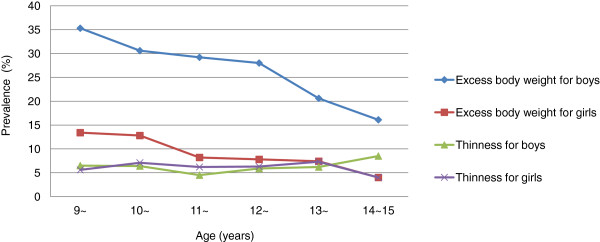
7,194 children (3,494 boys, 3,700 girls) were recruited, and 1,282 (17.8%) had excess bodyweight (14.5% overweight, 3.3% obesity). The combined prevalence gradually decreased with age, and were more prevalent among boys than girls (P <0.05). Meanwhile 6.3% were found thinness and there were little differences in genders (P >0.05). Preterm large for gestational age (OR = 2.746), maternal history of obesity related disease (OR = 1.713), paternal history of obesity related disease (OR = 1.583), preterm appropriate for gestational age (OR = 1.564), full term small for gestational age (OR = 1.454) and full term large for gestational age (OR = 1.418) were recognized as significant risk factors in the multivariate regression analysis (P <0.05).
While overweight and obesity was dramatically spreading, malnutrition still remained a serious problem. This unmatched nutritional status should be emphasized in backward cities of China. Children born of both preterm and LGA, whose parents particularly mothers had a history of obesity related disease, should be emphatically intervened as early as possible.
肥胖在包括发展中国家在内的全球范围内普遍存在。然而,贫困地区的营养不良仍然是一个严重的问题。在中国西部地区,很少有调查,特别是在大规模样本中进行过。本研究旨在评估中国西南部一个大城市 9-15 岁儿童的营养状况,并确定异常出生类别和肥胖相关疾病家族史对儿童超重和肥胖发展的差异影响。
采用多阶段随机整群抽样方法评估消瘦、超重和肥胖的患病率,消瘦、超重和肥胖分别由世界卫生组织(WHO)(2007 年)制定的新的年龄、性别、特定 BMI 参考值定义。然后进行频率匹配的病例对照研究,以确定超重和肥胖的危险因素。
共招募了 7194 名儿童(男 3494 名,女 3700 名),其中 1282 名(17.8%)体重超标(14.5%超重,3.3%肥胖)。综合患病率随年龄逐渐下降,且男孩多于女孩(P<0.05)。同时,发现 6.3%的儿童消瘦,性别差异不大(P>0.05)。巨大儿(OR=2.746)、母亲肥胖相关疾病史(OR=1.713)、父亲肥胖相关疾病史(OR=1.583)、早产儿(OR=1.564)、足月小样儿(OR=1.454)和足月巨大儿(OR=1.418)被认为是多变量回归分析中的显著危险因素(P<0.05)。
尽管超重和肥胖问题日益严重,但营养不良仍然是一个严重的问题。在中国欠发达地区,应重视这种不平衡的营养状况。对于父母特别是母亲有肥胖相关疾病史的早产儿和巨大儿,应尽早进行有针对性的干预。