Blanuša Maja, Orct Tatjana, Vihnanek Lazarus Maja, Sekovanić Ankica, Piasek Martina
Analytical Toxicology and Mineral Metabolism Unit, Institute for Medical Research and Occupational Health, Ksaverska Cesta 2, P.O. Box 291, HR-10001 Zagreb, Croatia.
J Biomed Biotechnol. 2012;2012:256965. doi: 10.1155/2012/256965. Epub 2012 Jul 26.
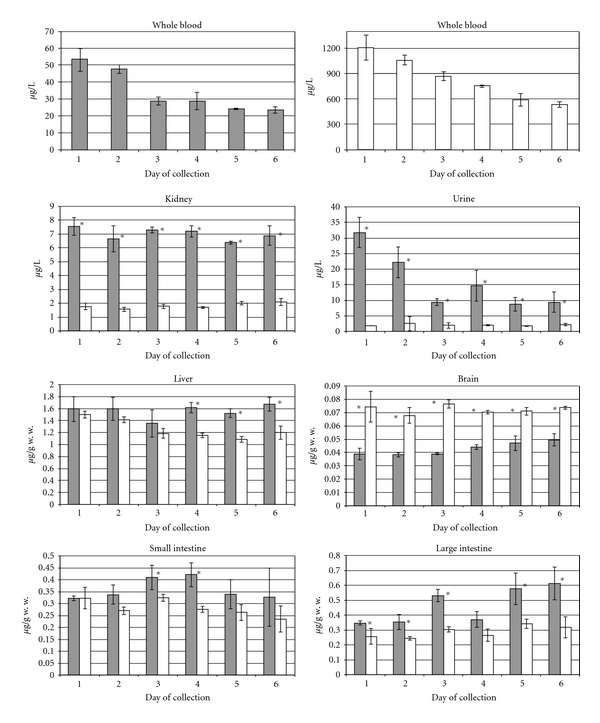
Due to the facts that thiomersal-containing vaccine is still in use in many developing countries, and all forms of mercury have recognised neurotoxic, nephrotoxic, and other toxic effects, studies on disposition of ethylmercury and other mercury forms are still justified, especially at young age. Our investigation aimed at comparing mercury distribution and rate of excretion in the early period of life following exposure to either thiomersal (TM) or mercuric chloride (HgCl₂) in suckling rats. Three experimental groups were studied: control, TM, and HgCl₂, with 12 to18 pups in each. Both forms of mercury were administered subcutaneously in equimolar quantities (0.81 μmol/kg b.w.) three times during the suckling period (on the days of birth 7, 9, and 11) to mimic the vaccination regimen in infants. After the last administration of TM or HgCl₂, total mercury retention and excretion was assessed during following six days. In TM-exposed group mercury retention was higher in the brain, enteral excretion was similar, and urinary excretion was much lower compared to HgCl₂-exposed sucklings. More research is still needed to elucidate all aspects of toxicokinetics and most harmful neurotoxic potential of various forms of mercury, especially in the earliest period of life.
由于含硫柳汞的疫苗仍在许多发展中国家使用,并且所有形式的汞都具有公认的神经毒性、肾毒性和其他毒性作用,因此对乙基汞和其他汞形式的代谢研究仍然是合理的,尤其是在幼年时期。我们的研究旨在比较哺乳期大鼠暴露于硫柳汞(TM)或氯化汞(HgCl₂)后生命早期的汞分布和排泄率。研究了三个实验组:对照组、TM组和HgCl₂组,每组有12至18只幼崽。在哺乳期(出生后第7、9和11天),两种形式的汞均以等摩尔量(0.81 μmol/kg体重)皮下注射三次,以模拟婴儿的疫苗接种方案。在最后一次给予TM或HgCl₂后,在接下来的六天内评估总汞保留和排泄情况。与暴露于HgCl₂的幼崽相比,TM暴露组的大脑中汞保留更高,肠道排泄相似,而尿液排泄则低得多。仍需要更多研究来阐明各种形式汞的毒代动力学的各个方面以及最有害的神经毒性潜力,尤其是在生命的最早阶段。