West J Emerg Med. 2012 Aug;13(3):260-71. doi: 10.5811/westjem.2012.3.11779.
Recent research suggests that men who have sex with men (MSM) experience intimate partner violence (IPV) at significantly higher rates than heterosexual men. Few studies, however, have investigated implications of heterosexist social pressures - namely, homophobic discrimination, internalized homophobia, and heterosexism - on risk for IPV among MSM, and no previous studies have examined cross-national variations in the relationship between IPV and social pressure. This paper examines reporting of IPV and associations with social pressure among a sample of internet-recruited MSM in the United States (U.S.), Canada, Australia, the United Kingdom, South Africa, and Brazil.
We recruited internet-using MSM from 6 countries through selective banner advertisements placed on Facebook. Eligibility criteria were men age over 18 reporting sex with a man in the past year. Of the 2,771 eligible respondents, 2,368 had complete data and were included in the analysis. Three outcomes were examined: reporting recent experience of physical violence, sexual violence, and recent perpetration of physical violence. The analysis focused on associations between reporting of IPV and experiences of homophobic discrimination, internalized homophobia, and heteronormativity.
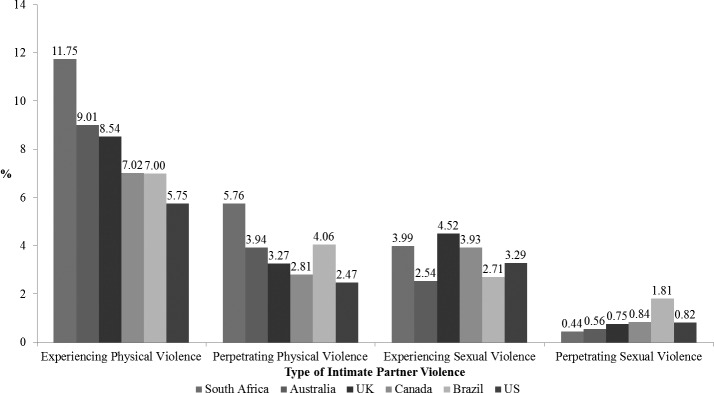
Reporting of experiencing physical IPV ranged from 5.75% in the U.S. to 11.75% in South Africa, while experiencing sexual violence was less commonly reported and ranged from 2.54% in Australia to 4.52% in the U.S. Perpetration of physical violence ranged from 2.47% in the U.S. to 5.76% in South Africa. Experiences of homophobic discrimination, internalized homophobia, and heteronormativity were found to increase odds of reporting IPV in all countries.
There has been little data on IPV among MSM, particularly MSM living in low- and middle-income countries. Despite the lack of consensus in demographic correlates of violence reporting, heterosexist social pressures were found to significantly increase odds of reporting IPV in all countries. These findings show the universality of violence reporting among MSM across countries, and highlight the unique role of heteronormativity as a risk factor for violence reporting among MSM. The results demonstrate that using internet-based surveys to reach MSM is feasible for certain areas, although modified efforts may be required to reach diverse samples of MSM.
最近的研究表明,男男性行为者(MSM)经历亲密伴侣暴力(IPV)的比率明显高于异性恋男性。然而,很少有研究调查异性恋社会压力——即恐同歧视、内化的恐同和异性恋主义——对 MSM 中 IPV 风险的影响,也没有先前的研究探讨 IPV 与社会压力之间的关系在不同国家的变化。本文研究了在美国(美国)、加拿大、澳大利亚、英国、南非和巴西,通过互联网招募的 MSM 样本中 IPV 的报告情况以及与社会压力的关系。
我们通过在 Facebook 上选择性地投放横幅广告,从 6 个国家招募使用互联网的 MSM。合格标准是年龄在 18 岁以上,报告过去一年与男性发生性行为。在 2771 名符合条件的应答者中,有 2368 人有完整的数据,并纳入分析。研究了三个结果:报告最近经历的身体暴力、性暴力和最近的身体暴力行为。分析重点是报告 IPV 与恐同歧视、内化的恐同和异性恋规范的经历之间的关联。
报告经历身体 IPV 的比例从美国的 5.75%到南非的 11.75%不等,而经历性暴力的比例较低,从澳大利亚的 2.54%到美国的 4.52%不等。身体暴力的实施比例从美国的 2.47%到南非的 5.76%不等。在所有国家,经历恐同歧视、内化的恐同和异性恋规范都被发现增加了报告 IPV 的几率。
关于 MSM 中的 IPV,特别是生活在中低收入国家的 MSM 中的 IPV,数据很少。尽管在暴力报告的人口统计学相关性方面缺乏共识,但异性恋社会压力被发现显著增加了所有国家报告 IPV 的几率。这些发现表明,跨国家 MSM 中的暴力报告具有普遍性,并强调了异性恋规范作为 MSM 暴力报告的一个风险因素的独特作用。结果表明,使用基于互联网的调查来接触 MSM 在某些地区是可行的,尽管可能需要进行修改以接触到不同的 MSM 样本。