Pikwer Mitra, Nilsson Jan-Åke, Bergström Ulf, Jacobsson Lennart T H, Turesson Carl
Arthritis Res Ther. 2012 Aug 17;14(4):R190. doi: 10.1186/ar4021.
We aimed to investigate whether recognized hormonal predictors of rheumatoid arthritis (RA) also influence the severity of RA.
One hundred thirty-four incident RA cases identified by four different local and national registers, who had participated in a community-based health survey between 1991 and 1996, were included. By a retrospective structured review of the medical records, information on the use of disease-modifying antirheumatic drugs (DMARDs), erosions on radiographs, rheumatoid factor (RF) status, and disability measured by using the health assessment questionnaire (HAQ) were collected. The variables were added to the SPSS TwoStep Cluster Analysis to reveal natural groupings of RA severity. Known hormonal predictors analyzed were breastfeeding history, history of oral contraceptive (OC) use, and menopausal age.
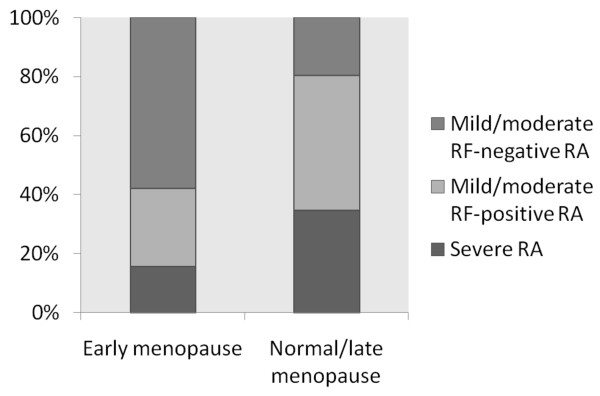
The mean age at RA diagnosis was 63.4 years; 72% were RF positive, and 28% had received biological treatment. Three clusters were identified, one with severe RA, one with mild/moderate RF-positive RA, and one with mild/moderate RF-negative RA. A significant difference (P = 0.005) was found in the distribution of clusters between patients with a history of early menopause compared with those with menopause after 45 years, with a higher proportion with mild/moderate RF-negative RA in the early-menopause subset. No major difference in severity of the disease was noted depending on OC use or history of breastfeeding.
Early menopause was associated with a milder form of RA. Hormonal changes may influence pathways that are distinct from those leading to severe, progressive disease.
我们旨在研究类风湿关节炎(RA)公认的激素预测指标是否也会影响RA的严重程度。
纳入了通过四个不同的地方和国家登记系统确定的134例初发RA病例,这些病例在1991年至1996年间参与了一项基于社区的健康调查。通过对病历进行回顾性结构化审查,收集了关于使用改善病情抗风湿药物(DMARDs)、X线片上的侵蚀情况、类风湿因子(RF)状态以及使用健康评估问卷(HAQ)测量的残疾情况的信息。将这些变量纳入SPSS两步聚类分析,以揭示RA严重程度的自然分组。分析的已知激素预测指标包括母乳喂养史、口服避孕药(OC)使用史和绝经年龄。
RA诊断时的平均年龄为63.4岁;72%为RF阳性,28%接受过生物治疗。确定了三个聚类,一个为重度RA,一个为轻度/中度RF阳性RA,一个为轻度/中度RF阴性RA。与45岁以后绝经的患者相比,早期绝经患者的聚类分布存在显著差异(P = 0.005),早期绝经亚组中轻度/中度RF阴性RA的比例更高。根据OC使用情况或母乳喂养史,未发现疾病严重程度有重大差异。
早期绝经与较轻形式的RA相关。激素变化可能影响与导致严重、进展性疾病不同的途径。