Department of Psychiatry, School of Medicine, University of California San Diego, 9500 Gilman Drive, M/C 0603, La Jolla, CA 92093-0603, USA.
Psychopharmacology (Berl). 2013 Jan;225(2):473-82. doi: 10.1007/s00213-012-2837-3. Epub 2012 Aug 19.
Chronic nicotine administration decreases the functioning of the cystine-glutamate antiporter system x(c)- which is hypothesized to promote nicotine-taking and nicotine-seeking behaviors. N-acetylcysteine (NAC), a cystine pro-drug, increases the activity of the cystine-glutamate antiporter system x(c)-. Thus, NAC could potentially reverse nicotine-induced alterations in glutamatergic transmission and decrease nicotine taking and seeking.
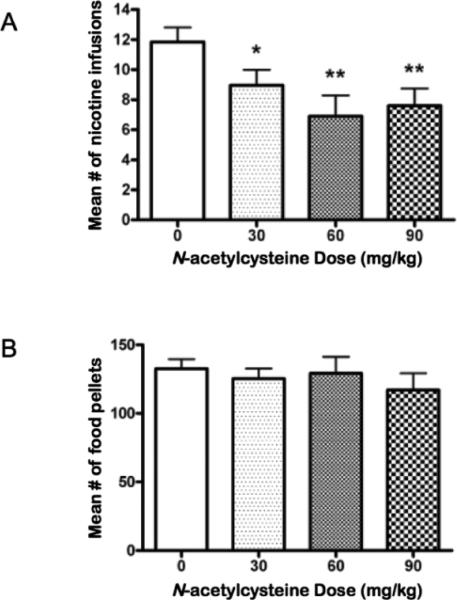
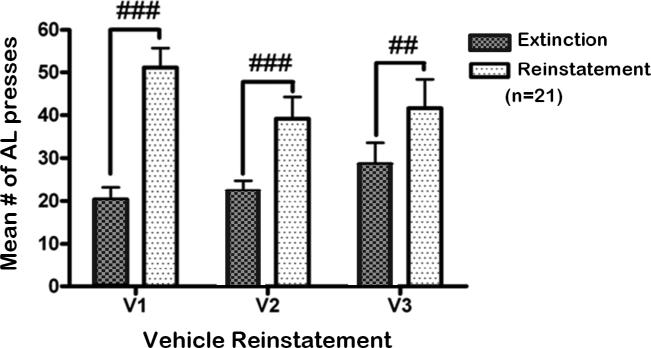
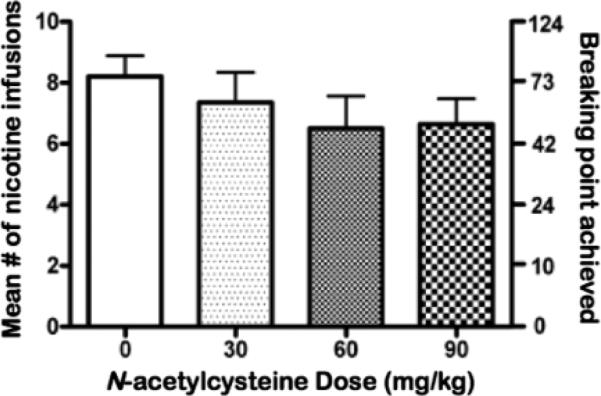
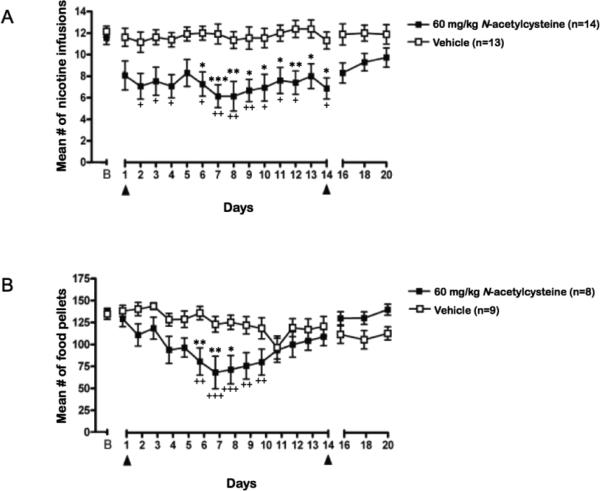
To test this hypothesis in the present study, the effects of acute NAC treatment (30, 60, and 90 mg/kg, i.p.) on nicotine (fixed- and progressive-ratio schedules) and food (fixed-ratio schedule) self-administration were assessed in rats. In addition, the effects of acute NAC treatment on cue-induced reinstatement of nicotine- and food-seeking behaviors were investigated. Finally, the effects of repeated daily NAC administration (60 mg/kg, i.p., 14 days) on nicotine and food self-administration were assessed.
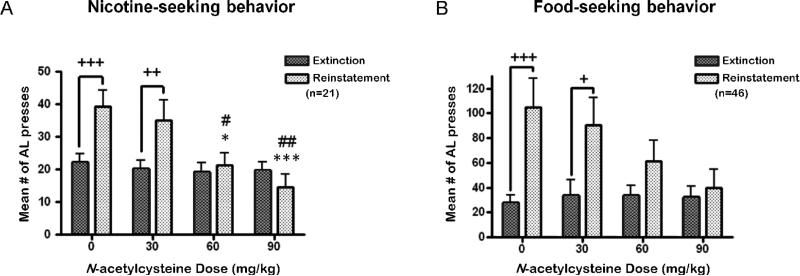
Acute NAC administration decreased nicotine self-administration but not food responding under a fixed-ratio schedule of reinforcement. In addition, acute NAC administration showed a nonsignificant trend in attenuating nicotine self-administration under a progressive-ratio schedule that was similar to the dose-response function under the fixed-ratio schedule. Furthermore, repeated NAC administration decreased nicotine self-administration from day 6 to 14 compared with vehicle treatment, with no indication of tolerance development. By contrast, repeated NAC administration decreased food responding from day 6 to 8 compared with vehicle treatment and showed rapid development of tolerance. Finally, acute NAC administration attenuated cue-induced reinstatement of nicotine and food seeking.
Altogether, these findings suggest that NAC may be useful in promoting smoking cessation in humans.
慢性尼古丁给药会降低胱氨酸-谷氨酸反向转运蛋白系统 x(c)-的功能,而该系统被认为可促进尼古丁摄入和觅药行为。N-乙酰半胱氨酸(NAC)是一种胱氨酸前体药物,可增加胱氨酸-谷氨酸反向转运蛋白系统 x(c)-的活性。因此,NAC 可能潜在地逆转尼古丁诱导的谷氨酸能传递改变,并减少尼古丁摄入和觅药。
为了在本研究中检验这一假设,我们评估了急性 NAC 处理(30、60 和 90mg/kg,ip)对大鼠尼古丁(固定和递增比例时间表)和食物(固定比例时间表)自我给药的影响。此外,我们还研究了急性 NAC 处理对线索诱导的尼古丁和食物觅药行为复吸的影响。最后,我们评估了重复每日 NAC 给药(60mg/kg,ip,14 天)对尼古丁和食物自我给药的影响。
急性 NAC 给药减少了固定比例强化方案下的尼古丁自我给药,但不影响食物反应。此外,急性 NAC 给药在递增比例时间表下减弱尼古丁自我给药呈非显著性趋势,与固定比例时间表下的剂量反应功能相似。此外,与载体处理相比,重复 NAC 处理从第 6 天到第 14 天减少了尼古丁自我给药,且没有出现耐受发展的迹象。相比之下,重复 NAC 处理从第 6 天到第 8 天减少了食物反应,且表现出快速的耐受发展。最后,急性 NAC 给药减弱了线索诱导的尼古丁和食物觅药的复吸。
总之,这些发现表明 NAC 可能对促进人类戒烟有用。