Foster Michael E, Wong Bryan M
Materials Chemistry Department, Sandia National Laboratories, Livermore, California 94551, United States.
J Chem Theory Comput. 2012 Aug 14;8(8):2682-2687. doi: 10.1021/ct300420f. Epub 2012 Jul 2.
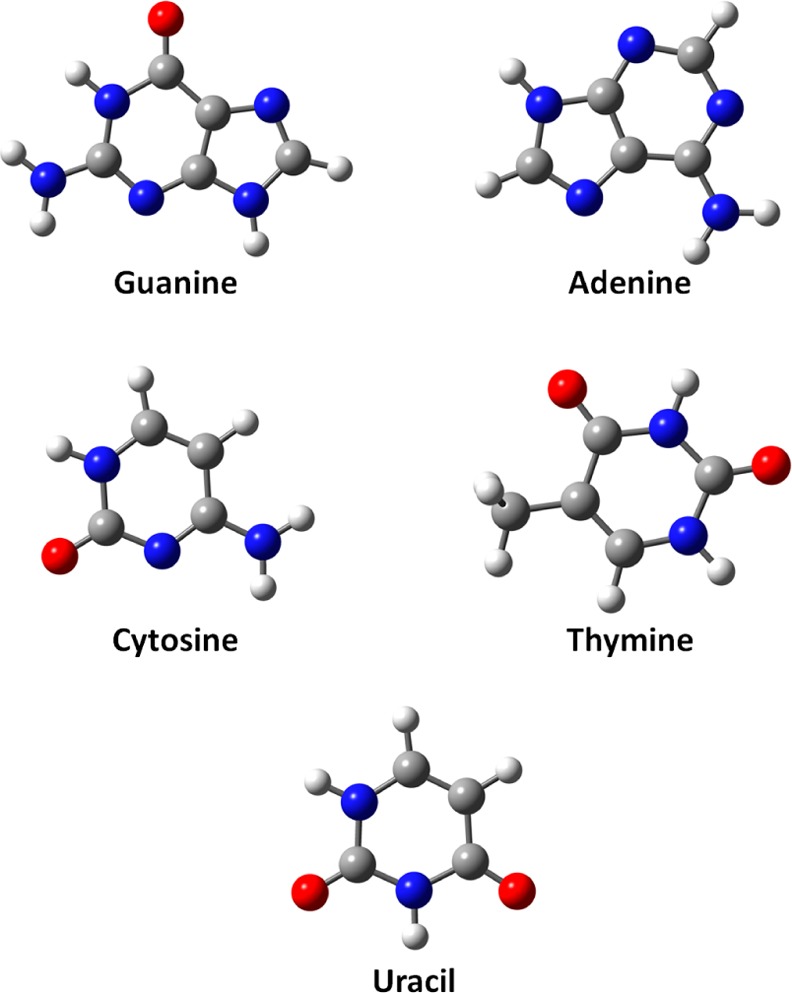
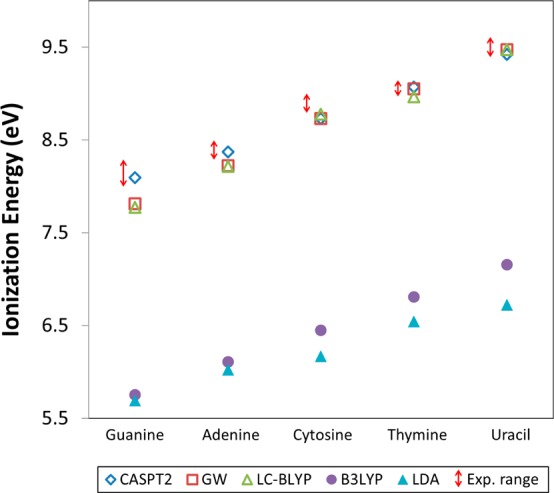
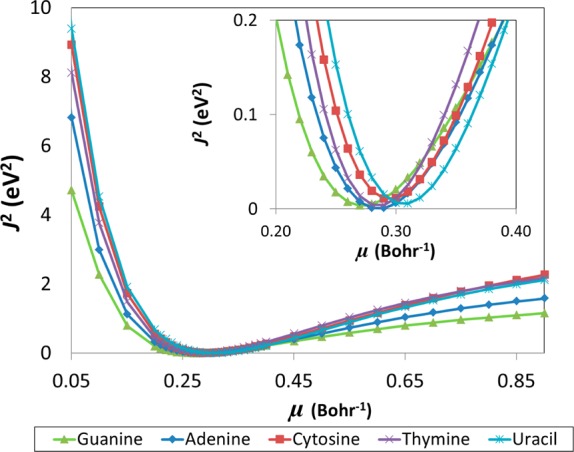
Using a nonempirically tuned range-separated DFT approach, we study both the quasiparticle properties (HOMO-LUMO fundamental gaps) and excitation energies of DNA and RNA nucleobases (adenine, thymine, cytosine, guanine, and uracil). Our calculations demonstrate that a physically motivated, first-principles tuned DFT approach accurately reproduces results from both experimental benchmarks and more computationally intensive techniques such as many-body GW theory. Furthermore, in the same set of nucleobases, we show that the nonempirical range-separated procedure also leads to significantly improved results for excitation energies compared to conventional DFT methods. The present results emphasize the importance of a nonempirically tuned range-separation approach for accurately predicting both fundamental and excitation gaps in DNA and RNA nucleobases.
我们使用一种未经经验调整的范围分离密度泛函理论(DFT)方法,研究了DNA和RNA核碱基(腺嘌呤、胸腺嘧啶、胞嘧啶、鸟嘌呤和尿嘧啶)的准粒子性质(最高占据分子轨道-最低未占据分子轨道基本能隙)和激发能。我们的计算表明,一种基于物理原理、经第一性原理调整的DFT方法能够准确再现实验基准以及诸如多体GW理论等计算量更大的技术所得到的结果。此外,在同一组核碱基中,我们表明与传统DFT方法相比,非经验范围分离程序在激发能方面也能带来显著改进的结果。目前的结果强调了非经验调整的范围分离方法对于准确预测DNA和RNA核碱基中的基本能隙和激发能隙的重要性。