Department of Microbiology and Immunology, The Geisel School of Medicine at Dartmouth, Lebanon, NH 03756, USA.
Lab Invest. 2012 Oct;92(10):1461-71. doi: 10.1038/labinvest.2012.104. Epub 2012 Aug 20.
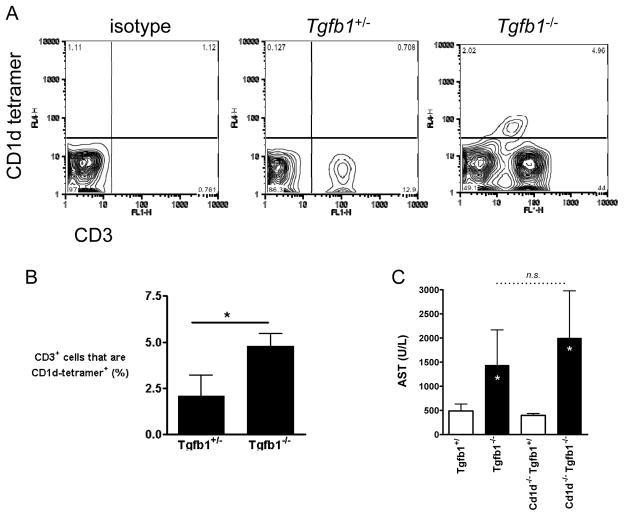
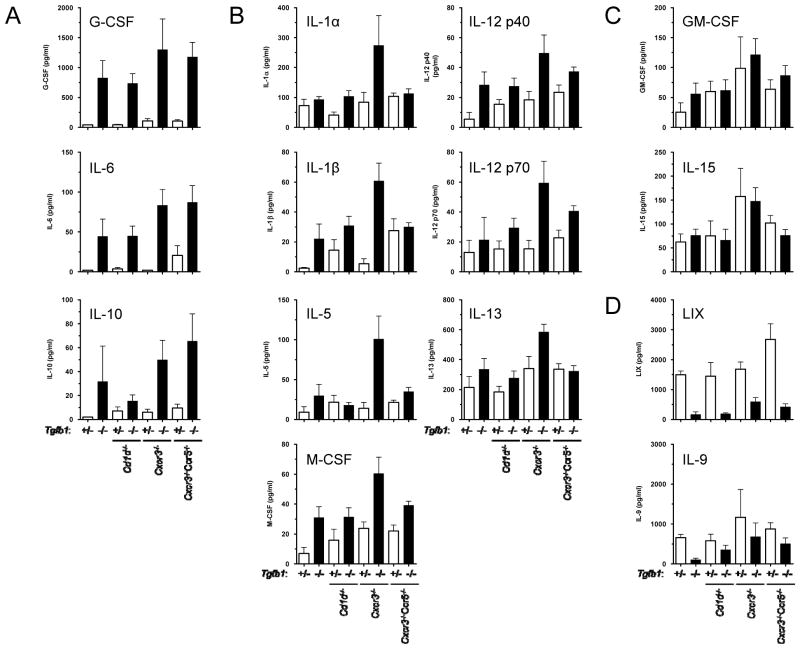
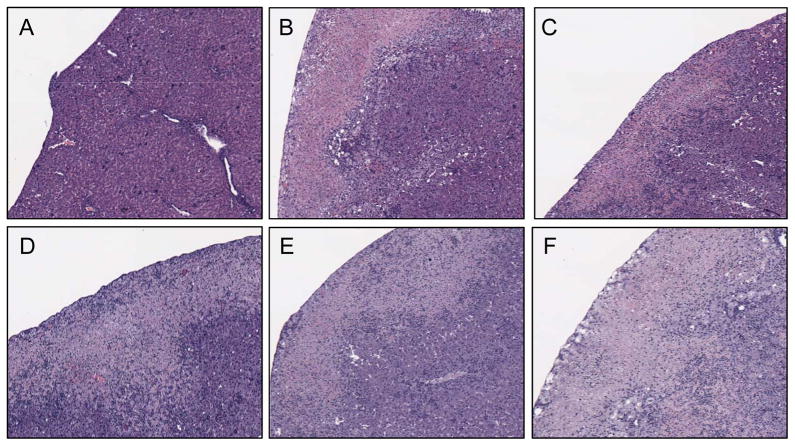
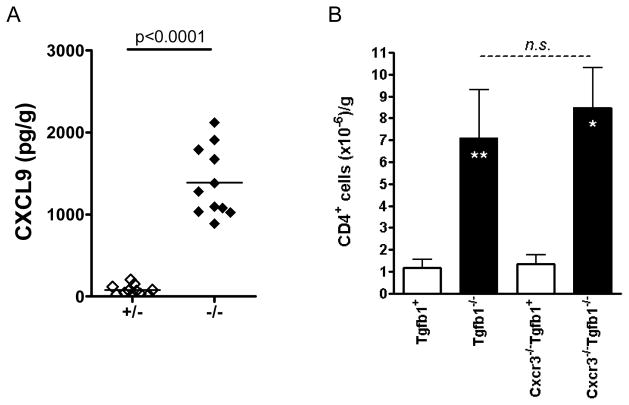
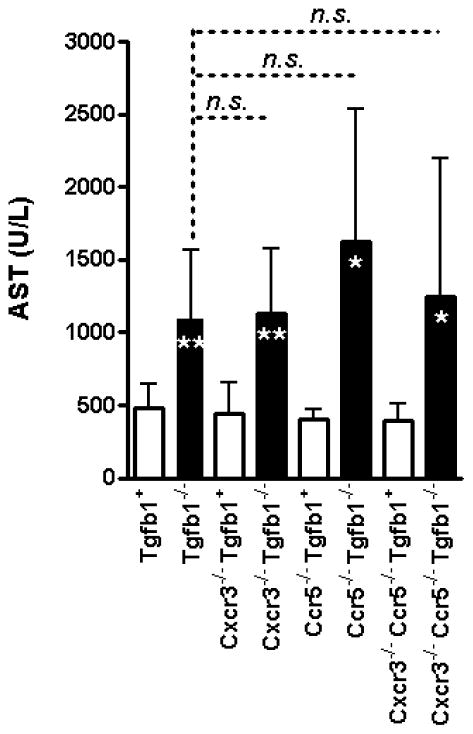
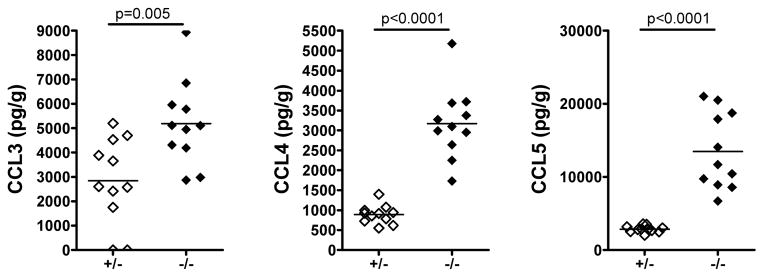
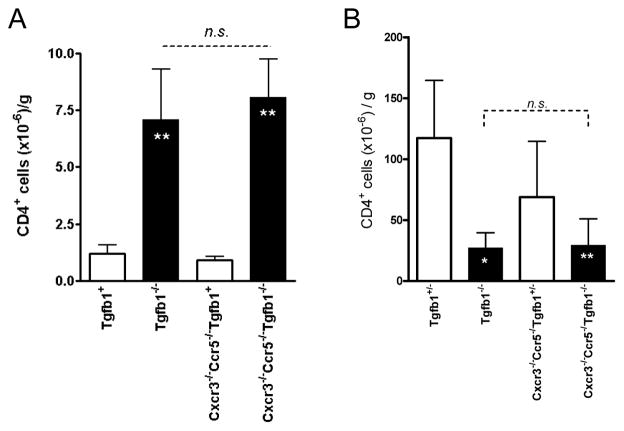
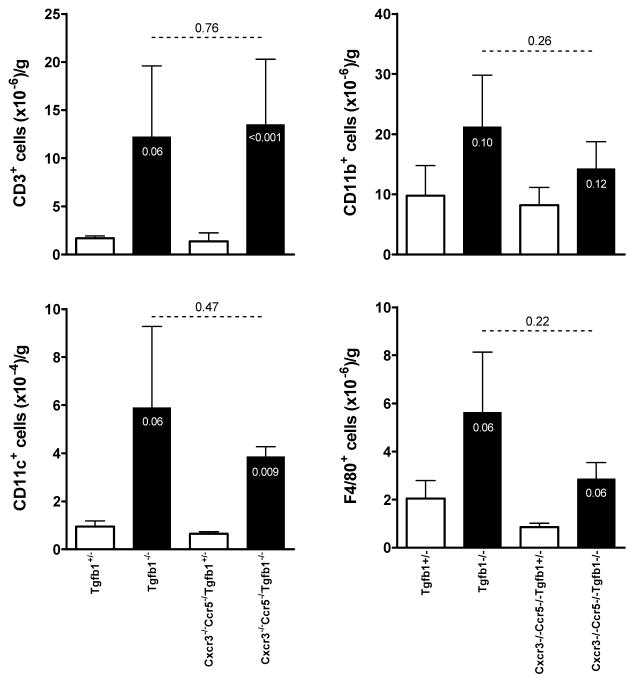
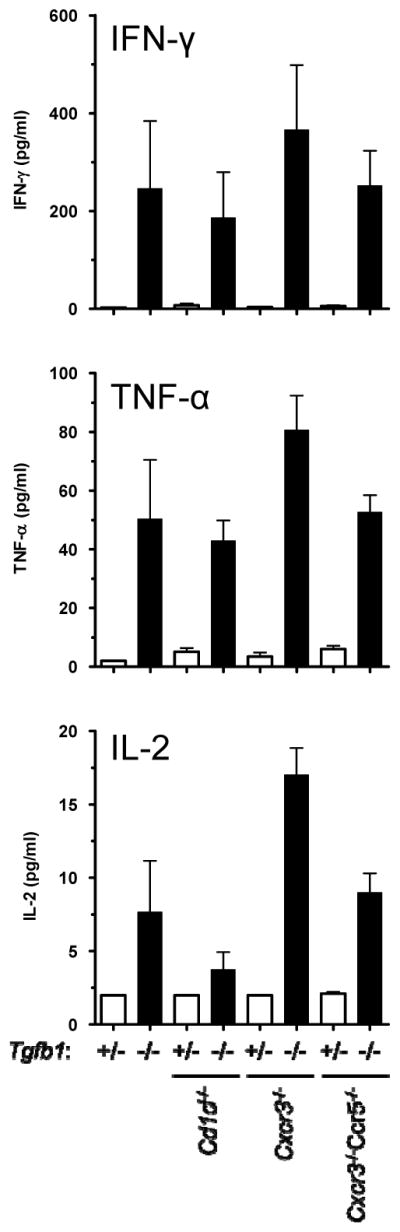
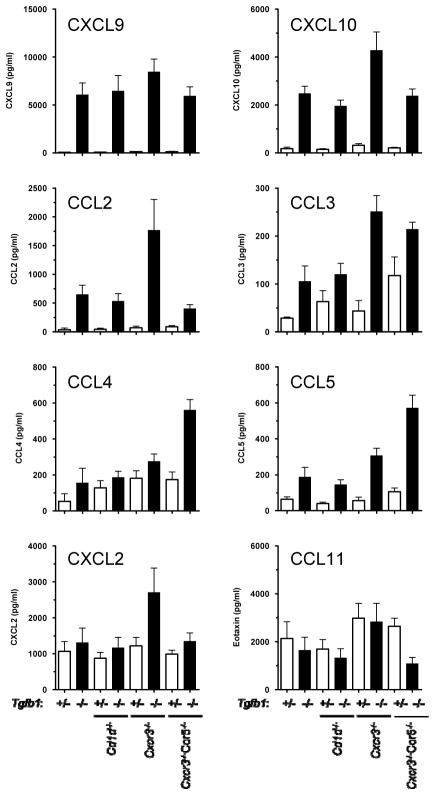
The specific mechanisms that mediate CD4(+) T-cell-mediated liver injury have not been fully elucidated. CD4(+) invariant natural killer T (iNKT) cells are required for liver damage in some mouse models of hepatitis, while the chemokine receptors CXCR3 and CCR5 are considered dominant Th1 chemokine receptors involved in Th1 trafficking in inflammatory conditions. BALB/c-Tgfb1(-/-) mice spontaneously develop Th1 hepatitis. Here, we directly test the hypotheses that iNKT cells or the Th1-cell chemokine receptors CXCR3 and CCR5 are required for development of liver disease in Tgfb1(-/-) mice. Tgfb1(-/-) mouse livers exhibited significant increases in iNKT cells and in ligands for CXCR3 or CCR5. Tgfb1(-/-) mice were rendered deficient in iNKT cells, CXCR3, CCR5, or both CXCR3 and CCR5, by cross-breeding with appropriate knockout mice. Tgfb1(-/-) mice developed severe liver injury, even in the absence of functional CD1d/iNKT cells, CXCR3, CCR5, or both CXCR3 and CCR5. Liver CD4(+) T cells accumulated to high numbers, and spleen CD4(+) T-cell numbers declined, regardless of the functionality of the CXCR3/CCR5 response pathways. Similarly, dendritic cells and macrophages accumulated in Tgfb1(-/-) livers even when CXCR3 and CCR5 were knocked out. Th1-associated cytokines (IFN-γ, TNF-α, IL-2) and chemokines (CXCL9, CXCL10) were strongly overexpressed in Tgfb1(-/-) mice despite knockouts in CD1d, CXCR3, or CCR5. These studies indicate that the cellular and biochemical basis for CD4(+) T-cell-mediated injury in liver can be complex, with myriad pathways potentially involved.
介导 CD4(+) T 细胞介导的肝损伤的具体机制尚未完全阐明。在一些肝炎的小鼠模型中,CD4(+) 不变自然杀伤 T(iNKT)细胞是肝损伤所必需的,而趋化因子受体 CXCR3 和 CCR5 被认为是参与炎症条件下 Th1 细胞趋化的主要 Th1 趋化因子受体。BALB/c-Tgfb1(-/-) 小鼠自发地发生 Th1 肝炎。在这里,我们直接测试了以下假设:iNKT 细胞或 Th1 细胞趋化因子受体 CXCR3 和 CCR5 是否是 Tgfb1(-/-) 小鼠发生肝病所必需的。Tgfb1(-/-) 鼠肝脏中 iNKT 细胞和 CXCR3 或 CCR5 的配体显著增加。通过与适当的敲除小鼠杂交,Tgfb1(-/-) 小鼠在 iNKT 细胞、CXCR3、CCR5 或 CXCR3 和 CCR5 两者均缺失的情况下表现出严重的肝损伤,即使在缺乏功能性 CD1d/iNKT 细胞、CXCR3、CCR5 或 CXCR3 和 CCR5 的情况下也是如此。肝 CD4(+)T 细胞大量聚集,脾脏 CD4(+)T 细胞数量减少,而无论 CXCR3/CCR5 反应途径的功能如何。同样,即使敲除了 CXCR3 和 CCR5,树突状细胞和巨噬细胞也在 Tgfb1(-/-) 肝脏中积聚。尽管在 CD1d、CXCR3 或 CCR5 敲除的情况下,Tgfb1(-/-) 小鼠中 Th1 相关细胞因子(IFN-γ、TNF-α、IL-2)和趋化因子(CXCL9、CXCL10)强烈过表达。这些研究表明,CD4(+) T 细胞介导的肝损伤的细胞和生化基础可能很复杂,可能涉及多种途径。