Chen Jun-Jie, Shen H-C Jennifer, Rivera Rosado Leslie A, Zhang Yaqin, Di Xu, Zhang Baolin
Division of Therapeutic Proteins, Office of Biotechnology Products, Center for Drug Evaluation and Research, Food and Drug Administration, Bethesda, Maryland, United States.
Oncotarget. 2012 Aug;3(8):833-42. doi: 10.18632/oncotarget.542.
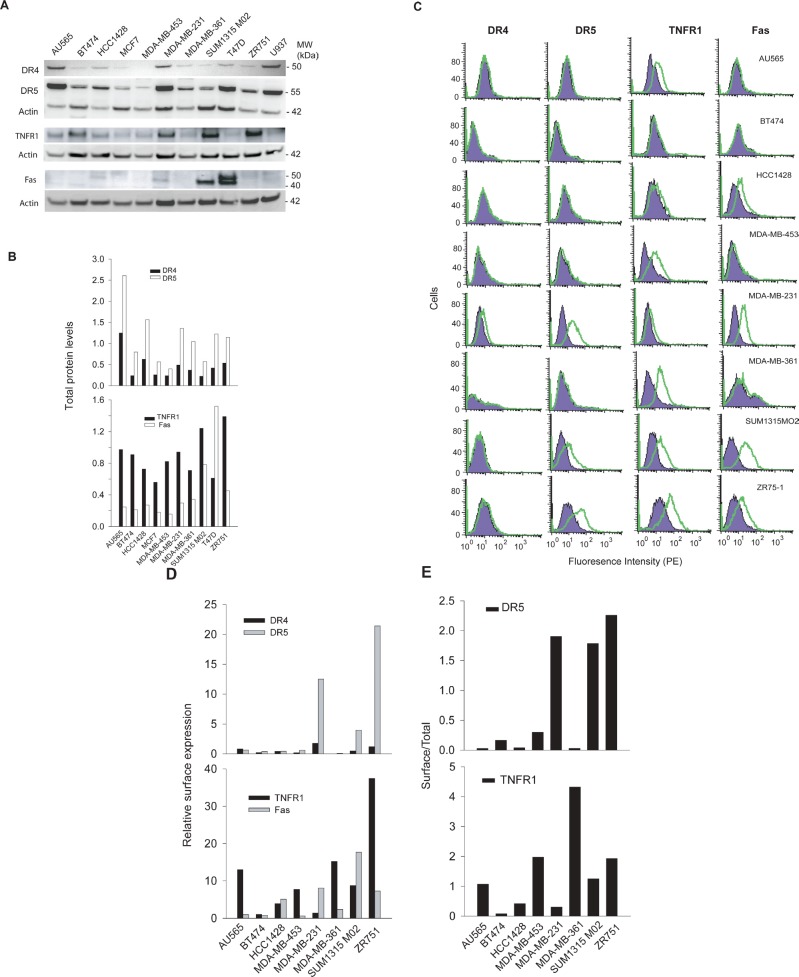
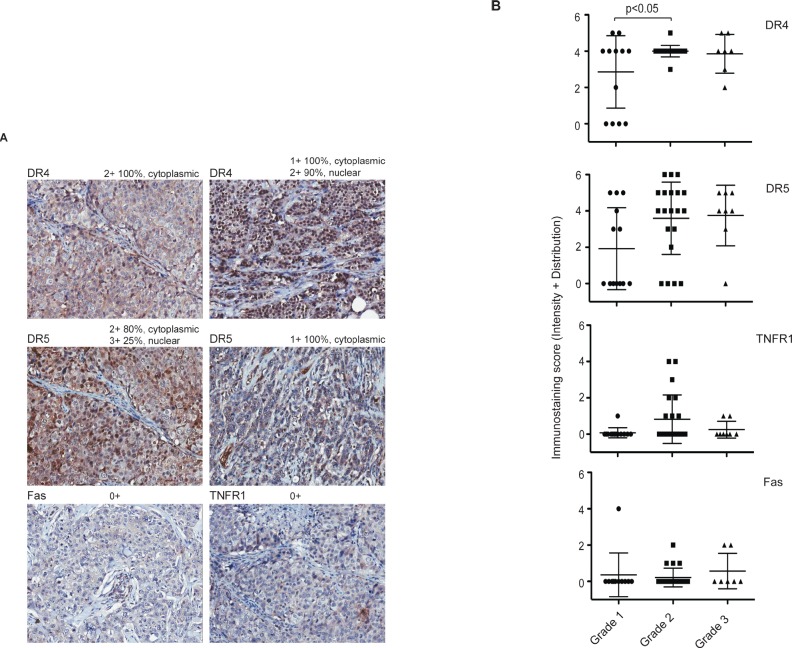
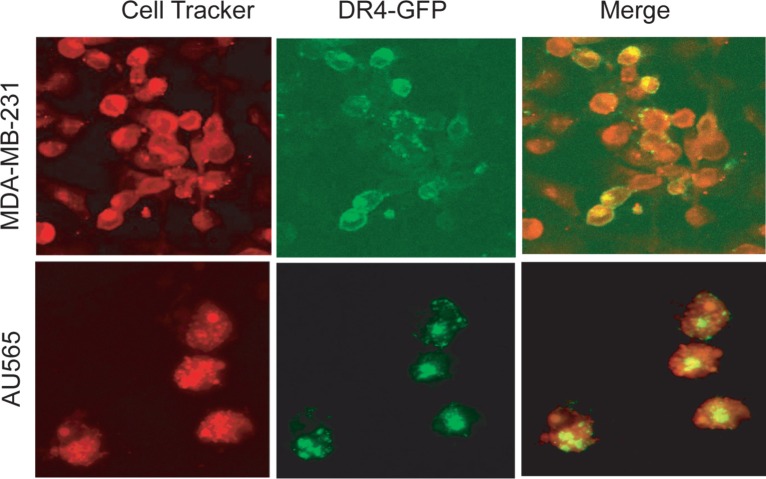
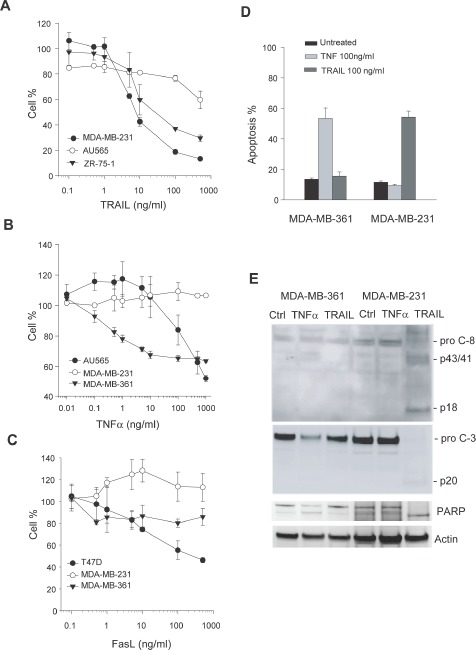
Multiple clinical trials are ongoing to evaluate the potential antitumor activity of human TNF variants, Fas ligand (FasL), TNF-related apoptosis inducing ligand (TRAIL) and its agonistic antibodies. These drug products act through the death receptors (DRs) TNF receptor 1 (TNFR1), Fas/CD95, DR4 (TRAIL-R1) and/or DR5 (TRAIL-R2), respectively. Therefore, characterization of the level and localization of DR expression in cancer cells is important for DR-targeted therapy. In this study, we examined the subcellular distribution of the four DRs in a panel of 10 human breast cancer cell lines by western blots and flow cytometry and 50 human breast tumors by immunohistochemistry. Despite their total protein expressions, the DRs were found to be absent on the surface of some cell lines. Consistent with this result, all four DRs were found to be mostly expressed in the cytoplasm and/or the nucleus of primary breast tumors (n=50). We further determined the growth inhibition activity (GI50) of the death ligands, recombinant human TNFα, FasL and TRAIL, and found a correlation with the subcellular localization of the corresponding DRs. These results demonstrate an aberrant expression of the death receptors in breast cancer cells, and suggest that the lack of surface DRs appears to be predictive of tumor resistance to DR-targeted therapies.
多项临床试验正在进行,以评估人肿瘤坏死因子(TNF)变体、Fas配体(FasL)、肿瘤坏死因子相关凋亡诱导配体(TRAIL)及其激动性抗体的潜在抗肿瘤活性。这些药物产品分别通过死亡受体(DRs)肿瘤坏死因子受体1(TNFR1)、Fas/CD95、DR4(TRAIL-R1)和/或DR5(TRAIL-R2)发挥作用。因此,表征癌细胞中DR表达的水平和定位对于以DR为靶点的治疗很重要。在本研究中,我们通过蛋白质印迹法和流式细胞术检测了10个人类乳腺癌细胞系中四种DR的亚细胞分布,并通过免疫组织化学检测了50个人类乳腺肿瘤中四种DR的亚细胞分布。尽管这些细胞系中有总的蛋白表达,但发现某些细胞系的表面不存在这些DR。与该结果一致,在原发性乳腺肿瘤(n = 50)中发现所有四种DR大多在细胞质和/或细胞核中表达。我们进一步测定了死亡配体、重组人TNFα、FasL和TRAIL的生长抑制活性(GI50),并发现其与相应DR的亚细胞定位相关。这些结果证明了乳腺癌细胞中死亡受体的异常表达,并表明表面DR的缺失似乎预示着肿瘤对以DR为靶点的治疗具有抗性。