Morris Joanne, Grimmer-Somers Karen, Kumar Saravana, Murphy Karen, Gilmore Lisa, Ashman Bryan, Perera Chandima, Vine Kathryn, Coulter Corinne
The Canberra Hospital, ACT Government Health Directorate, Canberra, ACT, Australia;
Patient Relat Outcome Meas. 2011 Jul;2:151-9. doi: 10.2147/PROM.S2373. Epub 2011 Aug 22.
There is generally a lengthy wait on outpatient orthopedic waiting lists in Australian public hospitals to consult a specialist. Patients then wait again for surgery, if required. Patients with higher need are rarely prioritized, and there is the potential for increased morbidity for those who wait. There is generally no option of alternative care whilst waiting. This paper compares historical orthopedic outpatient clinic data with the outcomes of a physiotherapy-led initiative in one large Australian tertiary hospital.
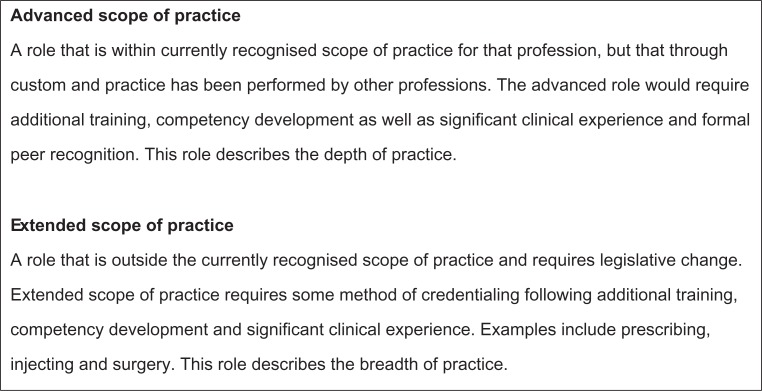
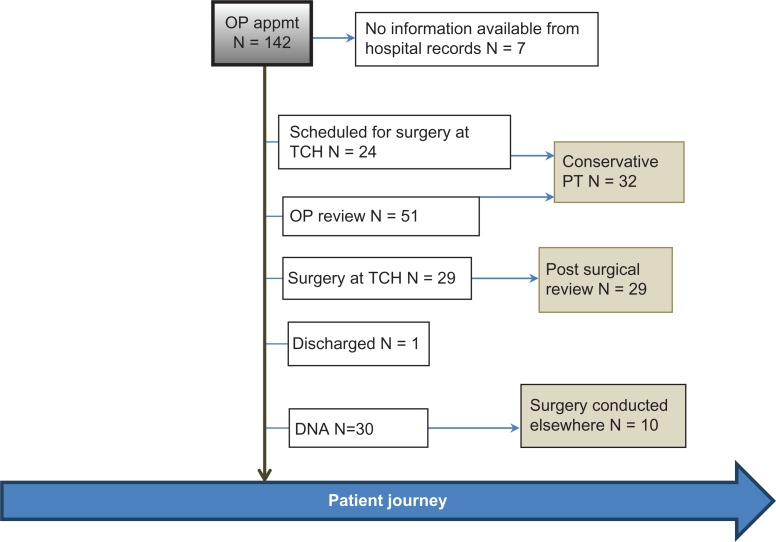
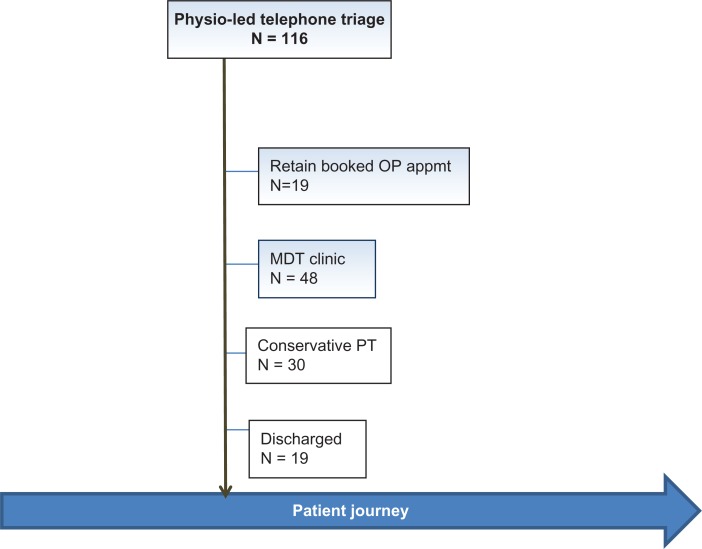
Two physiotherapists working within-scope conducted a telephone triage (October to December 2010) using a standard instrument for all new patients on the orthopedic waiting list. They were offered primary treatment options of retaining their appointment, being discharged, referral to a new model of assessment (multidisciplinary specialist clinic), or referral to physiotherapy. The outcomes were costs of the service, waiting time, and percentage of patients taking up management options. This was compared with a historical sample of new patients on the orthopedic waiting list (January to March 2009), whose treatment consumption was tracked longitudinally.
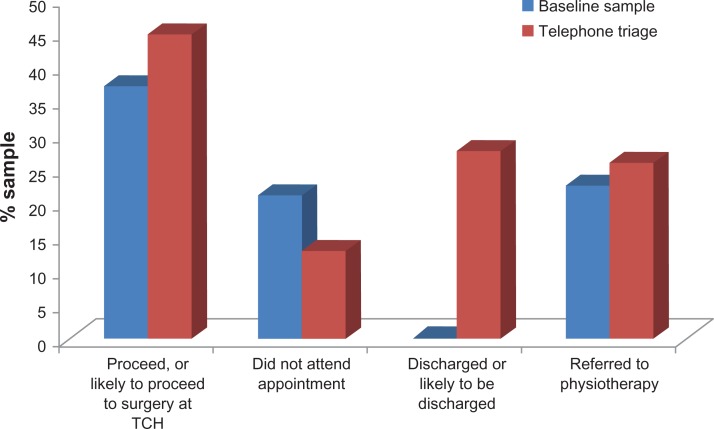
The telephone triage resulted in 16.4% patients being discharged directly (compared with 0.1% comparison sample). For approximately AU$17.00 per patient, the telephone triage process released 21 booked appointments on the outpatient clinic waiting list. Moreover, approximately 26% patients were referred directly to physiotherapy, which was not a primary management option in the comparison sample. The waiting time for an appointment, for those patients who remained on the waiting list, was significantly shorter for the telephone triage sample than the comparison sample. There were significantly higher rates of failure to attend appointments, and significantly lower rates of discharge, in the comparison sample, than the telephone triage sample.
A physiotherapist-led intervention offering alternative management options whilst patients waited for an orthopedic outpatient clinic consultation appears to be cost-effective, and patient-centered.
在澳大利亚公立医院,骨科门诊候诊名单上的患者通常需要漫长的等待才能咨询专科医生。如果需要手术,患者还需再次等待。需求较高的患者很少被优先考虑,等待的患者发病风险可能会增加。在等待期间,通常没有其他护理选择。本文将一家大型澳大利亚三级医院的骨科门诊历史数据与一项以物理治疗为主导的举措的结果进行了比较。
两名在职的物理治疗师使用标准工具对骨科候诊名单上的所有新患者进行了电话分诊(2010年10月至12月)。为他们提供了保留预约、出院、转介至新模式评估(多学科专科诊所)或转介至物理治疗等主要治疗选择。结果包括服务成本、等待时间以及选择管理方案的患者百分比。将其与骨科候诊名单上的新患者历史样本(2009年1月至3月)进行比较,对该样本的治疗消耗进行了纵向跟踪。
电话分诊导致16.4%的患者直接出院(相比之下,对照样本为0.1%)。电话分诊过程以每位患者约17澳元的成本,释放了门诊候诊名单上的21个预约。此外,约26%的患者直接被转介至物理治疗,而这在对照样本中并非主要管理选项。对于仍在候诊名单上的患者,电话分诊样本的预约等待时间明显短于对照样本。对照样本中未就诊率显著更高,出院率显著更低,低于电话分诊样本。
在患者等待骨科门诊咨询期间,由物理治疗师主导的提供替代管理选项的干预措施似乎具有成本效益且以患者为中心。