Department of Pharmaceutical Sciences, College of Pharmacy, Oregon State University, Corvallis, OR 97331-3507, USA.
Gene. 2012 Nov 1;509(1):16-23. doi: 10.1016/j.gene.2012.08.016. Epub 2012 Aug 20.
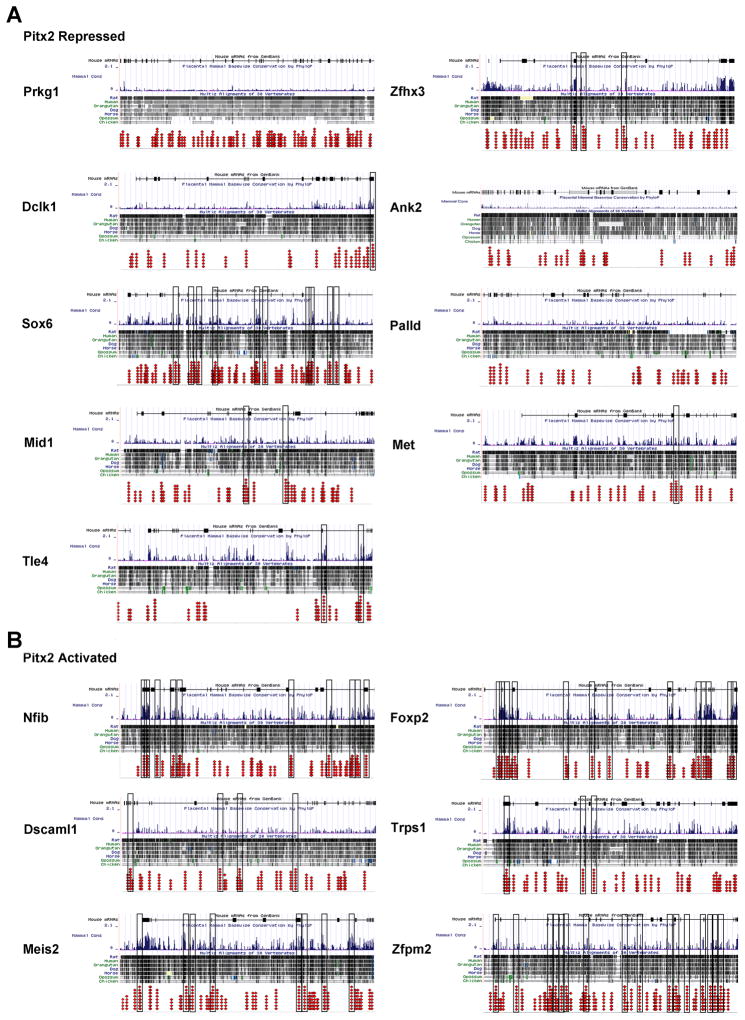
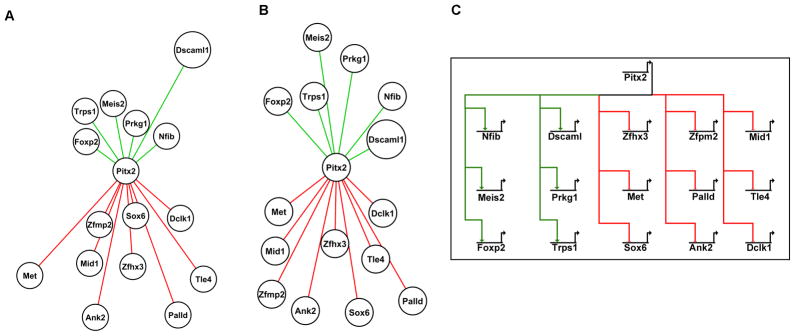
The ventrolateral dermomyotome gives rise to all muscles of the limbs through the delamination and migration of cells into the limb buds. These cells proliferate and form myoblasts, withdraw from the cell cycle and become terminally differentiated. The myogenic lineage colonizes pre-patterned regions to form muscle anlagen as muscle fibers are assembled. The regulatory mechanisms that control the later steps of this myogenic program are not well understood. The homeodomain transcription factor Pitx2 is expressed in the muscle lineage from the migration of precursors to adult muscle. Ablation of Pitx2 results in distortion, rather than loss, of limb muscle anlagen, suggesting that its function becomes critical during the colonization of, and/or fiber assembly in, the anlagen. Gene expression arrays were used to identify changes in gene expression in flow-sorted migratory muscle precursors, labeled by Lbx1(EGFP), which resulted from the loss of Pitx2. Target genes of Pitx2 were clustered using the "David Bioinformatics Functional Annotation Tool" to bin genes according to enrichment of gene ontology keywords. This provided a way to both narrow the target genes and identify potential gene families regulated by Pitx2. Representative target genes in the most enriched bins were analyzed for the presence and evolutionary conservation of Pitx2 consensus binding sequence, TAATCY, on the -20kb, intronic, and coding regions of the genes. Fifteen Pitx2 target genes were selected based on the above analysis and were identified as having functions involving cytoskeleton organization, tissue specification, and transcription factors. Data from these studies suggest that Pitx2 acts to regulate cell motility and expression of muscle specific genes in the muscle precursors during forelimb muscle development. This work provides a framework to develop the gene network leading to skeletal muscle development, growth and regeneration.
腹外侧真皮肌节通过细胞分层和迁移到肢芽中,产生所有的肢体肌肉。这些细胞增殖并形成成肌细胞,退出细胞周期并终末分化。成肌谱系定植于预先形成的区域,形成肌肉原基,同时组装肌肉纤维。控制这个成肌程序后期步骤的调节机制尚不清楚。同源盒转录因子 Pitx2 在肌肉谱系中从前体迁移到成年肌肉表达。Pitx2 的缺失导致肢体肌肉原基的扭曲,而不是缺失,这表明它的功能在原基的定植和/或纤维组装过程中变得至关重要。使用基因表达阵列来鉴定因 Pitx2 缺失而导致由 Lbx1(EGFP)标记的流动分选迁移肌肉前体的基因表达变化。使用“David 生物信息学功能注释工具”对 Pitx2 的靶基因进行聚类,根据基因本体论关键字的富集对基因进行分类。这为缩小靶基因范围和识别潜在的由 Pitx2 调节的基因家族提供了一种方法。在最富集的箱中分析代表性靶基因,以确定 Pitx2 共有结合序列 TAATCY 在基因的-20kb、内含子和编码区的存在和进化保守性。基于上述分析,选择了 15 个 Pitx2 靶基因,这些基因的功能涉及细胞骨架组织、组织特化和转录因子。这些研究的数据表明,Pitx2 在四肢肌肉发育过程中,通过调节细胞迁移和肌肉前体中肌肉特异性基因的表达来发挥作用。这项工作为建立导致骨骼肌发育、生长和再生的基因网络提供了一个框架。