Institute of Clinical Radiology, Research Centre for Radiation Medicine, 53 Melnikova, 04050 Kyiv, Ukraine.
Genes (Basel). 2011 May 31;2(2):384-93. doi: 10.3390/genes2020384.
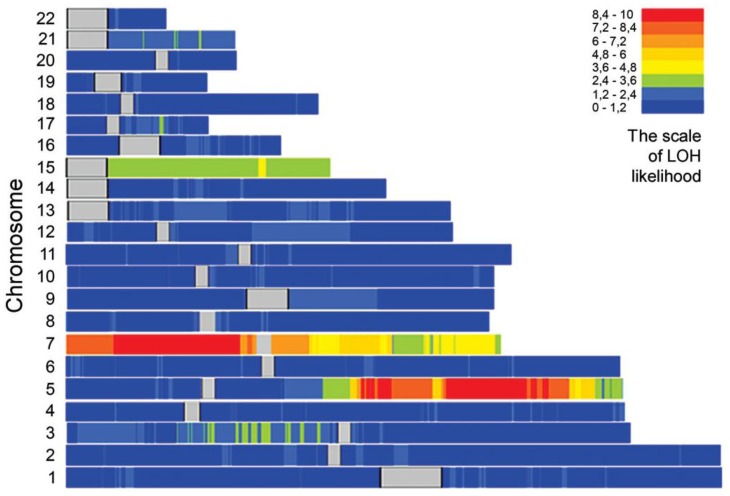
Acute myeloid leukemia (AML) can develop as a secondary malignancy following radiotherapy, but also following low-dose environmental or occupational radiation exposure. Therapy-related AML frequently carries deletions of chromosome 5q and/or 7, but for low-dose exposure associated AML this has not been described. For the present study we performed genome-wide screens for loss-of-heterozygosity (LOH) in a set of 19 AML cases that developed after radiation-exposure following the Chernobyl accident. Using Affymetrix SNP arrays we found large regions of LOH in 16 of the cases. Eight cases (42%) demonstrated LOH at 5q and/or 7, which is a known marker of complex karyotypic changes and poor prognosis. In accordance with literature data, the overall survival for these patients was significantly shorter as compared to patients without this alteration (P=0,014). We could show here for the first time that exposure to low-dose ionizing radiation induces AML with molecular alterations similar to those seen in therapy-related cases.
急性髓细胞白血病(AML)可继发于放疗后,也可继发于低剂量环境或职业辐射暴露。治疗相关的 AML 常伴有 5q 和/或 7 号染色体缺失,但低剂量暴露相关的 AML 尚未见报道。本研究我们对切尔诺贝利事故后辐射暴露后发生的 19 例 AML 病例进行了全基因组杂合性缺失(LOH)筛查。使用 Affymetrix SNP 芯片,我们在 16 例病例中发现了大片 LOH 区域。8 例(42%)在 5q 和/或 7 上显示 LOH,这是复杂核型改变和预后不良的已知标志物。与文献数据一致,这些患者的总生存率明显短于没有这种改变的患者(P=0.014)。我们首次证明,低剂量电离辐射暴露可诱导具有与治疗相关病例相似的分子改变的 AML。