Department of Respiratory Disease, Huashan Hospital, Fudan University, Shanghai 200040, China.
Mediators Inflamm. 2012;2012:403868. doi: 10.1155/2012/403868. Epub 2012 Aug 8.
This study aimed to investigate improvements in inflammatory mediator levels in induced sputum and airway hyperresponsiveness (AHR) in cough variant asthma (CVA) during long-term inhaled corticosteroid (ICS) treatment.
Patients with CVA (N = 35) and classic asthma (N = 26) and healthy subjects (N = 24) were recruited into this study. All patients were treated with budesonide (400 μg/day). Measurement of inflammatory mediators in induced sputum and PD20-FEV(1) (the accumulated provocative dose resulting in a 20% decrease in FEV(1)) in histamine-challenged subjects was performed every three months after the start of medication. Interleukin- (IL-) 5 and IL-10 were assayed by ELISA, and the percentage of eosinophils was detected with Giemsa stain. Trends during the follow-up period were analyzed using a general linear model.
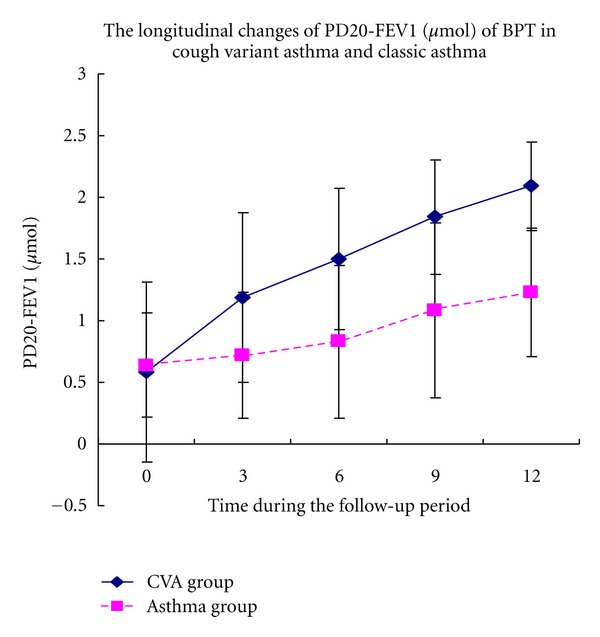
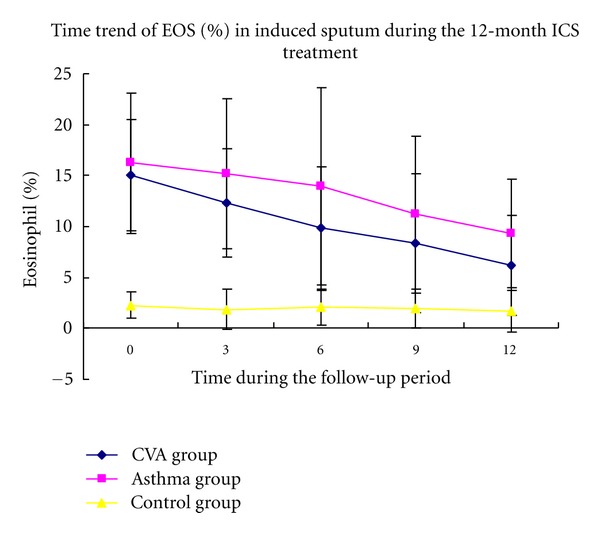
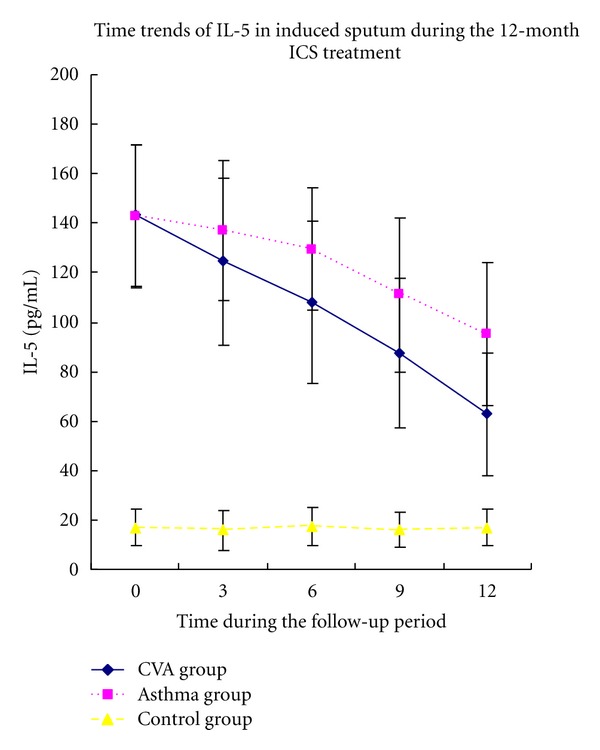
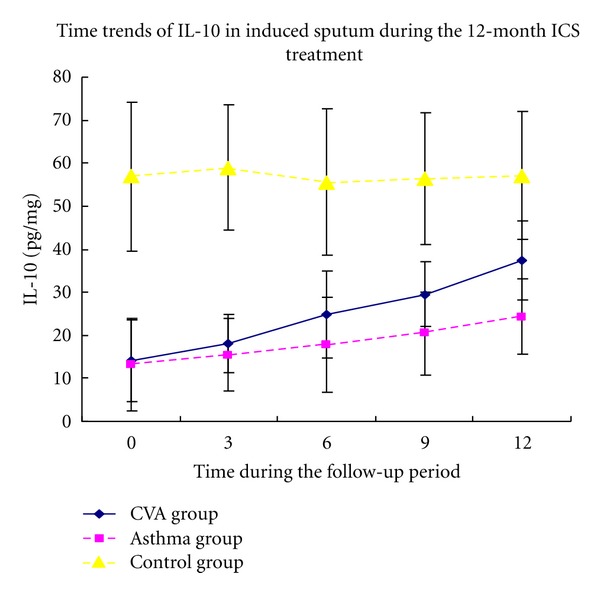
Inflammatory mediator levels in induced sputum and PD20-FEV(1) in patients with CVA and classic asthma differed from those in the control group, although no differences were found in the two asthmatic groups. PD20-FEV(1) significantly increased in CVA patients after ICS treatment for 3 months, while classic asthma patients exhibited a delayed change in AHR. After ICS treatment, levels of IL-5 and IL-10 as well as the percentage of eosinophils in the CVA group were altered at 3 months and 6 months, respectively. Accordingly, the level of inflammatory mediators in classic asthma changed more slowly.
CVA has a greater improvement in airway inflammation and airway hyperresponsiveness (AHR) than classic asthma with respect to inhaled corticosteroid (ICS). Short-term ICS considerably reduces AHR although longer treatment is required for complete control of airway inflammation.
本研究旨在探讨长期吸入皮质类固醇(ICS)治疗对咳嗽变异性哮喘(CVA)患者诱导痰中炎症介质水平和气道高反应性(AHR)的改善作用。
本研究纳入了 35 例 CVA 患者、26 例典型哮喘患者和 24 例健康对照者。所有患者均接受布地奈德(400μg/天)治疗。在开始用药后每 3 个月,对所有患者进行诱导痰中炎症介质测量和组胺激发后 PD20-FEV1(导致 FEV1 下降 20%的累积激发剂量)测量。采用 ELISA 法检测白细胞介素-(IL-)5 和 IL-10,吉姆萨染色法检测嗜酸性粒细胞百分比。采用一般线性模型分析随访期间的趋势。
尽管在两组哮喘患者之间未发现差异,但 CVA 和典型哮喘患者诱导痰中的炎症介质水平和 PD20-FEV1 与对照组不同。ICS 治疗 3 个月后,CVA 患者的 PD20-FEV1 显著增加,而典型哮喘患者的 AHR 变化则延迟。ICS 治疗后,CVA 组的 IL-5 和 IL-10 水平以及嗜酸性粒细胞百分比分别在 3 个月和 6 个月时发生变化。相应地,典型哮喘患者的炎症介质水平变化较慢。
与典型哮喘相比,ICS 治疗后 CVA 患者气道炎症和 AHR 的改善更为显著。尽管短期 ICS 治疗可显著降低 AHR,但需要更长时间的治疗才能完全控制气道炎症。