State Key Laboratory of Pathogen and Biosecurity, Beijing Institute of Microbiology and Epidemiology, Beijing, People's Republic of China.
PLoS One. 2012;7(8):e43686. doi: 10.1371/journal.pone.0043686. Epub 2012 Aug 21.
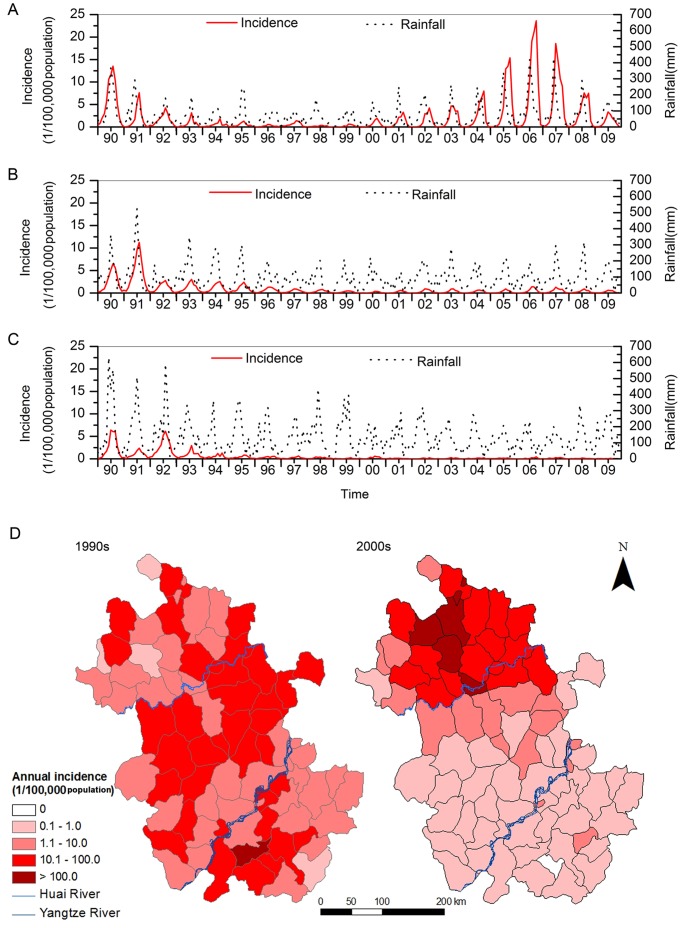
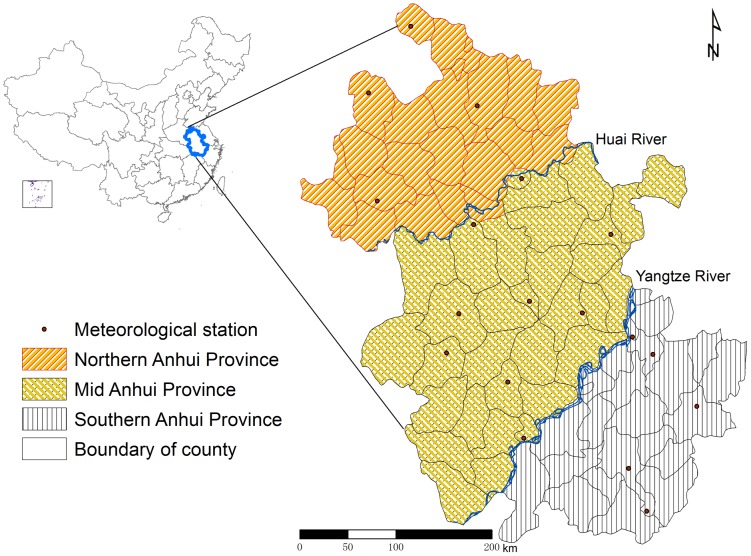
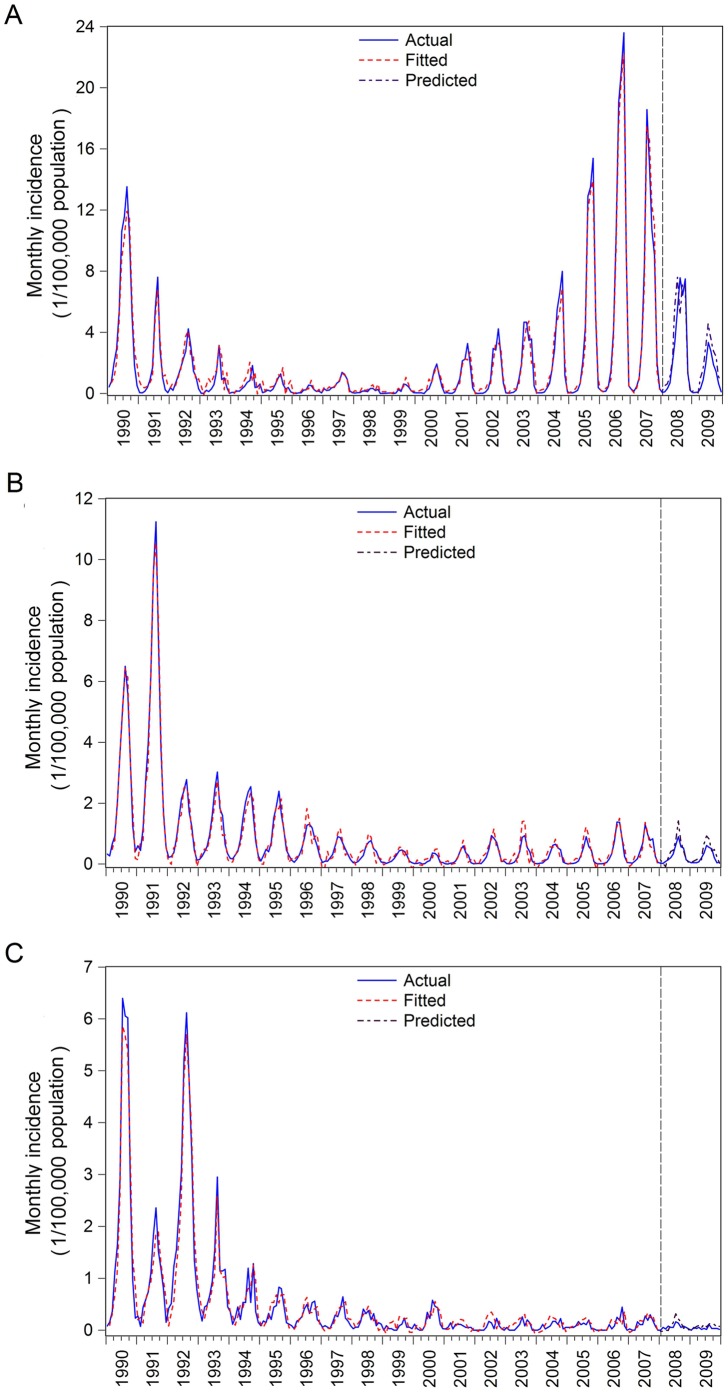
Malaria is re-emerging in Anhui Province, China after a decade long' low level of endemicity. The number of human cases has increased rapidly since 2000 and reached its peak in 2006. That year, the malaria cases accounted for 54.5% of total cases in mainland China. However, the spatial and temporal patterns of human cases and factors underlying the re-emergence remain unclear. We established a database containing 20 years' (1990-2009) records of monthly reported malaria cases and meteorological parameters. Spearman correlations were used to assess the crude association between malaria incidence and meteorological variables, and a polynomial distributed lag (PDL) time-series regression was performed to examine contribution of meteorological factors to malaria transmission in three geographic regions (northern, mid and southern Anhui Province), respectively. Then, a two-year (2008-2009) prediction was performed to validate the PDL model that was created by using the data collected from 1990 to 2007. We found that malaria incidence decreased in Anhui Province in 1990s. However, the incidence has dramatically increased in the north since 2000, while the transmission has remained at a relatively low level in the mid and south. Spearman correlation analyses showed that the monthly incidences of malaria were significantly associated with temperature, rainfall, relative humidity, and the multivariate El Niño/Southern Oscillation index with lags of 0-2 months in all three regions. The PDL model revealed that only rainfall with a 1-2 month lag was significantly associated with malaria incidence in all three regions. The model validation showed a high accuracy for the prediction of monthly incidence over a 2-year predictive period. Malaria epidemics showed a high spatial heterogeneity in Anhui Province during the 1990-2009 study periods. The change in rainfall drives the reemergence of malaria in the northern Anhui Province.
疟疾在中国安徽省经过长达十年的低流行水平后再次出现。自 2000 年以来,人类疟疾病例迅速增加,并在 2006 年达到高峰。当年,疟疾病例占中国大陆疟疾病例总数的 54.5%。然而,人类疟疾病例的时空模式和重新出现的原因仍不清楚。我们建立了一个包含 20 年(1990-2009 年)逐月报告疟疾病例和气象参数记录的数据库。采用 Spearman 相关分析评估疟疾发病率与气象变量之间的粗相关关系,并采用多项式分布滞后(PDL)时间序列回归分别分析三个地理区域(安徽北部、中部和南部)的气象因素对疟疾传播的贡献。然后,对 2008-2009 年进行了两年预测,以验证使用 1990-2007 年收集的数据创建的 PDL 模型。我们发现,1990 年代安徽省疟疾发病率下降。然而,自 2000 年以来,北部地区的发病率急剧上升,而中部和南部地区的传播率仍保持在相对较低的水平。Spearman 相关分析表明,疟疾月发病率与温度、降雨量、相对湿度以及多变量厄尔尼诺/南方涛动指数在三个地区均有 0-2 个月的滞后显著相关。PDL 模型表明,只有 1-2 个月滞后的降雨量与三个地区的疟疾发病率显著相关。模型验证表明,该模型对 2 年预测期内的月发病率预测具有较高的准确性。在 1990-2009 年的研究期间,安徽省的疟疾流行呈现出高度的空间异质性。降雨量的变化是导致安徽省北部疟疾重新出现的原因。