Istituto di Chimica Biomolecolare, CNR, Sassari, Italy.
J Transl Med. 2012 Aug 29;10:178. doi: 10.1186/1479-5876-10-178.
Role of KRAS, BRAF and PIK3CA mutations in pathogenesis of colorectal cancer (CRC) has been recently investigated worldwide. In this population-based study, we evaluated the incidence rates and distribution of such somatic mutations in genetically isolated population from Sardinia.
From April 2009 to July 2011, formalin-fixed paraffin-embedded tissues (N = 478) were prospectively collected from Sardinian CRC patients at clinics across the entire island. Genomic DNA was isolated from tissue sections and screened for mutations in KRAS, BRAF, and PIK3CA genes by automated DNA sequencing.
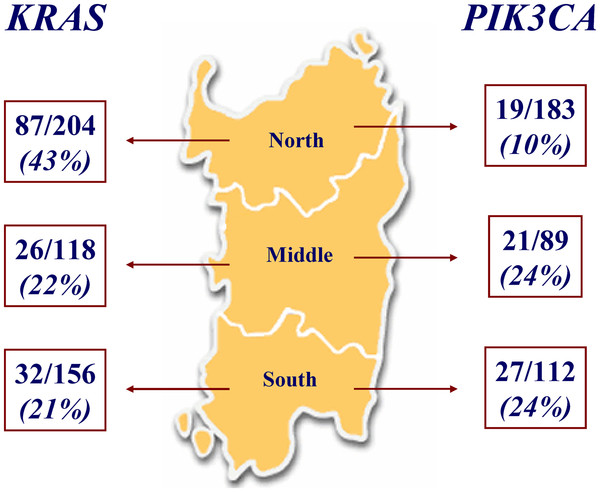
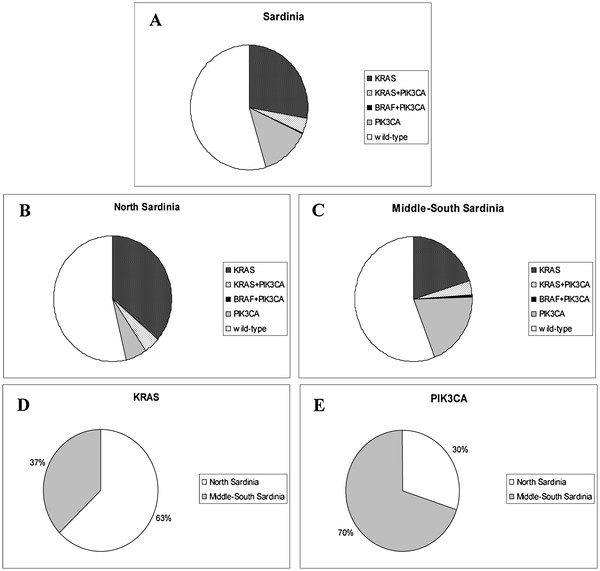
Overall, KRAS tumour mutation rate was 30% (145/478 positive cases). Distribution of mutation carriers was surprisingly different within the island: 87/204 (43%) in North Sardinia vs. 58/274 (21%) in Middle-South Sardinia (p<0.001). Among 384 CRC cases whose DNA was available, only one (0.3%) patient carried a mutation in BRAF gene; PIK3CA was found mutated in 67 (17%) patients. A significant inverse distribution of PIK3CA mutation rates was observed within Sardinian population: 19/183 (10%) cases from northern vs. 48/201 (24%) cases from central-southern island (p<0.001). This heterogeneity in frequencies of KRAS/PIK3CA somatic mutations is consistent with already-reported discrepancies in distribution of germline mutations for other malignancies within Sardinian population. Preliminary clinical evaluation of 118 KRAS wild-type patients undergoing anti-EGFR-based treatment indicated lack of role for PIK3CA in predicting response to therapy.
Our findings support the hypothesis that differences in patients' origins and related genetic backgrounds may contribute to even determine the incidence rate of somatic mutations in candidate cancer genes.
KRAS、BRAF 和 PIK3CA 突变在结直肠癌(CRC)的发病机制中的作用已在全球范围内得到研究。在这项基于人群的研究中,我们评估了来自撒丁岛遗传隔离人群中此类体细胞突变的发生率和分布情况。
2009 年 4 月至 2011 年 7 月,我们从撒丁岛各地诊所的 CRC 患者中前瞻性收集了福尔马林固定石蜡包埋组织(N=478)。从组织切片中提取基因组 DNA,并通过自动 DNA 测序筛选 KRAS、BRAF 和 PIK3CA 基因的突变。
总体而言,KRAS 肿瘤突变率为 30%(145/478 阳性病例)。在岛内,突变携带者的分布差异惊人:北撒丁岛 87/204(43%)与中-南撒丁岛 58/274(21%)(p<0.001)。在可获得 DNA 的 384 例 CRC 病例中,仅 1 例(0.3%)患者 BRAF 基因发生突变;PIK3CA 突变见于 67 例(17%)患者。PIK3CA 突变率在撒丁岛人群中呈显著负分布:北部 19/183(10%)病例与中南部岛屿 48/201(24%)病例(p<0.001)。KRAS/PIK3CA 体细胞突变的这种频率异质性与已报道的撒丁岛人群中其他恶性肿瘤种系突变分布的差异一致。对 118 例接受抗 EGFR 治疗的 KRAS 野生型患者进行的初步临床评估表明,PIK3CA 突变在预测治疗反应方面无作用。
我们的研究结果支持这样一种假设,即患者来源和相关遗传背景的差异可能导致候选癌症基因中体细胞突变的发生率发生变化。