Palomba Grazia, Cossu Antonio, Paliogiannis Panagiotis, Pazzola Antonio, Baldino Giovanni, Scartozzi Mario, Ionta Maria Teresa, Ortu Salvatore, Capelli Francesca, Lanzillo Annamaria, Sedda Tito, Sanna Giovanni, Barca Michela, Virdis Luciano, Budroni Mario, Palmieri Giuseppe
Institute of Biomolecular Chemistry, CNR, 07100 Sassari, Italy.
Department of Surgical, Microsurgical and Medical Sciences, University of Sassari, 07100 Sassari, Italy.
Oncol Lett. 2016 Aug;12(2):1415-1421. doi: 10.3892/ol.2016.4798. Epub 2016 Jun 29.
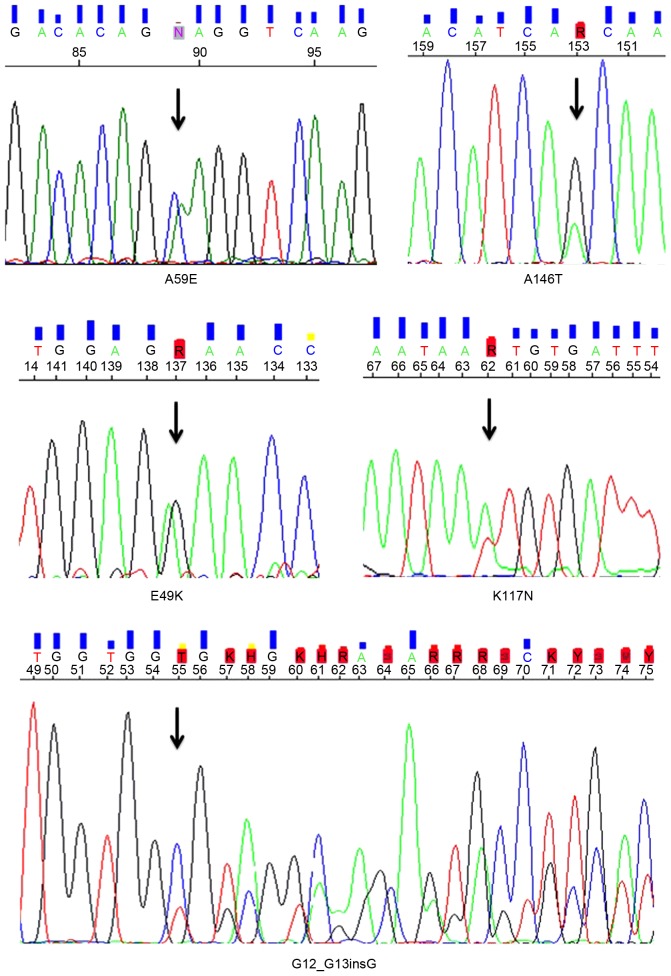
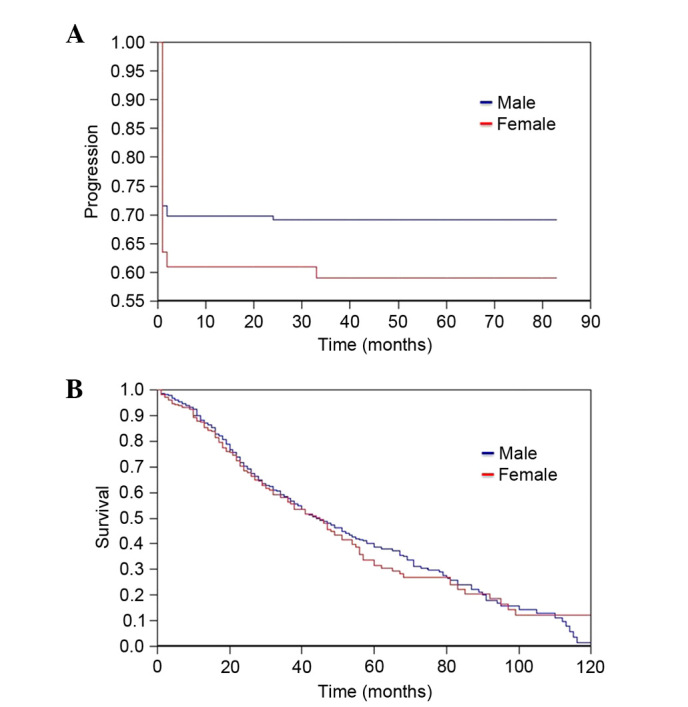
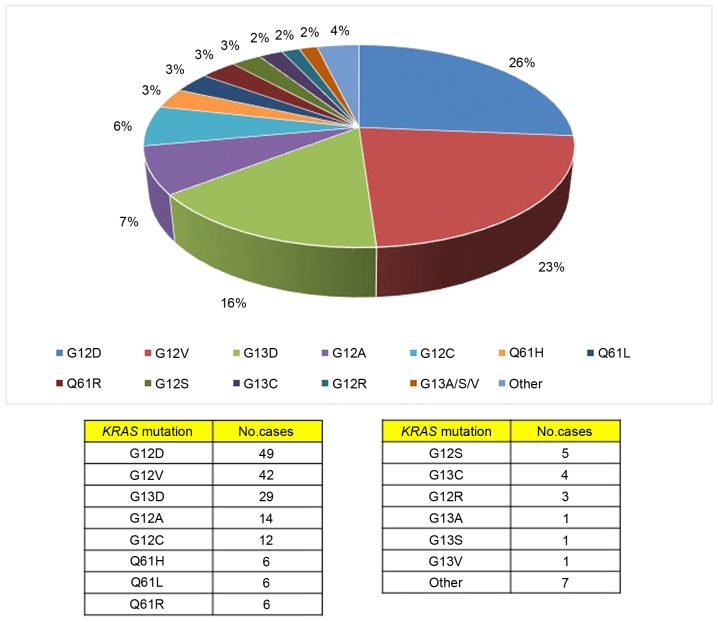
The presence of mutations in the KRAS gene is a predictor of a poor clinical response to EGFR-targeted agents in patients affected by colorectal cancer (CRC), but its significance as a global prognostic factor remains unclear. The aim of the present study was to evaluate the impact of the KRAS mutational status on time to first metastasis (TTM) and overall survival (OS) in a cohort of Sardinian CRC patients. A total of 551 patients with metastatic CRC at the time of enrolment were included. Clinical and pathological features of the disease, including follow-up information, were obtained from medical records and cancer registry data. For mutational analysis formalin-fixed paraffin-embedded tissue samples were processed using a standard protocol. The coding sequence and splice junctions of exons 2 and 3 of the KRAS gene were screened for mutations by direct automated sequencing. Overall, 186 KRAS mutations were detected in 183/551 (33%) patients: 125 (67%) were located in codon 12, 36 (19%) in codon 13, and 18 (10%) in codon 61. The remaining mutations (7; 4%) were detected in uncommonly-affected codons. No significant correlation between KRAS mutations and gender, age, anatomical location and stage of the disease at the time of diagnosis was identified. Furthermore, no prognostic value of KRAS mutations was found considering either TTM or OS. When patients were stratified by KRAS mutational status and gender, males were significantly associated with a longer TTM. The results of the present study indicate that KRAS mutation correlated with a slower metastatic progression in males with CRC from Sardinia, irrespective of the age at diagnosis and the codon of the mutation.
KRAS基因突变的存在是结直肠癌(CRC)患者对EGFR靶向药物临床反应不佳的一个预测指标,但其作为一个整体预后因素的意义仍不明确。本研究的目的是评估KRAS突变状态对一组撒丁岛CRC患者首次转移时间(TTM)和总生存期(OS)的影响。共纳入了551例入组时患有转移性CRC的患者。从病历和癌症登记数据中获取了疾病的临床和病理特征,包括随访信息。对于突变分析,使用标准方案处理福尔马林固定石蜡包埋组织样本。通过直接自动测序筛选KRAS基因第2和第3外显子的编码序列和剪接位点的突变。总体而言,在183/551(33%)例患者中检测到186个KRAS突变:125个(67%)位于密码子12,36个(19%)位于密码子13,18个(10%)位于密码子61。其余突变(7个;4%)在罕见受影响的密码子中检测到。未发现KRAS突变与诊断时的性别、年龄、解剖位置和疾病分期之间存在显著相关性。此外,考虑TTM或OS时,未发现KRAS突变具有预后价值。当按KRAS突变状态和性别对患者进行分层时,男性与较长的TTM显著相关。本研究结果表明,KRAS突变与撒丁岛男性CRC患者较慢的转移进展相关,与诊断年龄和突变密码子无关。