Spuch Carlos, Ortolano Saida, Navarro Carmen
Department of Pathology and Neuropathology, University Hospital of Vigo Vigo, Spain.
Front Physiol. 2012 Jul 16;3:269. doi: 10.3389/fphys.2012.00269. eCollection 2012.
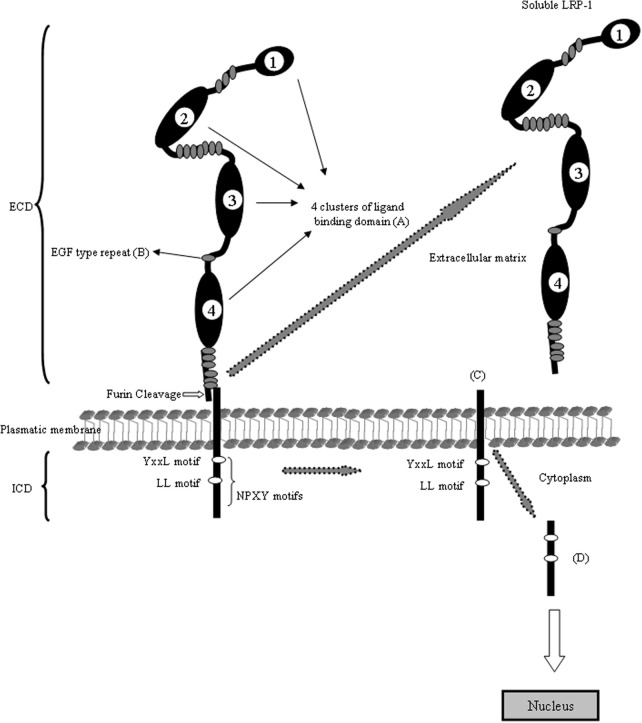
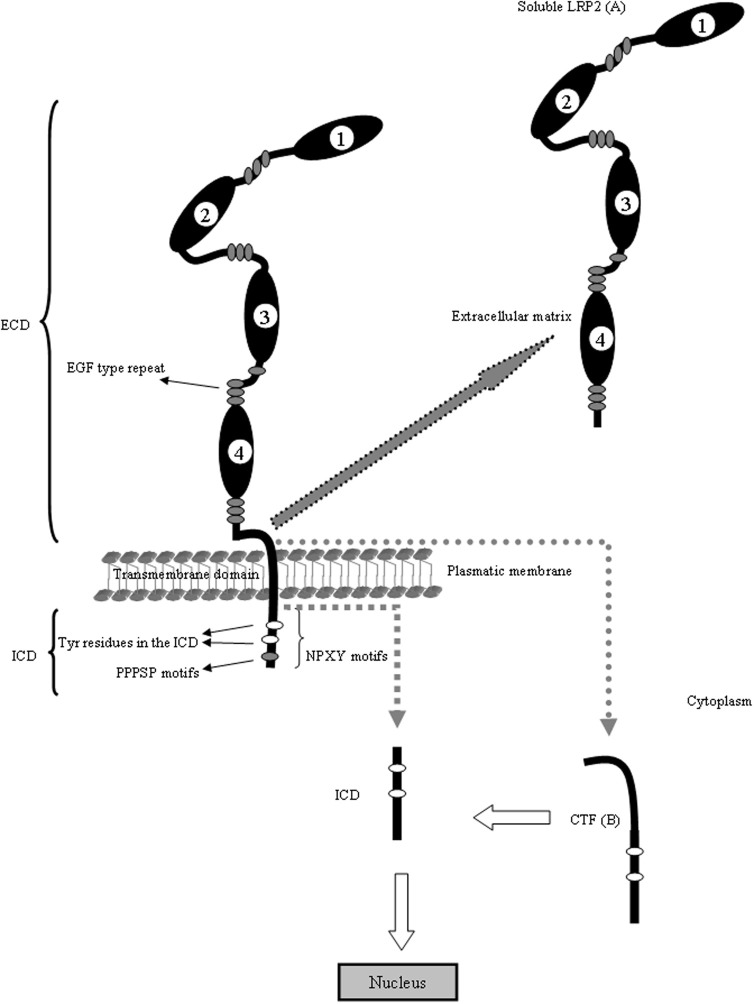
Low density lipoprotein receptor-related protein (LRP) belongs to the low-density lipoprotein receptor family, generally recognized as cell surface endocytic receptors, which bind and internalize extracellular ligands for degradation in lysosomes. Neurons require cholesterol to function and keep the membrane rafts stable. Cholesterol uptake into the neuron is carried out by ApoE via LRPs receptors on the cell surface. In neurons the most important are LRP-1 and LRP-2, even it is thought that a causal factor in Alzheimer's disease (AD) is the malfunction of this process which cause impairment intracellular signaling as well as storage and/or release of nutrients and toxic compounds. Both receptors are multifunctional cell surface receptors that are widely expressed in several tissues including neurons and astrocytes. LRPs are constituted by an intracellular (ICD) and extracellular domain (ECD). Through its ECD, LRPs bind at least 40 different ligands ranging from lipoprotein and protease inhibitor complex to growth factors and extracellular matrix proteins. These receptors has also been shown to interact with scaffolding and signaling proteins via its ICD in a phosphorylation-dependent manner and to function as a co-receptor partnering with other cell surface or integral membrane proteins. Thus, LRPs are implicated in two major physiological processes: endocytosis and regulation of signaling pathways, which are both involved in diverse biological roles including lipid metabolism, cell growth processes, degradation of proteases, and tissue invasion. Interestingly, LRPs were also localized in neurons in different stages, suggesting that both receptors could be implicated in signal transduction during embryonic development, neuronal outgrowth or in the pathogenesis of AD.
低密度脂蛋白受体相关蛋白(LRP)属于低密度脂蛋白受体家族,通常被认为是细胞表面的内吞受体,它结合并内化细胞外配体以便在溶酶体中降解。神经元需要胆固醇来发挥功能并维持膜筏的稳定性。胆固醇通过载脂蛋白E(ApoE)经由细胞表面的LRP受体进入神经元。在神经元中,最重要的是LRP - 1和LRP - 2,甚至有人认为阿尔茨海默病(AD)的一个致病因素是这一过程的功能障碍,该障碍会导致细胞内信号传导受损以及营养物质和有毒化合物的储存和/或释放。这两种受体都是多功能细胞表面受体,在包括神经元和星形胶质细胞在内的多种组织中广泛表达。LRP由细胞内结构域(ICD)和细胞外结构域(ECD)组成。通过其ECD,LRP可结合至少40种不同的配体,范围从脂蛋白和蛋白酶抑制剂复合物到生长因子和细胞外基质蛋白。这些受体还被证明通过其ICD以磷酸化依赖的方式与支架蛋白和信号蛋白相互作用,并作为与其他细胞表面或整合膜蛋白合作的共受体发挥作用。因此,LRP参与两个主要的生理过程:内吞作用和信号通路调节,这两个过程都涉及多种生物学作用,包括脂质代谢、细胞生长过程、蛋白酶降解和组织侵袭。有趣的是,LRP也定位于不同阶段的神经元中,这表明这两种受体可能在胚胎发育、神经元生长或AD发病机制中参与信号转导。