Department of Cell Biology, Biomedical Research Foundation of the Academy of Athens, Athens, Greece.
PLoS One. 2011;6(7):e21880. doi: 10.1371/journal.pone.0021880. Epub 2011 Jul 6.
Apolipoprotein E (ApoE), a cholesterol carrier associated with atherosclerosis, is a major risk factor for Alzheimer's disease (AD). The low-density lipoprotein receptor (LDLR) regulates ApoE levels in the periphery and in the central nervous system. LDLR has been identified on astrocytes and a number of studies show that it modulates amyloid deposition in AD transgenic mice. However these findings are controversial on whether LDLR deletion is beneficial or detrimental on the AD-like phenotype of the transgenic mice.
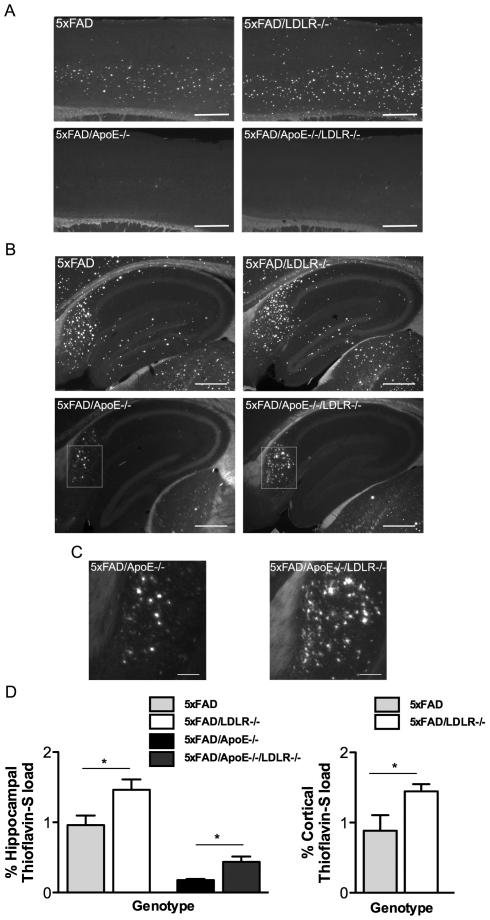
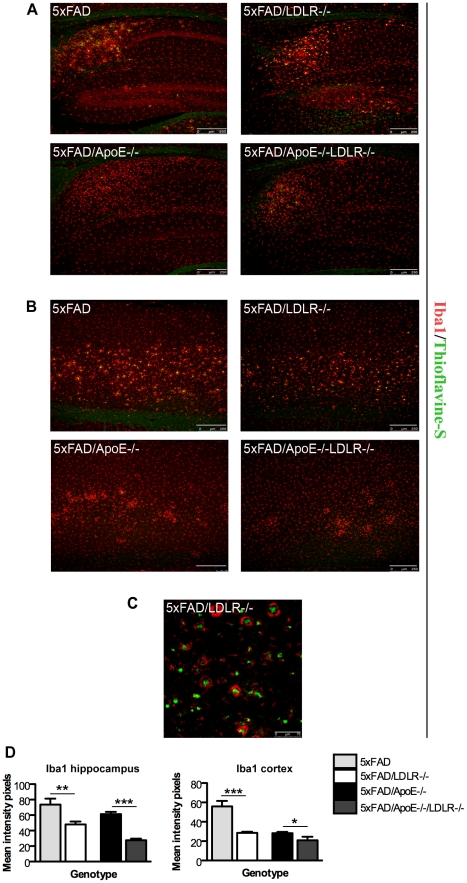
METHODOLOGY/PRINCIPAL FINDINGS: To investigate the role of LDLR in the development of the amyloid related phenotype we used an APP/PS1 transgenic mouse (5XFAD) that develops an AD-like pathology with amyloid plaques, astrocytosis and microgliosis. We found that 4 months old 5XFAD transgenic mice on the LDLR deficient background (LDLR-/-) have increased amyloid plaque deposition. This increase is associated with a significant decrease in astrocytosis and microgliosis in the 5XFAD/LDLR-/- mice. To further elucidate the role of LDLR in relation with ApoE we have generated 5XFAD transgenic mice on the ApoE deficient (ApoE-/-) or the ApoE/LDLR double deficient background (ApoE-/-/LDLR -/-). We have found that ApoE deletion in the 4 months old 5XFAD/ApoE-/- mice decreases amyloid plaque formation as expected, but has no effect on astrocytosis or microgliosis. By comparison 5XFAD/ApoE-/-LDLR -/- double deficient mice of the same age have increased amyloid deposition with decreased astrocytosis and microgliosis.
Our analysis shows that LDL deficiency regulates astrocytosis and microgliosis in an AD mouse model. This effect is independent of ApoE, as both 5XFAD/LDLR -/- and 5XFAD/ApoE-/- LDLR -/- mice show reduction in inflammatory response and increase in amyloid deposition compared to control mice. These results demonstrate that LDLR regulates glial response in this mouse model independently of ApoE and modifies amyloid deposition.
载脂蛋白 E(ApoE)是一种与动脉粥样硬化有关的胆固醇载体,是阿尔茨海默病(AD)的主要危险因素。低密度脂蛋白受体(LDLR)调节外周和中枢神经系统中的 ApoE 水平。LDLR 已在星形胶质细胞上被鉴定出来,许多研究表明它可以调节 AD 转基因小鼠中的淀粉样蛋白沉积。然而,这些发现对于 LDLR 缺失对转基因小鼠的 AD 样表型是有益还是有害存在争议。
方法/主要发现:为了研究 LDLR 在淀粉样相关表型发展中的作用,我们使用了一种 APP/PS1 转基因小鼠(5XFAD),该小鼠具有淀粉样斑块、星形胶质细胞增生和小胶质细胞增生的 AD 样病理学。我们发现,4 月龄 LDLR 缺陷背景(LDLR-/-)下的 5XFAD 转基因小鼠的淀粉样斑块沉积增加。这种增加与 5XFAD/LDLR-/-小鼠中的星形胶质细胞增生和小胶质细胞增生显著减少有关。为了进一步阐明 LDLR 与 ApoE 相关的作用,我们生成了 ApoE 缺陷(ApoE-/-)或 ApoE/LDLR 双缺陷背景(ApoE-/-/LDLR-/-)下的 5XFAD 转基因小鼠。我们发现,4 月龄 5XFAD/ApoE-/-小鼠中的 ApoE 缺失如预期那样减少了淀粉样斑块形成,但对星形胶质细胞增生或小胶质细胞增生没有影响。相比之下,相同年龄的 5XFAD/ApoE-/-LDLR-/-双缺陷小鼠的淀粉样沉积增加,星形胶质细胞增生和小胶质细胞增生减少。
我们的分析表明,LDL 缺乏症调节 AD 小鼠模型中的星形胶质细胞增生和小胶质细胞增生。这种作用不依赖于 ApoE,因为与对照小鼠相比,5XFAD/LDLR-/-和 5XFAD/ApoE-/-LDLR-/-小鼠均显示出炎症反应减少和淀粉样沉积增加。这些结果表明,LDLR 独立于 ApoE 调节该小鼠模型中的神经胶质反应,并改变淀粉样沉积。