The Kirby Institute, University of New South Wales, Sydney, Australia.
HIV Med. 2013 Feb;14(2):77-84. doi: 10.1111/j.1468-1293.2012.01038.x. Epub 2012 Aug 30.
The objective of the study was to conduct a within-cohort assessment of risk factors for incident AIDS-defining cancers (ADCs) and non-ADCs (NADCs) within the Australian HIV Observational Database (AHOD).
A total of 2181 AHOD registrants were linked to the National AIDS Registry/National HIV Database (NAR/NHD) and the Australian Cancer Registry to identify those with a notified cancer diagnosis. Included in the current analyses were cancers diagnosed after HIV infection. Risk factors for cancers were also assessed using logistic regression methods.
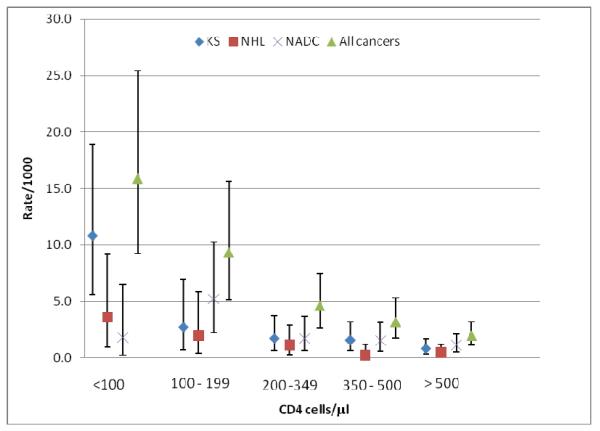
One hundred and thirty-nine cancer cases were diagnosed after HIV infection among 129 patients. More than half the diagnoses (n = 68; 60%) were ADCs, of which 69% were Kaposi's sarcoma and 31% non-Hodgkin's lymphoma. Among the NADCs, the most common cancers were melanoma (n = 10), lung cancer (n = 6), Hodgkin's lymphoma (n = 5) and anal cancer (n = 5). Over a total of 21021 person-years (PY) of follow-up since HIV diagnosis, the overall crude cancer incidence rate for any cancer was 5.09/1000 PY. The overall rate of cancers decreased from 15.9/1000 PY [95% confidence interval (CI) 9.25-25.40/1000 PY] for CD4 counts < 100 cells/μL to 2.4/1000 PY (95% CI 1.62-3.39/1000 PY) for CD4 counts > 350 cells/μL. Lower CD4 cell count and prior AIDS diagnoses were significant predictors for both ADCs and NADCs.
ADCs remain the predominant cancers in this population, although NADC rates have increased in the more recent time period. Immune deficiency is a risk factor for both ADCs and NADCs.
本研究旨在对澳大利亚艾滋病毒观察数据库(AHOD)中的队列内艾滋病定义癌症(ADC)和非艾滋病定义癌症(NADC)的发病风险因素进行评估。
共有 2181 名 AHOD 登记者与国家艾滋病登记处/国家艾滋病毒数据库(NAR/NHD)和澳大利亚癌症登记处进行了关联,以确定有通知癌症诊断的患者。目前的分析包括感染艾滋病毒后的癌症诊断。还使用逻辑回归方法评估了癌症的风险因素。
在 129 名患者中,有 139 例癌症病例在感染艾滋病毒后被诊断出。超过一半的诊断(n = 68;60%)是 ADC,其中 69%是卡波西肉瘤,31%是非霍奇金淋巴瘤。在 NADCs 中,最常见的癌症是黑色素瘤(n = 10)、肺癌(n = 6)、霍奇金淋巴瘤(n = 5)和肛门癌(n = 5)。自艾滋病毒诊断以来,总共有 21021 人年(PY)的随访,任何癌症的总体粗发病率为 5.09/1000 PY。癌症的总体发病率从 CD4 计数<100 个/μL 的 15.9/1000 PY 下降到 CD4 计数>350 个/μL 的 2.4/1000 PY(95%CI 1.62-3.39/1000 PY)。较低的 CD4 细胞计数和先前的艾滋病诊断是 ADC 和 NADCs 的显著预测因素。
在这一人群中,ADC 仍然是主要的癌症,尽管在最近的时期 NADCs 的发病率有所增加。免疫缺陷是 ADC 和 NADCs 的危险因素。