Department of Biology, Lund University, Sölvegatan 35, 22362 Lund, Sweden.
BMC Evol Biol. 2012 Aug 30;12:163. doi: 10.1186/1471-2148-12-163.
Opsins are key proteins in animal photoreception. Together with a light-sensitive group, the chromophore, they form visual pigments which initiate the visual transduction cascade when photoactivated. The spectral absorption properties of visual pigments are mainly determined by their opsins, and thus opsins are crucial for understanding the adaptations of animal eyes. Studies on the phylogeny and expression pattern of opsins have received considerable attention, but our knowledge about insect visual opsins is still limited. Up to now, researchers have focused on holometabolous insects, while general conclusions require sampling from a broader range of taxa. We have therefore investigated visual opsins in the ocelli and compound eyes of the two-spotted cricket Gryllus bimaculatus, a hemimetabolous insect.
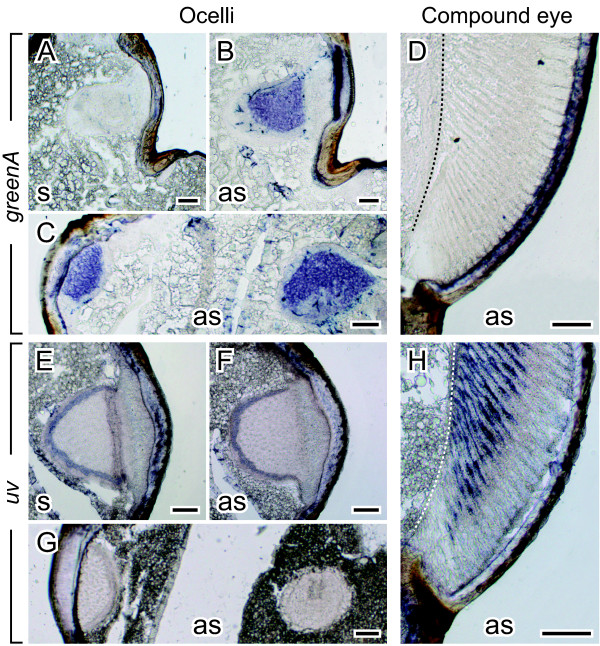
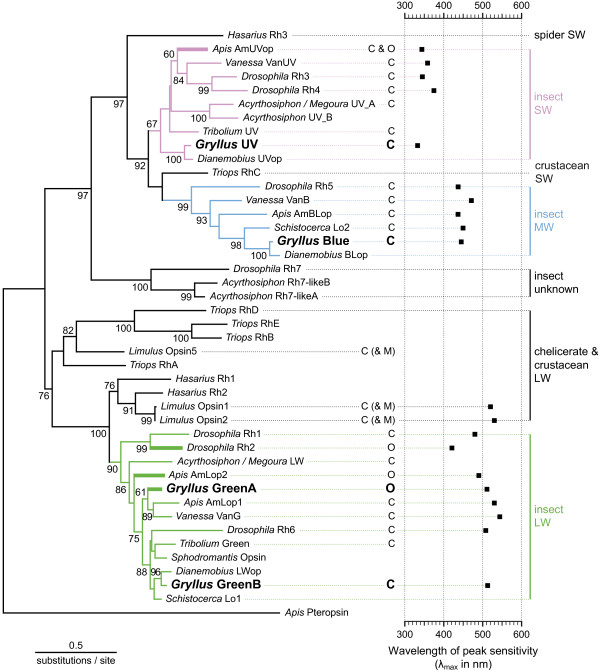
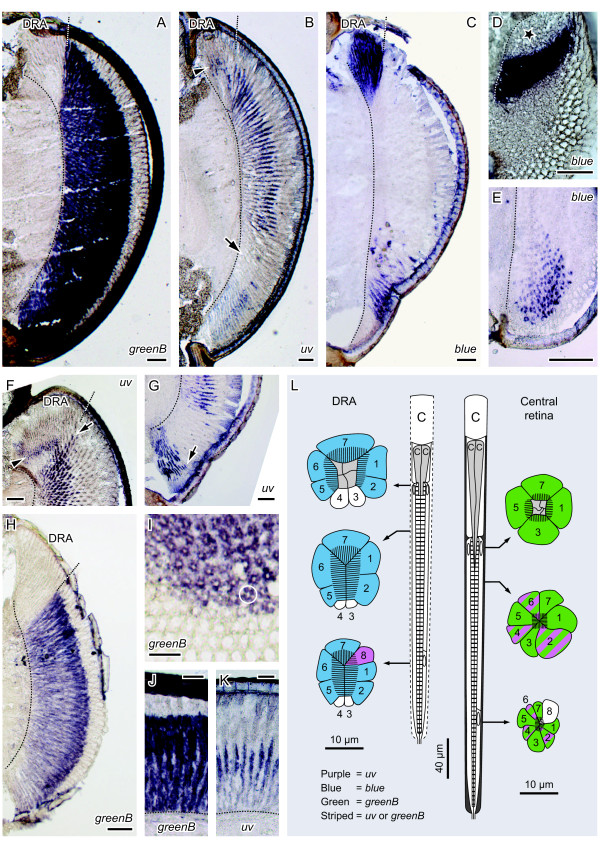
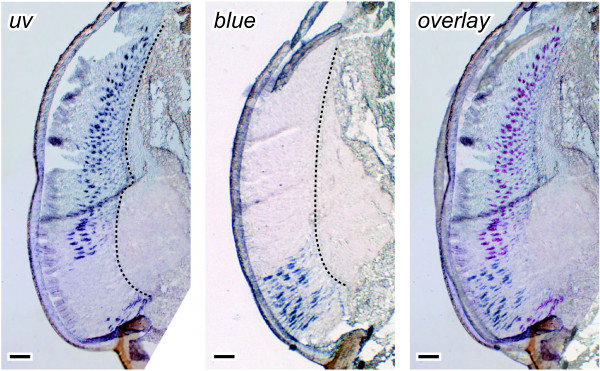
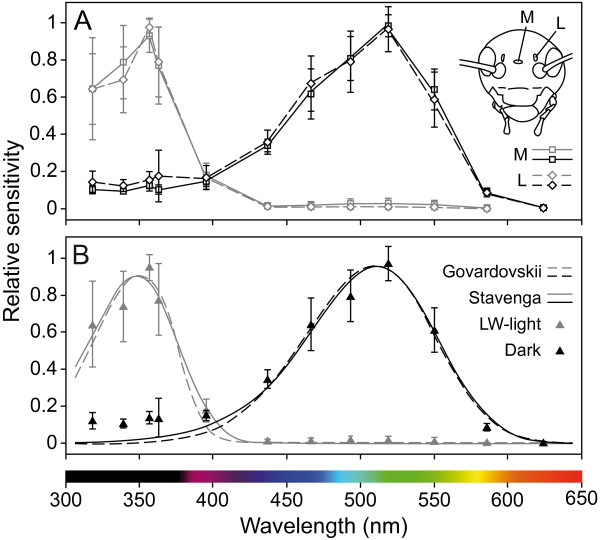
Phylogenetic analyses place all identified cricket sequences within the three main visual opsin clades of insects. We assign three of these opsins to visual pigments found in the compound eyes with peak absorbances in the green (515 nm), blue (445 nm) and UV (332 nm) spectral range. Their expression pattern divides the retina into distinct regions: (1) the polarization-sensitive dorsal rim area with blue- and UV-opsin, (2) a newly-discovered ventral band of ommatidia with blue- and green-opsin and (3) the remainder of the compound eye with UV- and green-opsin. In addition, we provide evidence for two ocellar photopigments with peak absorbances in the green (511 nm) and UV (350 nm) spectral range, and with opsins that differ from those expressed in the compound eyes.
Our data show that cricket eyes are spectrally more specialized than has previously been assumed, suggesting that similar adaptations in other insect species might have been overlooked. The arrangement of spectral receptor types within some ommatidia of the cricket compound eyes differs from the generally accepted pattern found in holometabolous insect taxa and awaits a functional explanation. From the opsin phylogeny, we conclude that gene duplications, which permitted differential opsin expression in insect ocelli and compound eyes, occurred independently in several insect lineages and are recent compared to the origin of the eyes themselves.
视蛋白是动物光感受器中的关键蛋白。它们与感光基团(视黄醛)一起形成视觉色素,当被光激活时,启动视觉转导级联反应。视觉色素的光谱吸收特性主要取决于它们的视蛋白,因此视蛋白对于理解动物眼睛的适应至关重要。对视蛋白的系统发育和表达模式的研究受到了相当多的关注,但我们对昆虫视觉视蛋白的了解仍然有限。到目前为止,研究人员主要集中在完全变态昆虫上,而一般结论需要从更广泛的分类群中进行采样。因此,我们研究了半变态昆虫双斑蟋蟀 Gryllus bimaculatus 的复眼和小眼中的视觉视蛋白。
系统发育分析将所有鉴定的蟋蟀序列置于昆虫的三个主要视觉视蛋白类群内。我们将其中三个视蛋白分配给在绿光(515nm)、蓝光(445nm)和紫外光(332nm)光谱范围内具有峰值吸收的复眼视觉色素。它们的表达模式将视网膜分为不同的区域:(1)具有蓝视蛋白和紫外视蛋白的极化敏感的背缘区域;(2)新发现的具有蓝视蛋白和绿视蛋白的腹带小眼;(3)其余的复眼具有紫外视蛋白和绿视蛋白。此外,我们提供了两个小眼光色素的证据,它们的峰值吸收在绿光(511nm)和紫外光(350nm)光谱范围内,并且视蛋白与复眼表达的视蛋白不同。
我们的数据表明,蟋蟀的眼睛在光谱上比以前认为的更为专业化,这表明其他昆虫物种中可能存在类似的适应,但尚未被发现。在蟋蟀复眼的一些小眼内,光谱受体类型的排列与在完全变态昆虫分类群中普遍接受的模式不同,需要一个功能解释。从视蛋白系统发育来看,我们得出结论,基因复制使得昆虫小眼和复眼的视蛋白表达发生差异,这种情况在几个昆虫谱系中独立发生,并且与眼睛本身的起源相比是最近的。