Instituto de Investigación en Recursos Cinegéticos IREC-CSIC-UCLM-JCCM, Ronda de Toledo s/n, Ciudad Real 13005, Spain.
Parasit Vectors. 2012 Aug 30;5:181. doi: 10.1186/1756-3305-5-181.
Anaplasma phagocytophilum infects a wide variety of hosts and causes granulocytic anaplasmosis in humans, horses and dogs and tick-borne fever in ruminants. Infection with A. phagocytophilum results in the modification of host gene expression and immune response. The objective of this research was to characterize gene expression in pigs (Sus scrofa) naturally and experimentally infected with A. phagocytophilum trying to identify mechanisms that help to explain low infection prevalence in this species.
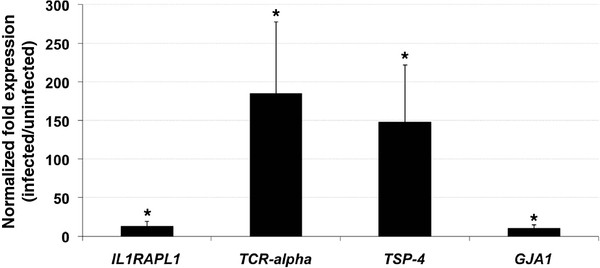
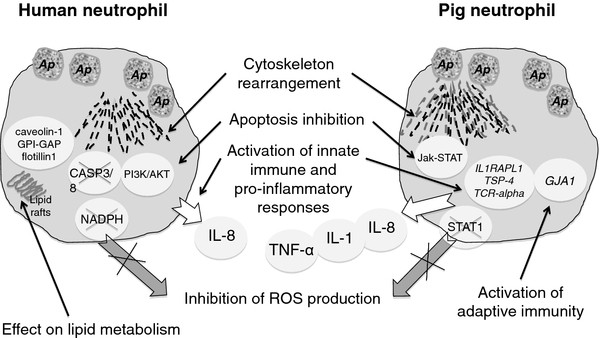
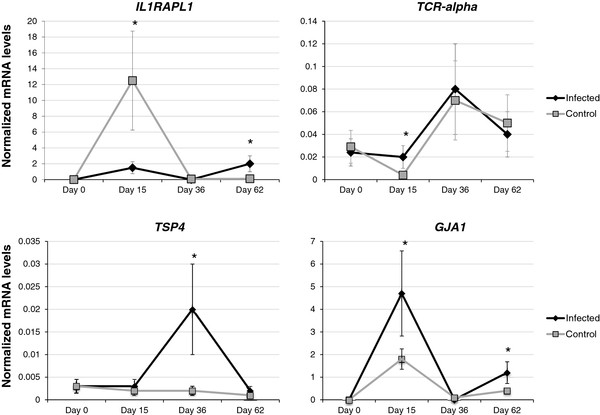
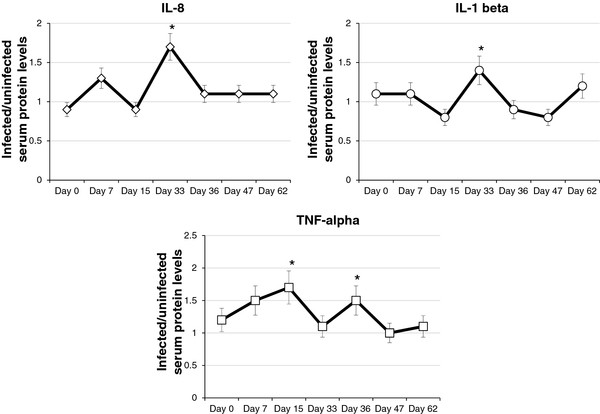
For gene expression analysis in naturally infected pigs, microarray hybridization was used. The expression of differentially expressed immune response genes was analyzed by real-time RT-PCR in naturally and experimentally infected pigs. Results suggested that A. phagocytophilum infection affected cytoskeleton rearrangement and increased both innate and adaptive immune responses by up regulation of interleukin 1 receptor accessory protein-like 1 (IL1RAPL1), T-cell receptor alpha chain (TCR-alpha), thrombospondin 4 (TSP-4) and Gap junction protein alpha 1 (GJA1) genes. Higher serum levels of IL-1 beta, IL-8 and TNF-alpha in infected pigs when compared to controls supported data obtained at the mRNA level.
These results suggested that pigs are susceptible to A. phagocytophilum but control infection, particularly through activation of innate immune responses, phagocytosis and autophagy. This fact may account for the low infection prevalence detected in pigs in some regions and thus their low or no impact as a reservoir host for this pathogen. These results advanced our understanding of the molecular mechanisms at the host-pathogen interface and suggested a role for newly reported genes in the protection of pigs against A. phagocytophilum.
嗜吞噬细胞无形体感染多种宿主,导致人类、马和狗粒细胞无形体病以及反刍动物的蜱传发热。感染嗜吞噬细胞无形体导致宿主基因表达和免疫反应的改变。本研究的目的是描述自然和实验感染嗜吞噬细胞无形体的猪的基因表达情况,试图确定有助于解释该物种低感染率的机制。
对于自然感染猪的基因表达分析,使用了微阵列杂交。通过实时 RT-PCR 分析自然和实验感染猪中差异表达的免疫反应基因的表达。结果表明,嗜吞噬细胞无形体感染影响细胞骨架重排,并通过上调白细胞介素 1 受体辅助蛋白样 1(IL1RAPL1)、T 细胞受体α链(TCR-α)、血小板反应蛋白 4(TSP-4)和间隙连接蛋白α 1(GJA1)基因,增加先天和适应性免疫反应。与对照组相比,感染猪的血清中白细胞介素 1β、白细胞介素 8 和肿瘤坏死因子-α水平升高,支持了 mRNA 水平获得的数据。
这些结果表明猪易感染嗜吞噬细胞无形体,但能控制感染,特别是通过激活先天免疫反应、吞噬作用和自噬作用。这一事实可能解释了在某些地区检测到的猪感染率较低,因此它们作为该病原体的储存宿主的影响较低或没有。这些结果加深了我们对宿主-病原体界面分子机制的理解,并表明了新报道的基因在保护猪免受嗜吞噬细胞无形体感染中的作用。