Institute of Collaborative Biotechnologies, University of California Santa Barbara, Santa Barbara, California, United States of America.
PLoS One. 2012;7(8):e42958. doi: 10.1371/journal.pone.0042958. Epub 2012 Aug 22.
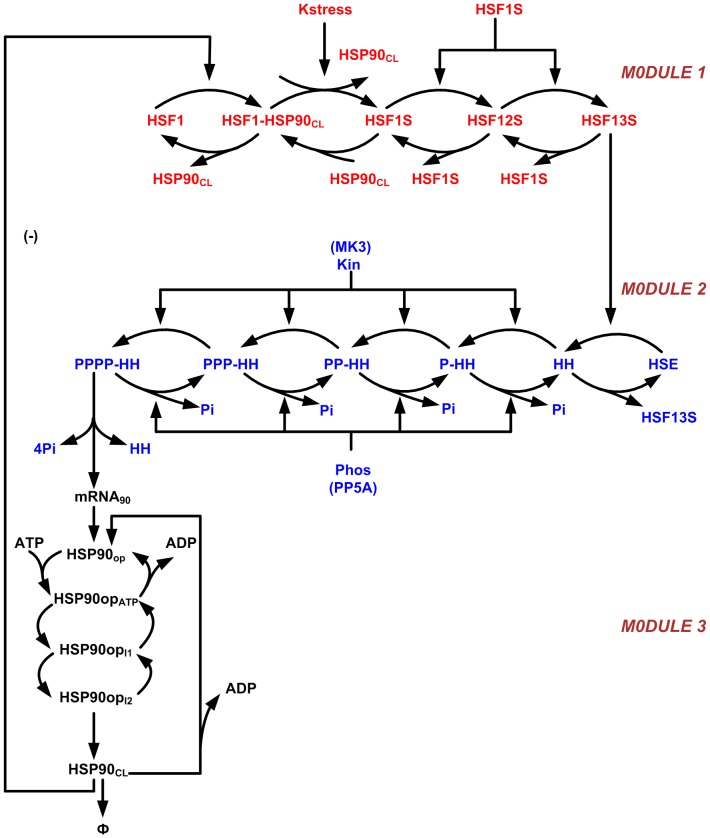
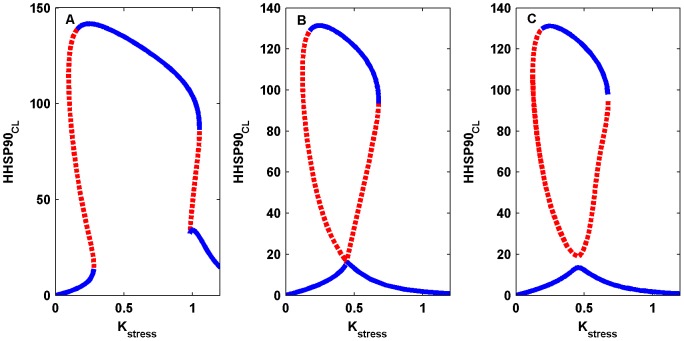
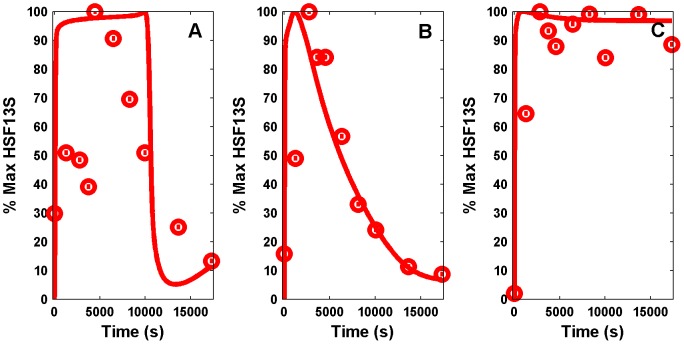
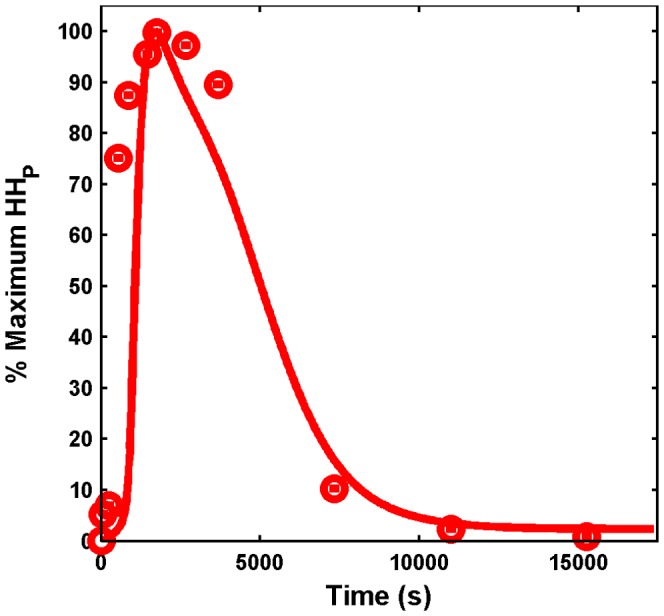
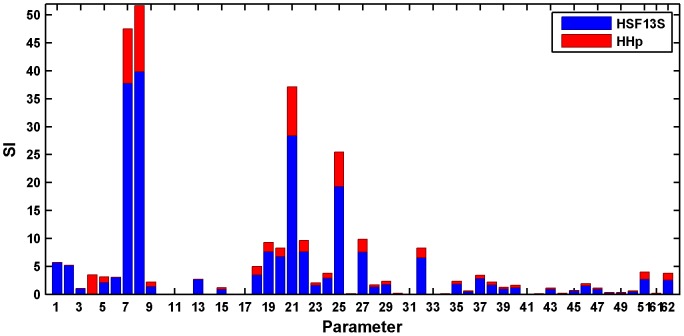
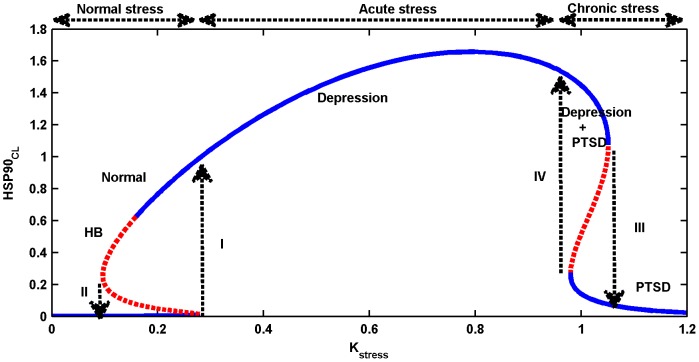
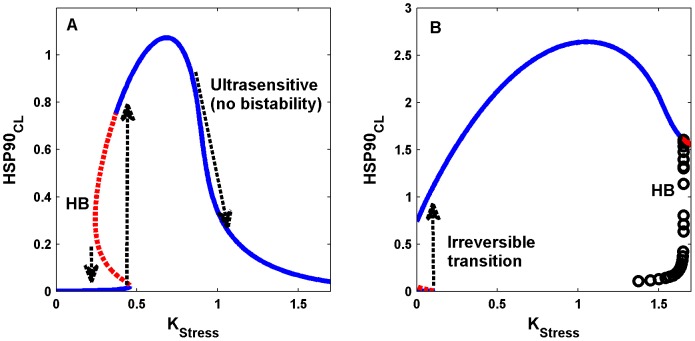
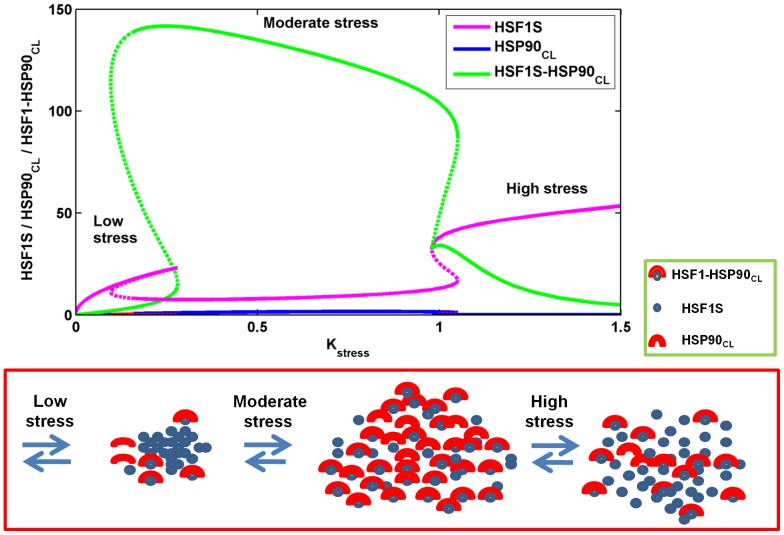
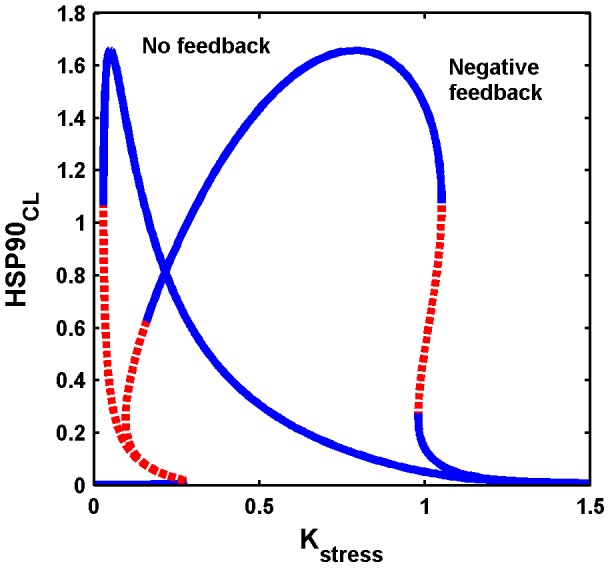
Physiological and psychological stresses cause anxiety disorders such as depression and post-traumatic stress disorder (PTSD) and induce drastic changes at a molecular level in the brain. To counteract this stress, the heat-shock protein (HSP) network plays a vital role in restoring the homeostasis of the system. To study the stress-induced dynamics of heat-shock network, we analyzed three modules of the HSP90 network--namely trimerization reactions, phosphorylation-dephosphorylation reactions, and the conversion of HSP90 from an open to a closed conformation--and constructed a corresponding nonlinear differential equation model based on mass action kinetics laws. The kinetic parameters of the model were obtained through global optimization, and sensitivity analyses revealed that the most sensitive parameters are the kinase and phosphatase that drive the phosphorylation-dephosphorylation reactions. Bifurcation analysis carried out with the estimated kinetic parameters of the model with stress as bifurcation parameter revealed the occurrence of "mushroom", a type of complex dynamics in which S-shaped and Z-shaped hysteretic bistable forms are present together. We mapped the molecular events responsible for generating the mushroom dynamics under stress and interpreted the occurrence of the S-shaped hysteresis to a normal level of stress, and the Z-shaped hysteresis to the HSP90 variations under acute and chronic stress in the fear conditioned system, and further, we hypothesized that this can be extended to stress-related disorders such as depression and PTSD in humans. Finally, we studied the effect of parameter variations on the mushroom dynamics to get insight about the role of phosphorylation-dephosphorylation parameters in HSP90 network in bringing about complex dynamics such as isolas, where the stable steady states in a bistable system are isolated and separated from each other and not connected by an unstable steady state.
生理和心理压力会导致焦虑症,如抑郁症和创伤后应激障碍(PTSD),并在大脑的分子水平上引起剧烈变化。为了对抗这种压力,热休克蛋白(HSP)网络在恢复系统的动态平衡中起着至关重要的作用。为了研究应激诱导的热休克网络动力学,我们分析了 HSP90 网络的三个模块——三聚反应、磷酸化-去磷酸化反应以及 HSP90 从开放构象到闭合构象的转变——并基于质量作用动力学定律构建了相应的非线性微分方程模型。通过全局优化获得了模型的动力学参数,敏感性分析表明,最敏感的参数是驱动磷酸化-去磷酸化反应的激酶和磷酸酶。用模型的估计动力学参数作为分岔参数进行分支分析,揭示了“蘑菇”型复杂动力学的发生,其中存在 S 型和 Z 型滞后双稳态形式。我们绘制了在应激下产生蘑菇动力学的分子事件图,并将 S 型滞后解释为正常应激水平,将 Z 型滞后解释为恐惧条件系统中 HSP90 的急性和慢性应激下的变化,进一步假设这可以扩展到人类的应激相关障碍,如抑郁症和 PTSD。最后,我们研究了参数变化对蘑菇动力学的影响,以了解磷酸化-去磷酸化参数在 HSP90 网络中产生复杂动力学(如隔离区)的作用,在双稳态系统中,稳定的稳态被隔离并彼此分离,而不稳定的稳态不连接。