The Bowles Center for Alcohol Studies, University of North Carolina, Chapel Hill, North Carolina, United States of America.
PLoS One. 2012;7(8):e43067. doi: 10.1371/journal.pone.0043067. Epub 2012 Aug 22.
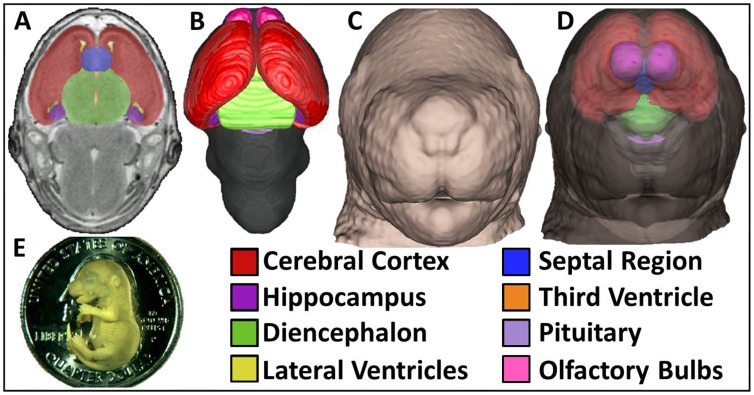
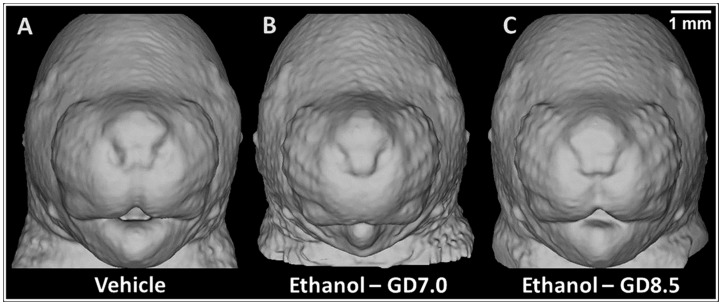
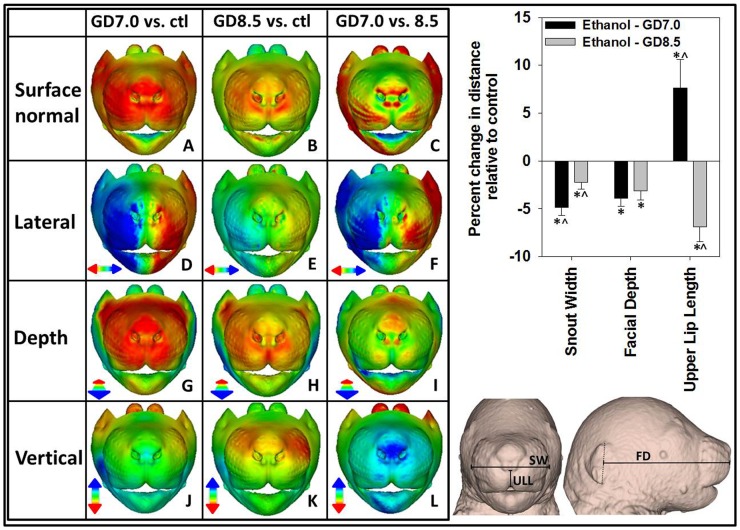
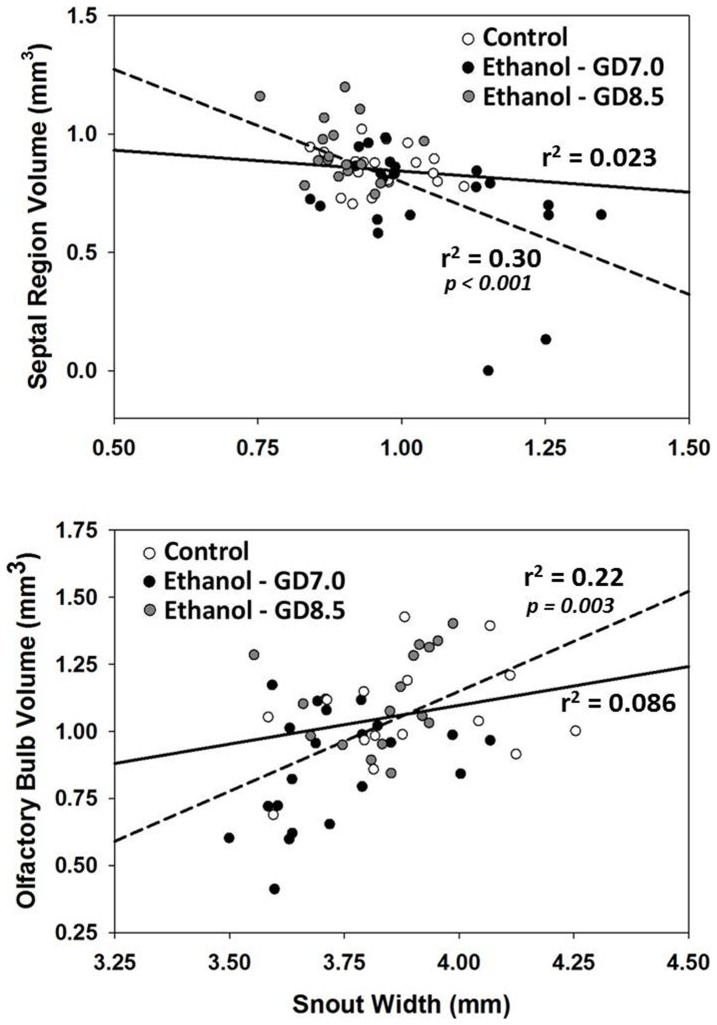
Prenatal ethanol exposure is the leading preventable cause of congenital mental disability. Whereas a diagnosis of fetal alcohol syndrome (FAS) requires identification of a specific pattern of craniofacial dysmorphology, most individuals with behavioral and neurological sequelae of heavy prenatal ethanol exposure do not exhibit these defining facial characteristics. Here, a novel integration of MRI and dense surface modeling-based shape analysis was applied to characterize concurrent face-brain phenotypes in C57Bl/6J fetuses exposed to ethanol on gestational day (GD)7 or GD8.5. The facial phenotype resulting from ethanol exposure depended upon stage of insult and was predictive of unique patterns of corresponding brain abnormalities. Ethanol exposure on GD7 produced a constellation of dysmorphic facial features characteristic of human FAS, including severe midfacial hypoplasia, shortening of the palpebral fissures, an elongated upper lip, and deficient philtrum. In contrast, ethanol exposure on GD8.5 caused mild midfacial hypoplasia and palpebral fissure shortening, a shortened upper lip, and a preserved philtrum. These distinct, stage-specific facial phenotypes were associated with unique volumetric and shape abnormalities of the septal region, pituitary, and olfactory bulbs. By demonstrating that early prenatal ethanol exposure can cause more than one temporally-specific pattern of defects, these findings illustrate the need for an expansion of current diagnostic criteria to better capture the full range of facial and brain dysmorphology in fetal alcohol spectrum disorders.
产前乙醇暴露是先天性精神残疾的主要可预防原因。虽然胎儿酒精综合征 (FAS) 的诊断需要确定特定的颅面畸形模式,但大多数有严重产前乙醇暴露的行为和神经后遗症的个体并不表现出这些明确的面部特征。在这里,将 MRI 与基于密集表面建模的形状分析相结合的新方法应用于在妊娠第 7 天或第 8.5 天暴露于乙醇的 C57Bl/6J 胎儿的同期面部-大脑表型进行特征描述。乙醇暴露引起的面部表型取决于损伤阶段,并可预测相应的独特大脑异常模式。在 GD7 暴露于乙醇会产生一系列与人类 FAS 特征一致的畸形面部特征,包括严重的中面部发育不全、睑裂缩短、上唇拉长和人中缺失。相比之下,在 GD8.5 暴露于乙醇会导致轻度中面部发育不全和睑裂缩短、上唇缩短和人中保留。这些独特的、阶段特异性的面部表型与鼻中隔区域、垂体和嗅球的独特体积和形状异常有关。通过证明早期产前乙醇暴露会导致多种暂时特异性缺陷模式,这些发现说明了需要扩展当前的诊断标准,以更好地捕捉胎儿酒精谱系障碍的全面面部和大脑畸形。