Department of Epidemiology, University of North Carolina at Chapel Hill, Chapel Hill, North Carolina, United States of America.
PLoS One. 2012;7(8):e43582. doi: 10.1371/journal.pone.0043582. Epub 2012 Aug 24.
The Infectious Disease Society of America (IDSA) 2010 Clinical Practice Guidelines for the management of cryptococcosis outlined three key populations at risk of disease: (1) HIV-infected, (2) transplant recipient, and (3) HIV-negative/non-transplant. However, direct comparisons of management, severity and outcomes of these groups have not been conducted.
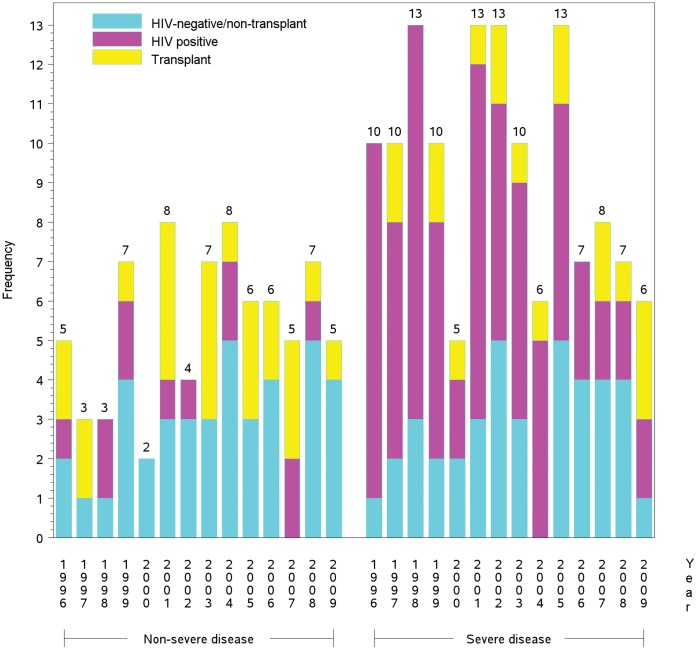
METHODOLOGY/PRINCIPAL FINDINGS: Annual changes in frequency of cryptococcosis diagnoses, cryptococcosis-attributable mortality and mortality were captured. Differences examined between severe and non-severe disease within the context of the three groups included: demographics, symptoms, microbiology, clinical management and treatment. An average of nearly 15 patients per year presented at Duke University Medical Center (DUMC) with cryptococcosis. Out of 207 study patients, 86 (42%) were HIV-positive, 42 (20%) were transplant recipients, and 79 (38%) were HIV-negative/non-transplant. HIV-infected individuals had profound CD4 lymphocytopenia and a majority had elevated intracranial pressure. Transplant recipients commonly (38%) had renal dysfunction. Nearly one-quarter (24%) had their immunosuppressive regimens stopped or changed. The HIV-negative/non-transplant population reported longer duration of symptoms than HIV-positive or transplant recipients and 28% (22/79) had liver insufficiency or underlying hematological malignancies. HIV-positive and HIV-negative/non-transplant patients accounted for 89% of severe disease cryptococcosis-attributable deaths and 86% of all-cause mortality.
CONCLUSIONS/SIGNIFICANCE: In this single-center study, the frequency of cryptococcosis did not change in the last two decades, although the underlying case mix shifted (fewer HIV-positive cases, stable transplant cases, more cases with neither). Cryptococcosis had a relatively uniform and informed treatment strategy, but disease-attributable mortality was still common.
美国传染病学会(IDSA)2010 年发布的 cryptococcosis 临床实践指南概述了三种易患疾病的关键人群:(1)HIV 感染者,(2)移植受者,和(3)HIV 阴性/非移植者。然而,这些人群的管理、严重程度和结局的直接比较尚未进行。
方法/主要发现:每年 cryptococcosis 诊断的频率、与 cryptococcosis 相关的死亡率和死亡率的变化都被捕获。在这三个群体的背景下,在严重和非严重疾病之间检查了差异,包括:人口统计学、症状、微生物学、临床管理和治疗。在杜克大学医学中心(DUMC),平均每年有近 15 名患者因 cryptococcosis 就诊。在 207 名研究患者中,86 名(42%)为 HIV 阳性,42 名(20%)为移植受者,79 名(38%)为 HIV 阴性/非移植者。HIV 感染者存在严重的 CD4 淋巴细胞减少症,大多数人颅内压升高。移植受者常(38%)有肾功能障碍。近四分之一(24%)停止或改变了他们的免疫抑制方案。HIV 阴性/非移植人群报告的症状持续时间长于 HIV 阳性或移植受者,28%(22/79)有肝衰竭或潜在的血液恶性肿瘤。HIV 阳性和 HIV 阴性/非移植患者占严重 cryptococcosis 相关死亡和所有原因死亡的 89%。
结论/意义:在这项单中心研究中,在过去的二十年中,cryptococcosis 的频率没有变化,尽管潜在的病例组合发生了变化(HIV 阳性病例减少,移植病例稳定,无 HIV 感染和移植的病例更多)。 cryptococcosis 有一个相对统一和明智的治疗策略,但疾病相关的死亡率仍然很高。