Department of Surgery, Perelman School of Medicine, University of Pennsylvania, Philadelphia, PA, USA.
Surgery. 2012 Sep;152(3):355-62. doi: 10.1016/j.surg.2012.06.009.
Reducing readmissions has become a focus in efforts by Medicare to improve health care quality and reduce costs. This study aimed to determine whether causes for readmission differed between obese and nonobese patients, possibly allowing for targeted interventions.
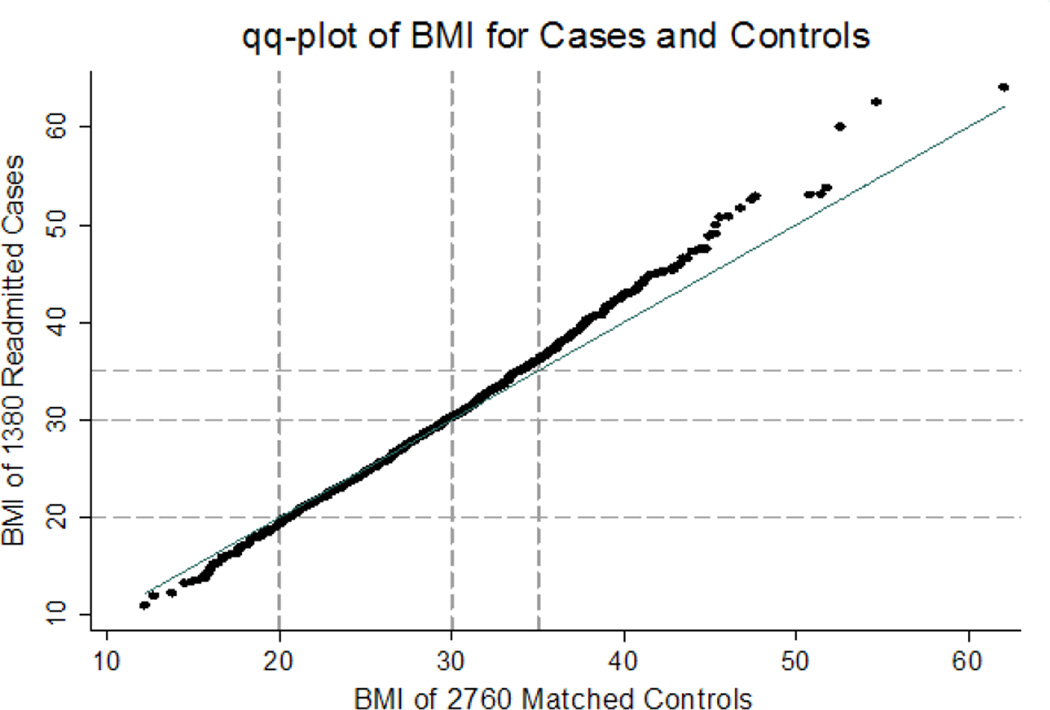
A matched case control study of Medicare patients admitted between 2002 and 2006 who were readmitted after hip or knee surgery, colectomy, or thoracotomy was performed. Patients were matched exactly for procedure, while also balancing on hospital, age, and sex. Conditional logistic regression was used to study the odds of readmission for very obese cases (body mass index >35 kg/m2) versus normal weight patients (body mass index of 20-30 kg/m2) after also controlling for race, transfer-in and emergency status, and comorbidities.
Among 15,914 patient admissions, we identified 1,380 readmitted patients and 2,760 controls. The risk of readmission was increased for obese compared to nonobese patients both before and after controlling for comorbidities (before: odds ratio, 1.35; P = .003; after: odds ratio, 1.25; P = .04). Reasons for readmission varied by procedure but were not different by body mass index category.
Obese patients have an increased risk of readmission, yet the reasons for readmission in obese patients appear to be similar to those for nonobese patients, suggesting that improved postdischarge management for the obese cannot focus on a few specific causes of readmission but must instead provide a broad range of interventions.
降低再入院率已成为医疗保险改善医疗质量和降低成本的重点。本研究旨在确定肥胖和非肥胖患者的再入院原因是否存在差异,以便进行有针对性的干预。
对 2002 年至 2006 年间接受髋关节或膝关节手术、结肠切除术或开胸术的医疗保险患者进行了一项匹配病例对照研究,这些患者在手术后再次入院。患者的手术过程完全匹配,同时还根据医院、年龄和性别进行了平衡。采用条件逻辑回归分析研究非常肥胖病例(体重指数>35kg/m2)与正常体重患者(体重指数为 20-30kg/m2)在考虑种族、转入和紧急状态以及合并症后再次入院的几率。
在 15914 例患者入院中,我们确定了 1380 例再入院患者和 2760 例对照。与非肥胖患者相比,肥胖患者在合并症之前和之后再次入院的风险均增加(之前:优势比,1.35;P =.003;之后:优势比,1.25;P =.04)。再入院的原因因手术而异,但与体重指数类别无关。
肥胖患者再次入院的风险增加,但肥胖患者再入院的原因似乎与非肥胖患者相似,这表明改善肥胖患者的出院后管理不能仅针对再入院的少数特定原因,而必须提供广泛的干预措施。