Department of Management Science and Statistics, University of Texas at San Antonio, One UTSA Circle, San Antonio, TX 78249, USA.
J Neurosci Methods. 2012 Oct 15;211(1):145-58. doi: 10.1016/j.jneumeth.2012.08.013. Epub 2012 Aug 23.
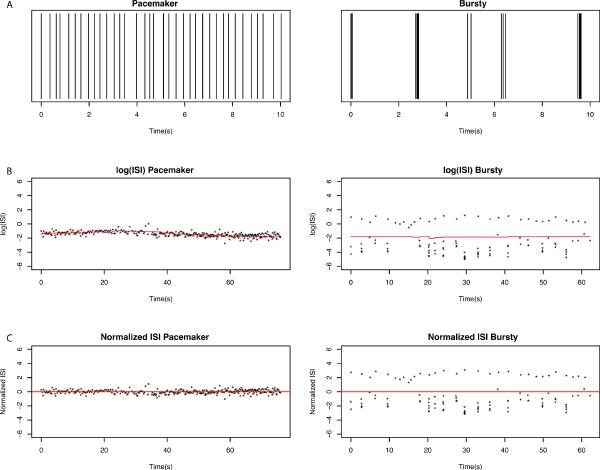
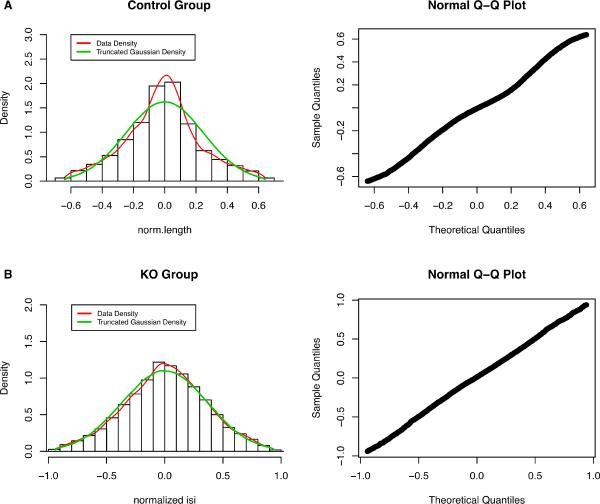
Midbrain dopaminergic neurons in vivo exhibit a wide range of firing patterns. They normally fire constantly at a low rate, and speed up, firing a phasic burst when reward exceeds prediction, or pause when an expected reward does not occur. Therefore, the detection of bursts and pauses from spike train data is a critical problem when studying the role of phasic dopamine (DA) in reward related learning, and other DA dependent behaviors. However, few statistical methods have been developed that can identify bursts and pauses simultaneously. We propose a new statistical method, the Robust Gaussian Surprise (RGS) method, which performs an exhaustive search of bursts and pauses in spike trains simultaneously. We found that the RGS method is adaptable to various patterns of spike trains recorded in vivo, and is not influenced by baseline firing rate, making it applicable to all in vivo spike trains where baseline firing rates vary over time. We compare the performance of the RGS method to other methods of detecting bursts, such as the Poisson Surprise (PS), Rank Surprise (RS), and Template methods. Analysis of data using the RGS method reveals potential mechanisms underlying how bursts and pauses are controlled in DA neurons.
中脑多巴胺能神经元在体内表现出广泛的放电模式。它们通常以低速率持续不断地放电,当奖励超过预期时会加快速度,产生一个相位突发,或者当预期的奖励没有出现时会暂停。因此,在研究相位多巴胺(DA)在奖励相关学习和其他依赖 DA 的行为中的作用时,从尖峰列车数据中检测突发和暂停是一个关键问题。然而,很少有统计学方法可以同时识别突发和暂停。我们提出了一种新的统计方法,即稳健高斯惊喜(RGS)方法,它可以同时对尖峰列车中的突发和暂停进行穷举搜索。我们发现,RGS 方法适应于体内记录的各种尖峰列车模式,不受基线放电率的影响,因此适用于所有基线放电率随时间变化的体内尖峰列车。我们将 RGS 方法与其他检测突发的方法(如泊松惊喜(PS)、秩惊喜(RS)和模板方法)进行了比较。使用 RGS 方法对数据的分析揭示了 DA 神经元中控制突发和暂停的潜在机制。