Department of Chemical Engineering, University of California, Santa Barbara, CA 93106, USA.
Biol Chem. 2012 Sep;393(9):933-41. doi: 10.1515/hsz-2012-0162.
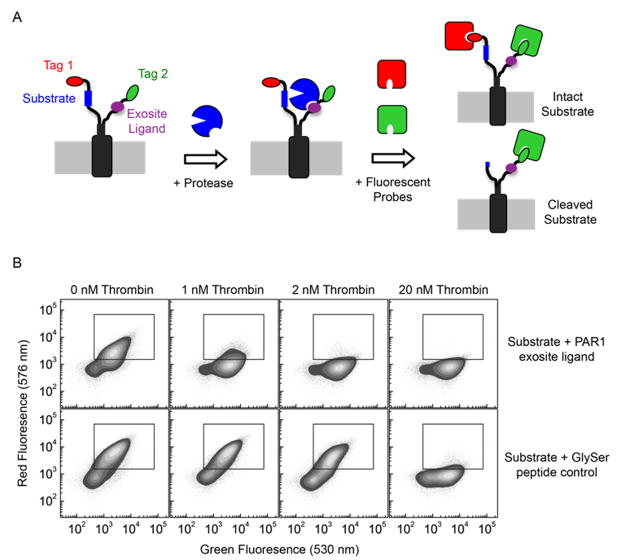
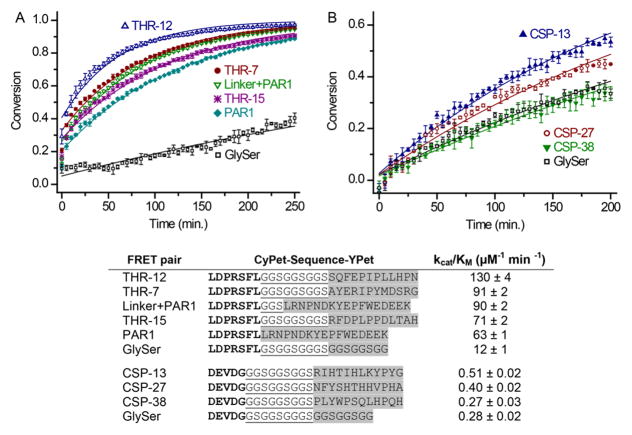
Many peptidases are thought to require non-active site interaction surfaces, or exosites, to recognize and cleave physiological substrates with high specificity and catalytic efficiency. However, the existence and function of protease exosites remain obscure owing to a lack of effective methods to identify and characterize exosite-interacting substrates. To address this need, we modified the cellular libraries of peptide substrates (CLiPS) methodology to enable the discovery of exosite-interacting peptide ligands. Invariant cleavage motifs recognized by the active sites of thrombin and caspase-7 were displayed on the outer surface of bacteria adjacent to a candidate exosite-interacting peptide. Exosite peptide libraries were then screened for ligands that accelerate cleavage of the active site recognition motif using two-color flow cytometry. Exosite CLiPS (eCLiPS) identified exosite-binding peptides for thrombin that were highly similar to a critical exosite interaction motif in the thrombin substrate, protease-activated receptor 1. Protease activity probes incorporating exosite-binding peptides were cleaved ten-fold faster than substrates without exosite ligands, increasing their sensitivity to thrombin activity in vitro. For comparison, screening with caspase-7 yielded peptides that modestly enhanced (two-fold) substrate cleavage rates. The eCLiPS method provides a new tool to profile the ligand specificity of protease exosites and to develop improved substrates.
许多肽酶被认为需要非活性位点相互作用表面(外位),以识别和切割具有高特异性和催化效率的生理底物。然而,由于缺乏有效识别和表征外位相互作用底物的方法,蛋白酶外位的存在和功能仍然不清楚。为了解决这一需求,我们修改了肽底物的细胞文库(CLiPS)方法,以发现外位相互作用的肽配体。凝血酶和 caspase-7 的活性位点识别的不变切割基序被展示在细菌的外表面上,与候选外位相互作用的肽相邻。然后,使用双色流式细胞术筛选外位肽文库中加速切割活性位点识别基序的配体。外位 CLiPS(eCLiPS)鉴定了凝血酶的外位结合肽,这些肽与凝血酶底物中关键的外位相互作用基序高度相似,即蛋白酶激活受体 1。包含外位结合肽的蛋白酶活性探针比没有外位配体的底物切割速度快十倍,提高了它们在体外对凝血酶活性的敏感性。相比之下,用 caspase-7 筛选得到的肽可适度提高(两倍)底物的切割速率。eCLiPS 方法提供了一种新的工具来分析蛋白酶外位的配体特异性,并开发改进的底物。