Centre for Biological Diversity, School of Biology, University of St Andrews, Fife KY16 9TH, United Kingdom.
Evolution. 2012 Sep;66(9):2674-84. doi: 10.1111/j.1558-5646.2012.01647.x. Epub 2012 May 11.
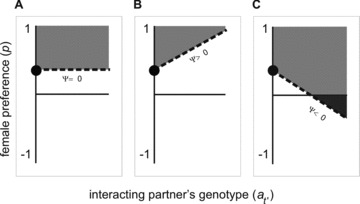
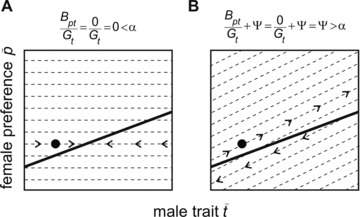
Female mating preferences are often flexible, reflecting the social environment in which they are expressed. Associated indirect genetic effects (IGEs) can affect the rate and direction of evolutionary change, but sexual selection models do not capture these dynamics. We incorporate IGEs into quantitative genetic models to explore how variation in social environments and mate choice flexibility influence Fisherian sexual selection. The importance of IGEs is that runaway sexual selection can occur in the absence of a genetic correlation between male traits and female preferences. Social influences can facilitate the initiation of the runaway process and increase the rate of trait elaboration. Incorporating costs to choice do not alter the main findings. Our model provides testable predictions: (1) genetic covariances between male traits and female preferences may not exist, (2) social flexibility in female choice will be common in populations experiencing strong sexual selection, (3) variation in social environments should be associated with rapid sexual trait divergence, and (4) secondary sexual traits will be more elaborate than previously predicted. Allowing feedback from the social environment resolves discrepancies between theoretical predictions and empirical data, such as why indirect selection on female preferences, theoretically weak, might be sufficient for preferences to become elaborated.
雌性的交配偏好通常是灵活的,反映了它们所处的社会环境。相关的间接遗传效应(IGE)可以影响进化变化的速度和方向,但性选择模型无法捕捉到这些动态。我们将 IGE 纳入定量遗传模型,以探讨社会环境和择偶灵活性的变化如何影响费希尔性选择。IGE 的重要性在于,在雄性特征和雌性偏好之间没有遗传相关性的情况下,也可能发生失控的性选择。社会影响可以促进失控过程的开始,并增加特征细化的速度。纳入选择成本不会改变主要发现。我们的模型提供了可测试的预测:(1)雄性特征和雌性偏好之间的遗传协方差可能不存在;(2)在经历强烈性选择的种群中,雌性择偶的社会灵活性将很常见;(3)社会环境的变化应与快速的性特征分歧相关;(4)次生性特征将比以前预测的更加精细。允许社会环境的反馈解决了理论预测和经验数据之间的差异,例如,为什么对雌性偏好的间接选择,理论上较弱,可能足以使偏好变得更加精细。