Department of Biochemistry, School of Medicine, Case Western Reserve University (CWRU) and the Comprehensive Cancer Center of CWRU and University Hospital of Cleveland (UHC), Cleveland, OH 44106, USA.
BMC Genomics. 2012 Sep 4;13:453. doi: 10.1186/1471-2164-13-453.
Promyelocytic leukemia protein (PML) is a tumor suppressor that is highly expressed in endothelial cells nonetheless its role in endothelial cell biology remains elusive. Tumor necrosis factor alpha (TNFα) is an important cytokine associated with many inflammation-related diseases. We have previously demonstrated that TNFα induces PML protein accumulation. We hypothesized that PML may play a role in TNFα signaling pathway. To identify potential PML target genes and investigate the putative crosstalk between PML's function and TNFα signaling in endothelial cells, we carried out a microarray analysis in human primary umbilical endothelial cells (HUVECs).
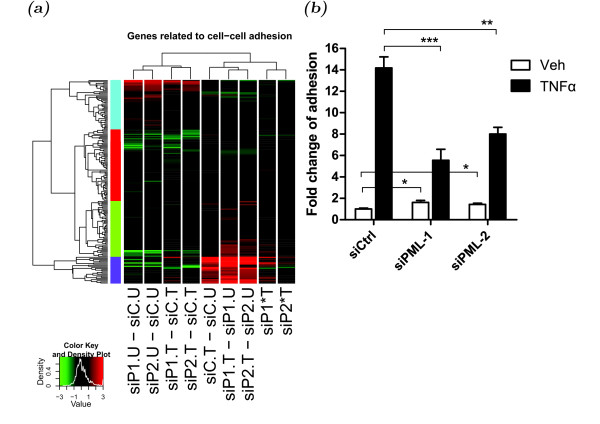
We found that PML and TNFα regulate common and distinct genes involved in a similar spectrum of biological processes, pathways and human diseases. More importantly, we found that PML is required for fine-tuning of TNFα-mediated immune and inflammatory responses. Furthermore, our data suggest that PML and TNFα synergistically regulate cell adhesion by engaging multiple molecular mechanisms. Our biological functional assays exemplified that adhesion of U937 human leukocytes to HUVECs is co-regulated by PML and TNFα signaling.
Together, our study identified PML as an essential regulator of TNFα signaling by revealing the crosstalk between PML knockdown-mediated effects and TNFα-elicited signaling, thereby providing novel insights into TNFα signaling in endothelial cells.
早幼粒细胞白血病蛋白(PML)是一种肿瘤抑制因子,尽管在血管内皮细胞中高度表达,但它在血管内皮细胞生物学中的作用仍不清楚。肿瘤坏死因子-α(TNFα)是一种与许多炎症相关疾病相关的重要细胞因子。我们之前已经证明 TNFα 诱导 PML 蛋白积累。我们假设 PML 可能在 TNFα 信号通路中发挥作用。为了鉴定潜在的 PML 靶基因,并研究 PML 的功能与 TNFα 在血管内皮细胞中的信号转导之间的潜在相互作用,我们在人脐静脉内皮细胞(HUVEC)中进行了微阵列分析。
我们发现 PML 和 TNFα 调节共同和不同的基因,这些基因参与相似的生物学过程、途径和人类疾病谱。更重要的是,我们发现 PML 是精细调节 TNFα 介导的免疫和炎症反应所必需的。此外,我们的数据表明,PML 和 TNFα 通过多种分子机制协同调节细胞黏附。我们的生物学功能测定例示了 U937 人白血病细胞与 HUVEC 的黏附受 PML 和 TNFα 信号的共同调节。
总之,我们的研究通过揭示 PML 敲低介导的效应与 TNFα 诱导的信号之间的相互作用,将 PML 鉴定为 TNFα 信号的重要调节因子,从而为内皮细胞中 TNFα 信号提供了新的见解。