Sznycer Daniel, Takemura Kosuke, Delton Andrew W, Sato Kosuke, Robertson Theresa, Cosmides Leda, Tooby John
Center for Evolutionary Psychology, University of California, Santa Barbara, CA, USA.
Evol Psychol. 2012 Jun 29;10(2):352-70. doi: 10.1177/147470491201000213.
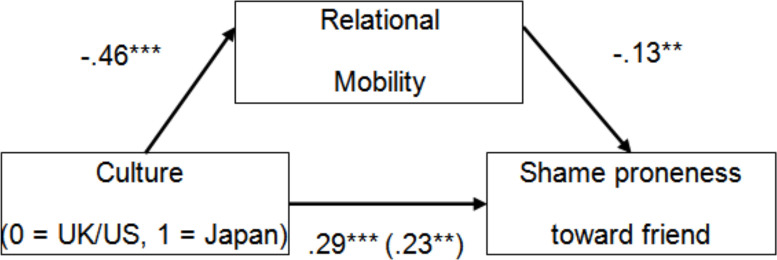
People vary in how easily they feel ashamed, that is, in their shame proneness. According to the information threat theory of shame, variation in shame proneness should, in part, be regulated by features of a person's social ecology. On this view, shame is an emotion program that evolved to mitigate the likelihood or costs of reputation-damaging information spreading to others. In social environments where there are fewer possibilities to form new relationships (i.e., low relational mobility), there are higher costs to damaging or losing existing ones. Therefore, shame proneness toward current relationship partners should increase as perceived relational mobility decreases. In contrast, individuals with whom one has little or no relationship history are easy to replace, and so shame-proneness towards them should not be modulated by relational mobility. We tested these predictions cross-culturally by measuring relational mobility and shame proneness towards friends and strangers in Japan, the United States, and the United Kingdom. Japanese subjects were more shame-prone than their British and American counterparts. Critically, lower relational mobility was associated with greater shame proneness towards friends (but not strangers), and this relationship partially mediated the cultural differences in shame proneness. Shame proneness appears tailored to respond to relevant features of one's social ecology.
人们在感到羞耻的难易程度上存在差异,也就是说,在他们的羞耻倾向方面存在差异。根据羞耻的信息威胁理论,羞耻倾向的差异部分应由一个人的社会生态特征来调节。按照这种观点,羞耻是一种情绪程序,其进化目的是降低有损声誉的信息传播给他人的可能性或成本。在形成新关系可能性较少的社会环境中(即关系流动性低),损害或失去现有关系的代价更高。因此,随着感知到的关系流动性降低,对当前关系伙伴的羞耻倾向应该会增加。相比之下,与一个人几乎没有关系历史的个体很容易被取代,所以对他们的羞耻倾向不应受关系流动性的调节。我们通过测量日本、美国和英国的关系流动性以及对朋友和陌生人的羞耻倾向,跨文化地检验了这些预测。日本受试者比他们的英国和美国同行更容易感到羞耻。至关重要的是,较低的关系流动性与对朋友(而非陌生人)更大的羞耻倾向相关,并且这种关系部分介导了羞耻倾向的文化差异。羞耻倾向似乎是为了应对一个人的社会生态的相关特征而量身定制的。