INDEPTH Network, P,O Box KD 213 Kanda, Accra, Ghana.
Malar J. 2012 Sep 5;11:311. doi: 10.1186/1475-2875-11-311.
Drug prescription practices depend on several factors related to the patient, health worker and health facilities. A better understanding of the factors influencing prescription patterns is essential to develop strategies to mitigate the negative consequences associated with poor practices in both the public and private sectors.
A cross-sectional study was conducted in rural Tanzania among patients attending health facilities, and health workers. Patients, health workers and health facilities-related factors with the potential to influence drug prescription patterns were used to build a model of key predictors. Standard data mining methodology of classification tree analysis was used to define the importance of the different factors on prescription patterns.
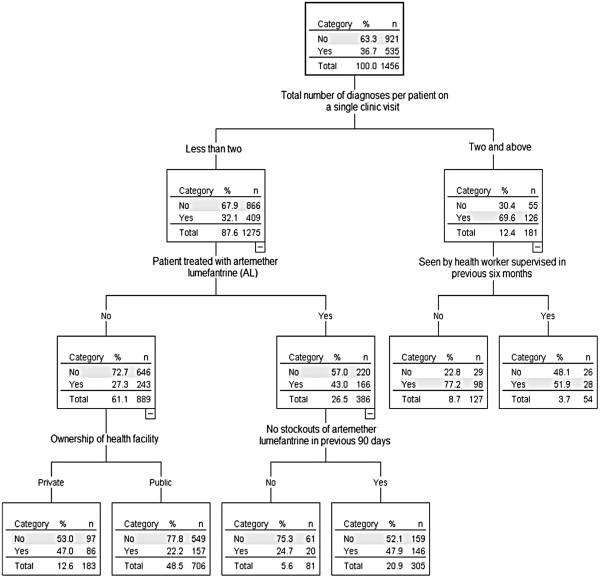
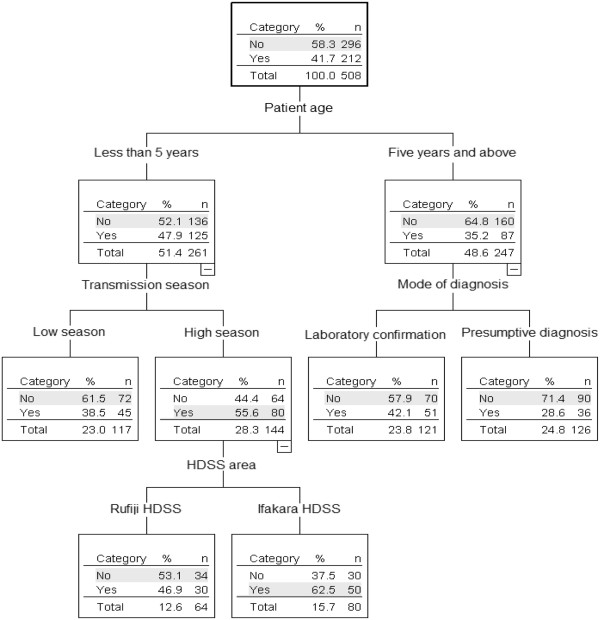
This analysis included 1,470 patients and 71 health workers practicing in 30 health facilities. Patients were mostly treated in dispensaries. Twenty two variables were used to construct two classification tree models: one for polypharmacy (prescription of ≥3 drugs) on a single clinic visit and one for co-prescription of artemether-lumefantrine (AL) with antibiotics. The most important predictor of polypharmacy was the diagnosis of several illnesses. Polypharmacy was also associated with little or no supervision of the health workers, administration of AL and private facilities. Co-prescription of AL with antibiotics was more frequent in children under five years of age and the other important predictors were transmission season, mode of diagnosis and the location of the health facility.
Standard data mining methodology is an easy-to-implement analytical approach that can be useful for decision-making. Polypharmacy is mainly due to the diagnosis of multiple illnesses.
药物处方实践取决于与患者、卫生工作者和卫生机构相关的几个因素。更好地了解影响处方模式的因素对于制定策略来减轻公共和私营部门中与不良实践相关的负面影响至关重要。
在坦桑尼亚农村地区,对就诊于卫生机构的患者和卫生工作者进行了一项横断面研究。使用了可能影响药物处方模式的患者、卫生工作者和卫生机构相关因素来构建关键预测因素模型。采用分类树分析的标准数据挖掘方法来定义不同因素对处方模式的重要性。
这项分析包括 1470 名患者和 71 名在 30 个卫生机构工作的卫生工作者。患者大多在诊所接受治疗。使用了 22 个变量来构建两个分类树模型:一个用于单次就诊时的多种药物(处方≥3 种药物),另一个用于青蒿琥酯-咯萘啶与抗生素的共同处方。多种药物的最重要预测因素是多种疾病的诊断。多种药物与卫生工作者几乎没有或没有监督、青蒿琥酯-咯萘啶的使用以及私立机构有关。在五岁以下儿童中,青蒿琥酯-咯萘啶与抗生素的共同处方更为常见,其他重要的预测因素是传播季节、诊断方式和卫生机构的位置。
标准数据挖掘方法是一种易于实施的分析方法,可用于决策制定。多种药物主要是由于多种疾病的诊断。