Jiang Mengxi, Zhao Linbo, Gamez Monica, Imperiale Michael J
Department of Microbiology and Immunology and Comprehensive Cancer Center, University of Michigan Medical School, Ann Arbor, Michigan, United States of America.
PLoS Pathog. 2012;8(8):e1002898. doi: 10.1371/journal.ppat.1002898. Epub 2012 Aug 30.
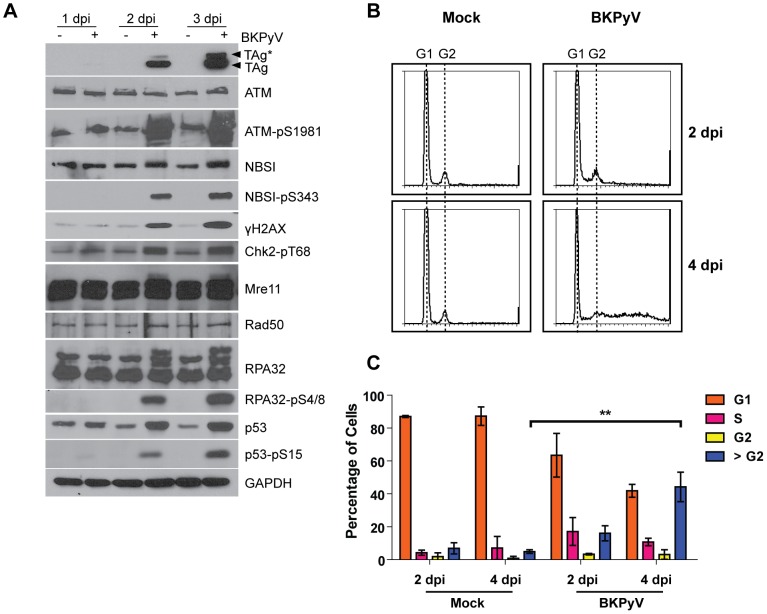
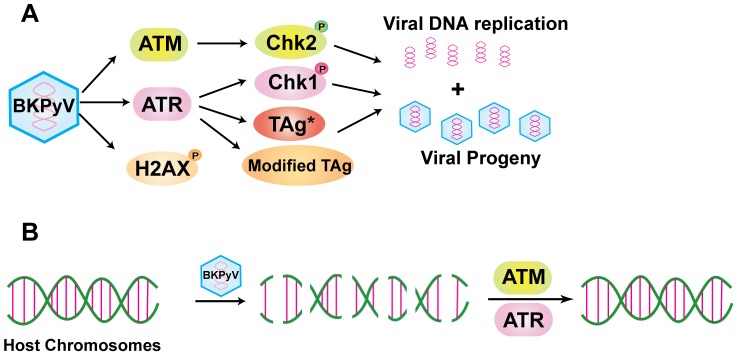
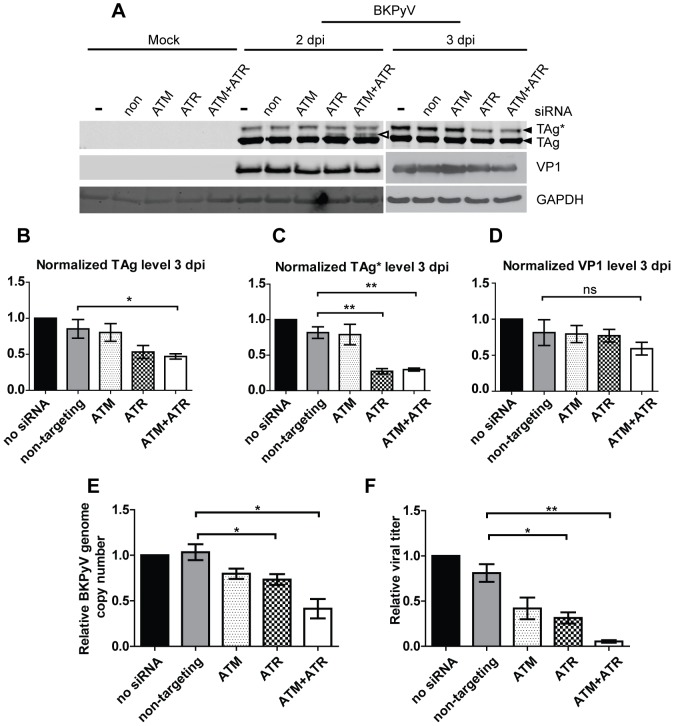
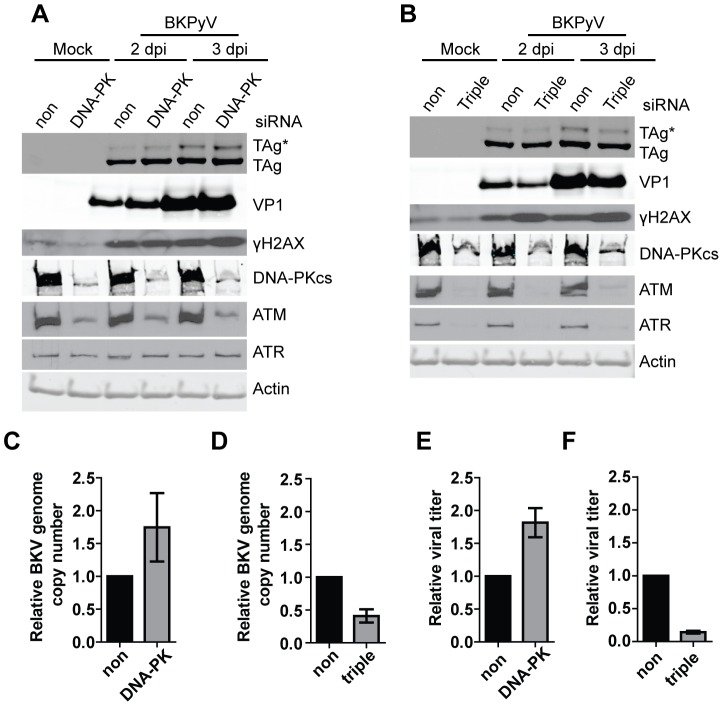
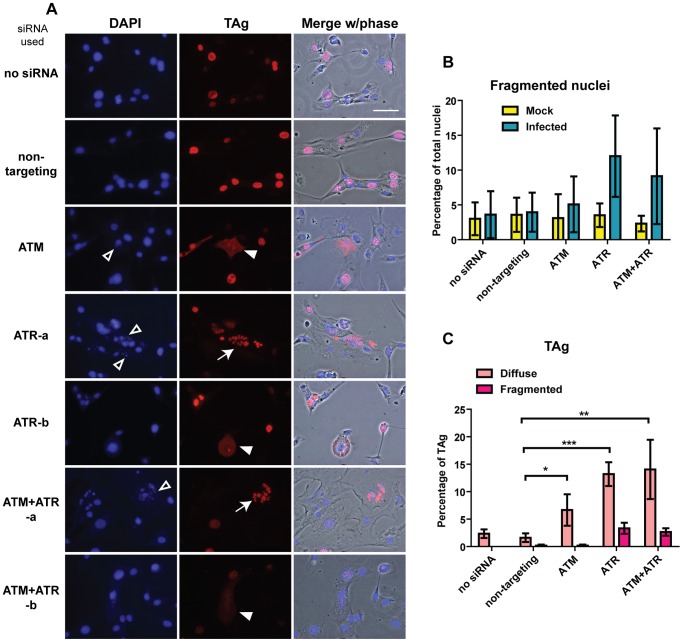
BK polyomavirus (BKPyV) is an emerging pathogen whose reactivation causes severe disease in transplant patients. Unfortunately, there is no specific anti-BKPyV treatment available, and host cell components that affect the infection outcome are not well characterized. In this report, we examined the relationship between BKPyV productive infection and the activation of the cellular DNA damage response (DDR) in natural host cells. Our results showed that both the ataxia-telangiectasia mutated (ATM)- and ATM and Rad-3-related (ATR)-mediated DDR were activated during BKPyV infection, accompanied by the accumulation of polyploid cells. We assessed the involvement of ATM and ATR during infection using small interfering RNA (siRNA) knockdowns. ATM knockdown did not significantly affect viral gene expression, but reduced BKPyV DNA replication and infectious progeny production. ATR knockdown had a slightly more dramatic effect on viral T antigen (TAg) and its modified forms, DNA replication, and progeny production. ATM and ATR double knockdown had an additive effect on DNA replication and resulted in a severe reduction in viral titer. While ATM mainly led to the activation of pChk2 and ATR was primarily responsible for the activation of pChk1, knockdown of all three major phosphatidylinositol 3-kinase-like kinases (ATM, ATR, and DNA-PKcs) did not abolish the activation of γH2AX during BKPyV infection. Finally, in the absence of ATM or ATR, BKPyV infection caused severe DNA damage and aberrant TAg staining patterns. These results indicate that induction of the DDR by BKPyV is critical for productive infection, and that one of the functions of the DDR is to minimize the DNA damage which is generated during BKPyV infection.
BK多瘤病毒(BKPyV)是一种新出现的病原体,其重新激活会在移植患者中引发严重疾病。不幸的是,目前尚无可用的特异性抗BKPyV治疗方法,且影响感染结果的宿主细胞成分尚未得到充分表征。在本报告中,我们研究了BKPyV在天然宿主细胞中的有效感染与细胞DNA损伤反应(DDR)激活之间的关系。我们的结果表明,在BKPyV感染期间,共济失调毛细血管扩张症突变基因(ATM)和ATM与Rad-3相关蛋白(ATR)介导的DDR均被激活,同时伴有多倍体细胞的积累。我们使用小干扰RNA(siRNA)敲低技术评估了ATM和ATR在感染过程中的作用。敲低ATM对病毒基因表达没有显著影响,但减少了BKPyV DNA复制和感染性子代产生。敲低ATR对病毒T抗原(TAg)及其修饰形式、DNA复制和子代产生的影响更为显著。同时敲低ATM和ATR对DNA复制具有累加效应,并导致病毒滴度严重降低。虽然ATM主要导致pChk2的激活,而ATR主要负责pChk1的激活,但敲低所有三种主要的磷脂酰肌醇3激酶样激酶(ATM、ATR和DNA-PKcs)并没有消除BKPyV感染期间γH2AX的激活。最后,在缺乏ATM或ATR的情况下,BKPyV感染会导致严重的DNA损伤和异常的TAg染色模式。这些结果表明,BKPyV诱导DDR对于有效感染至关重要,并且DDR的功能之一是将BKPyV感染期间产生的DNA损伤降至最低。