Scripps Institution of Oceanography, University of California San Diego, La Jolla, California, United States of America.
PLoS One. 2012;7(8):e43843. doi: 10.1371/journal.pone.0043843. Epub 2012 Aug 28.
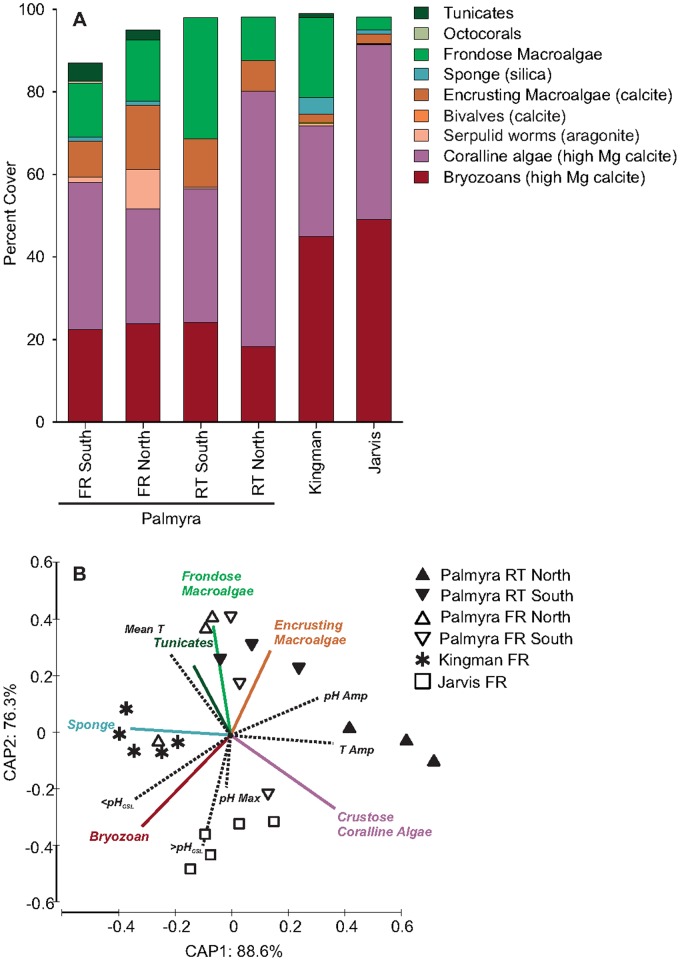
Community structure and assembly are determined in part by environmental heterogeneity. While reef-building corals respond negatively to warming (i.e. bleaching events) and ocean acidification (OA), the extent of present-day natural variability in pH on shallow reefs and ecological consequences for benthic assemblages is unknown. We documented high resolution temporal patterns in temperature and pH from three reefs in the central Pacific and examined how these data relate to community development and net accretion rates of early successional benthic organisms. These reefs experienced substantial diel fluctuations in temperature (0.78°C) and pH (>0.2) similar to the magnitude of 'warming' and 'acidification' expected over the next century. Where daily pH within the benthic boundary layer failed to exceed pelagic climatological seasonal lows, net accretion was slower and fleshy, non-calcifying benthic organisms dominated space. Thus, key aspects of coral reef ecosystem structure and function are presently related to natural diurnal variability in pH.
群落结构和组装在一定程度上取决于环境异质性。虽然造礁珊瑚对升温(即白化事件)和海洋酸化(OA)反应消极,但目前浅海珊瑚礁中 pH 值的自然变化幅度及其对底栖生物群落的生态后果尚不清楚。我们记录了太平洋中部三个珊瑚礁的高分辨率时间温度和 pH 值模式,并研究了这些数据如何与群落发展和早期演替底栖生物的净附着率相关。这些珊瑚礁经历了显著的日温度波动(0.78°C)和 pH 值变化(>0.2),与未来一个世纪预计的“升温”和“酸化”幅度相似。在底栖边界层中,每日 pH 值未能超过浮游生物气候季节性低值时,净附着率较慢,肉质、非钙化的底栖生物占据主导地位。因此,珊瑚礁生态系统结构和功能的关键方面目前与 pH 值的自然日变化有关。