Department of Neurology, University Medical Center Utrecht, Utrecht, The Netherlands.
PLoS One. 2012;7(8):e44074. doi: 10.1371/journal.pone.0044074. Epub 2012 Aug 31.
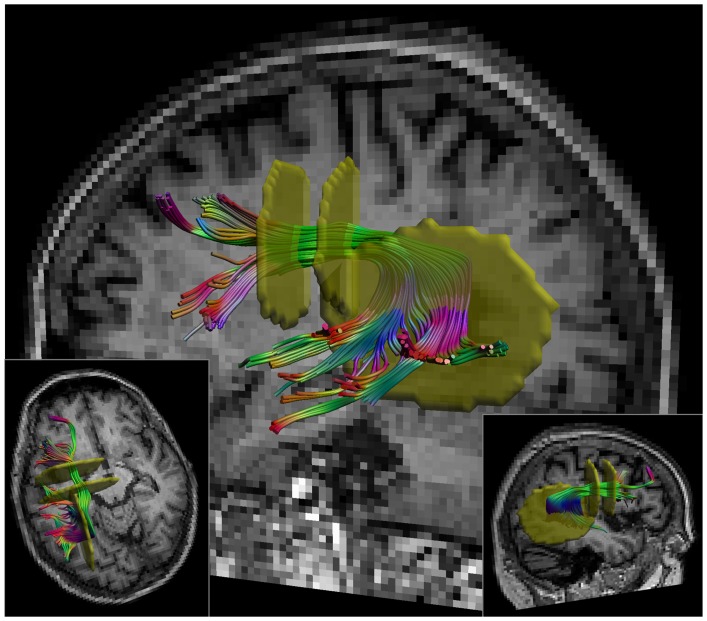
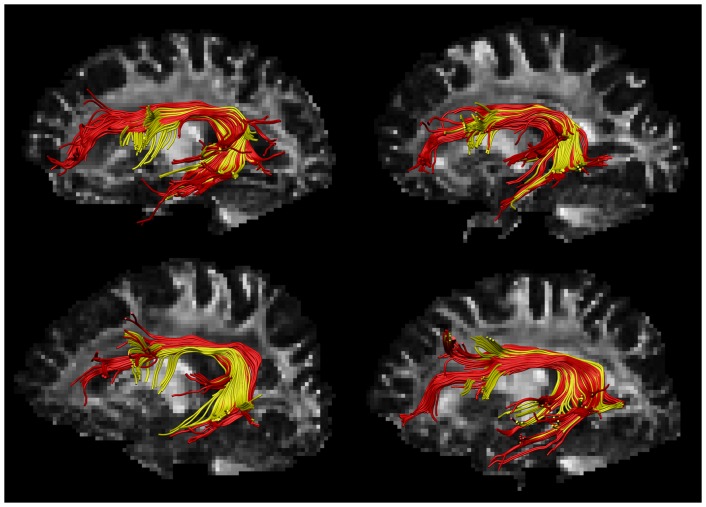
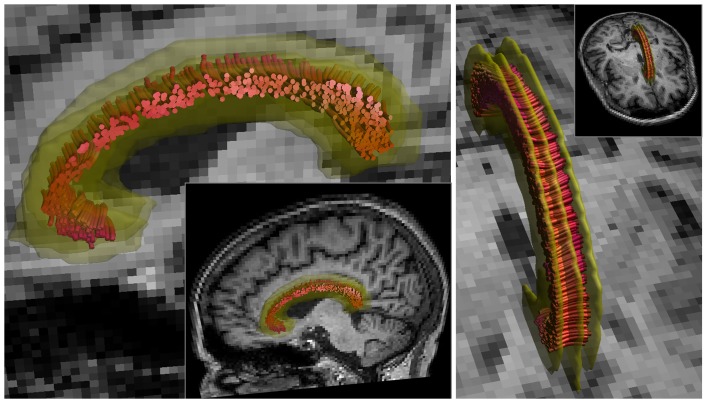
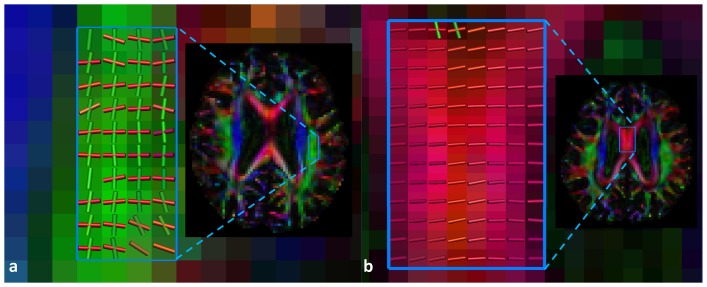
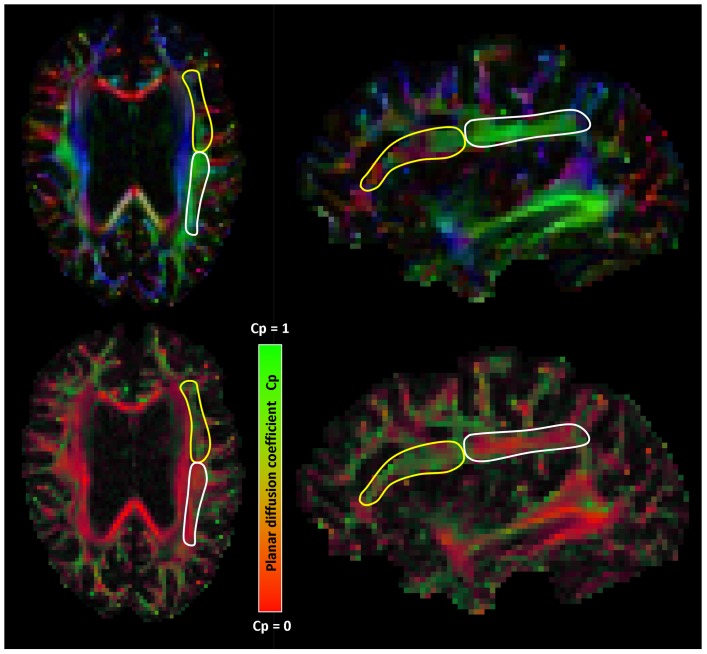
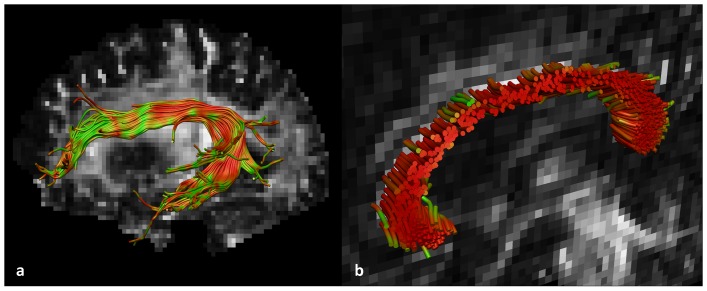
Diffusion tensor imaging (DTI) based fiber tractography (FT) is the most popular approach for investigating white matter tracts in vivo, despite its inability to reconstruct fiber pathways in regions with "crossing fibers." Recently, constrained spherical deconvolution (CSD) has been developed to mitigate the adverse effects of "crossing fibers" on DTI based FT. Notwithstanding the methodological benefit, the clinical relevance of CSD based FT for the assessment of white matter abnormalities remains unclear. In this work, we evaluated the applicability of a hybrid framework, in which CSD based FT is combined with conventional DTI metrics to assess white matter abnormalities in 25 patients with early Alzheimer's disease. Both CSD and DTI based FT were used to reconstruct two white matter tracts: one with regions of "crossing fibers," i.e., the superior longitudinal fasciculus (SLF) and one which contains only one fiber orientation, i.e. the midsagittal section of the corpus callosum (CC). The DTI metrics, fractional anisotropy (FA) and mean diffusivity (MD), obtained from these tracts were related to memory function. Our results show that in the tract with "crossing fibers" the relation between FA/MD and memory was stronger with CSD than with DTI based FT. By contrast, in the fiber bundle where one fiber population predominates, the relation between FA/MD and memory was comparable between both tractography methods. Importantly, these associations were most pronounced after adjustment for the planar diffusion coefficient, a measure reflecting the degree of fiber organization complexity. These findings indicate that compared to conventionally applied DTI based FT, CSD based FT combined with DTI metrics can increase the sensitivity to detect functionally significant white matter abnormalities in tracts with complex white matter architecture.
基于弥散张量成像(DTI)的纤维束追踪(FT)是研究活体白质束的最常用方法,尽管它无法重建“交叉纤维”区域中的纤维通路。最近,约束球分解(CSD)已被开发出来,以减轻“交叉纤维”对基于 DTI 的 FT 的不利影响。尽管在方法上有优势,但 CSD 基于 FT 对评估白质异常的临床相关性尚不清楚。在这项工作中,我们评估了一种混合框架的适用性,其中 CSD 基于 FT 与常规 DTI 指标相结合,用于评估 25 例早期阿尔茨海默病患者的白质异常。CSD 和 DTI 基于 FT 均用于重建两个白质束:一个包含“交叉纤维”区域,即上纵束(SLF),另一个仅包含一个纤维方向,即胼胝体的中矢状面(CC)。从这些束中获得的 DTI 指标,各向异性分数(FA)和平均扩散系数(MD),与记忆功能相关。我们的结果表明,在包含“交叉纤维”的束中,FA/MD 与记忆之间的关系与 CSD 相比,与基于 DTI 的 FT 更强。相比之下,在纤维束中,一种纤维群体占主导地位,FA/MD 与记忆之间的关系在两种追踪方法之间相当。重要的是,在调整平面扩散系数(反映纤维组织复杂性程度的指标)后,这些关联最为明显。这些发现表明,与常规应用的基于 DTI 的 FT 相比,CSD 基于 FT 与 DTI 指标相结合可以提高检测具有复杂白质结构的束中功能重要的白质异常的敏感性。