Department of Cognitive Psychology, Vrije Universiteit, Amsterdam, The Netherlands.
PLoS One. 2012;7(8):e44290. doi: 10.1371/journal.pone.0044290. Epub 2012 Aug 31.
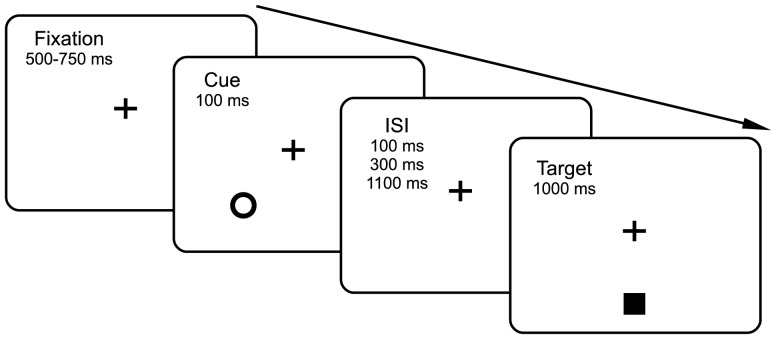
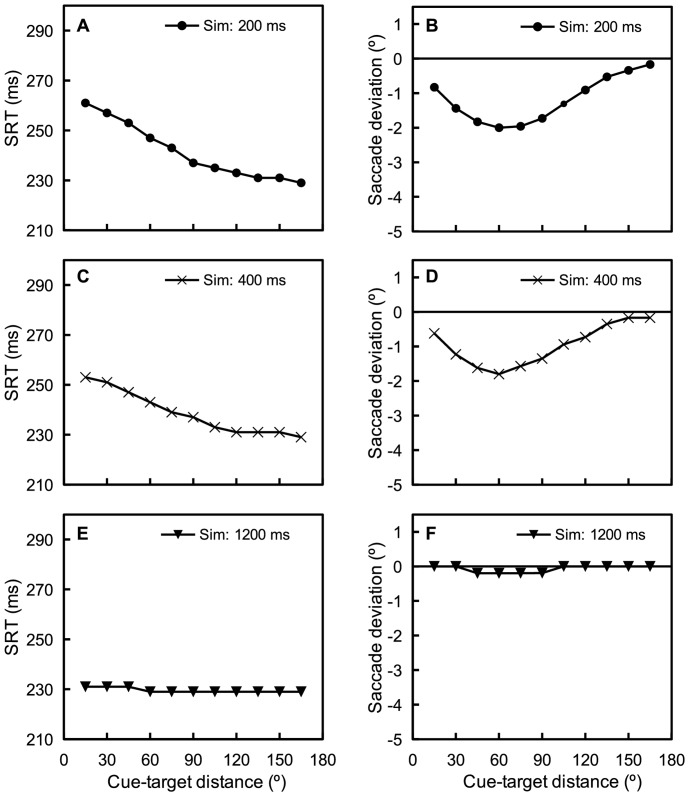
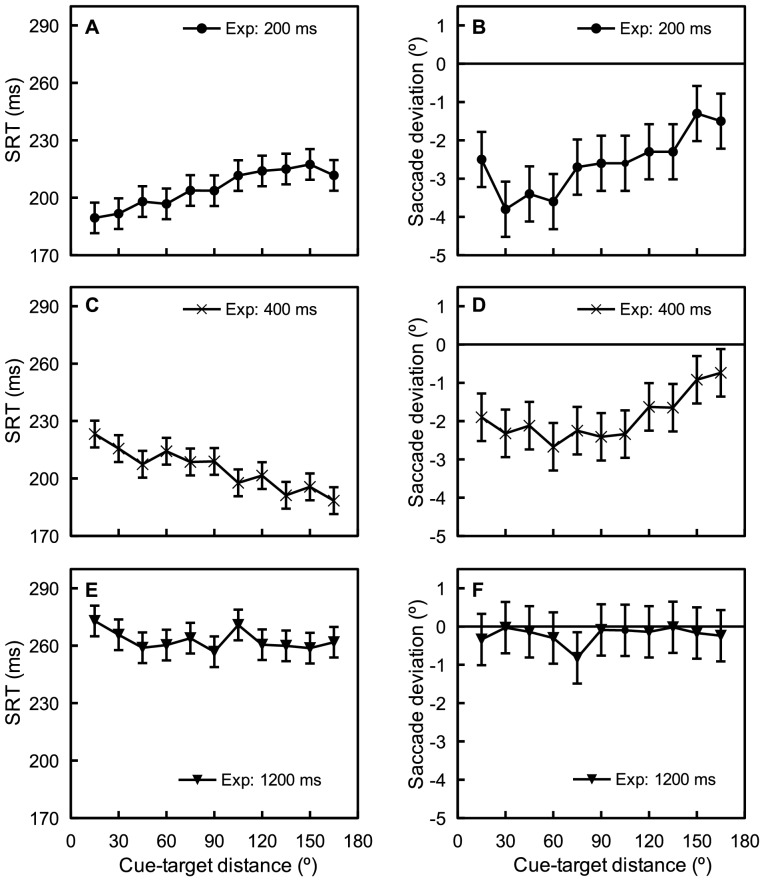
Inhibition of return (IOR) refers to the relative suppression of processing at locations that have recently been attended. It is frequently explored using a spatial cueing paradigm and is characterized by slower responses to cued than to uncued locations. The current study investigates the impact of IOR on overt visual orienting involving saccadic eye movements. Using a spatial cueing paradigm, our experiments have demonstrated that at a cue-target onset asynchrony (CTOA) of 400 ms saccades to the vicinity of cued locations are not only delayed (temporal cost) but also biased away (spatial effect). Both of these effects are basically no longer present at a CTOA of 1200 ms. At a shorter 200 ms CTOA, the spatial effect becomes stronger while the temporal cost is replaced by a temporal benefit. These findings suggest that IOR has a spatial effect that is dissociable from its temporal effect. Simulations using a neural field model of the superior colliculus (SC) revealed that a theory relying on short-term depression (STD) of the input pathway can explain most, but not all, temporal and spatial effects of IOR.
返回抑制(IOR)是指对最近被注意到的位置的处理相对抑制。它通常使用空间提示范式进行探索,其特征是对提示位置的反应比对未提示位置的反应慢。本研究探讨了 IOR 对涉及眼跳的显性视觉定向的影响。使用空间提示范式,我们的实验表明,在 400 毫秒的提示-目标起始时距(CTOA)下,朝向提示位置附近的眼跳不仅会延迟(时间成本),而且还会偏离(空间效应)。这两种效应在 1200 毫秒的 CTOA 下基本上不再存在。在更短的 200 毫秒 CTOA 下,空间效应变得更强,而时间成本则被时间收益所取代。这些发现表明,IOR 具有与时间效应可分离的空间效应。使用上丘(SC)的神经场模型进行的模拟表明,依赖于输入通路的短期抑制(STD)的理论可以解释 IOR 的大部分但不是全部的时间和空间效应。