Division of Geriatric Medicine and Gerontology, Johns Hopkins University School of Medicine, Baltimore, Maryland, USA.
Curr Opin Rheumatol. 2012 Nov;24(6):623-7. doi: 10.1097/BOR.0b013e328358d59b.
Sarcopenia, or the decline of skeletal muscle tissue with age, is one of the most important causes of functional decline and loss of independence in older adults. The purpose of this article is to review the current definitions of sarcopenia, its potential causes and clinical consequences, and the potential for intervention.
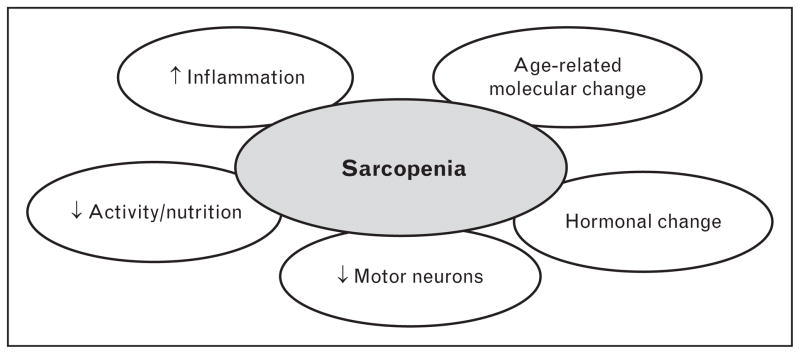
Although no consensus diagnosis has been reached, sarcopenia is increasingly defined by both loss of muscle mass and loss of muscle function or strength. Its cause is widely regarded as multifactorial, with neurological decline, hormonal changes, inflammatory pathway activation, declines in activity, chronic illness, fatty infiltration, and poor nutrition, all shown to be contributing factors. Recent molecular findings related to apoptosis, mitochondrial decline, and the angiotensin system in skeletal muscle have highlighted biological mechanisms that may be contributory. Interventions in general continue to target nutrition and exercise.
Efforts to develop a consensus definition are ongoing and will greatly facilitate the development and testing of novel interventions for sarcopenia. Although pharmaceutical agents targeting multiple biological pathways are being developed, adequate nutrition and targeted exercise remain the gold standard for therapy.
肌肉减少症,即随年龄增长骨骼肌组织的减少,是导致老年人功能下降和丧失独立性的最重要原因之一。本文旨在综述肌肉减少症的现有定义、潜在病因和临床后果,以及干预的可能性。
尽管尚未达成共识诊断,但肌肉减少症越来越多地被定义为肌肉量和肌肉功能或力量的丧失。其病因被广泛认为是多因素的,包括神经功能下降、激素变化、炎症途径激活、活动减少、慢性疾病、脂肪浸润和营养状况不佳,所有这些都被认为是促成因素。最近在骨骼肌中与细胞凋亡、线粒体减少和血管紧张素系统相关的分子发现强调了可能具有促成作用的生物学机制。一般来说,干预措施仍针对营养和运动。
目前正在努力达成共识定义,这将极大地促进针对肌肉减少症的新干预措施的开发和测试。虽然正在开发针对多种生物学途径的药物,但充足的营养和有针对性的运动仍然是治疗的金标准。