Department of Surgery, The University of Hong Kong, Hong Kong SAR, China.
Ann Surg Oncol. 2013 Feb;20(2):653-9. doi: 10.1245/s10434-012-2624-8. Epub 2012 Sep 7.
The efficacy of reoperative cervical neck dissection (RND) in achieving biochemical complete remission (BCR) (or postreoperation stimulated thyroglobulin [sTg] of <0.5 ng/mL) remains unclear in persistent/recurrent papillary thyroid carcinoma (PTC). We hypothesized that lower postablation sTg levels would indicate a higher rate of BCR after RND. Our study examined the association between postablation sTg and BCR after one or more RNDs.
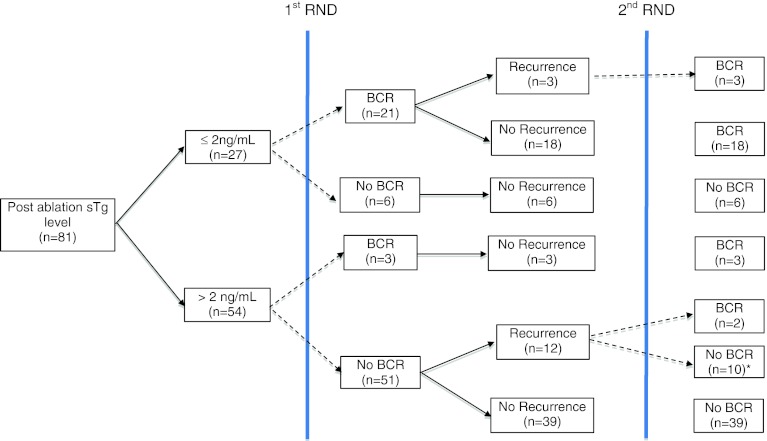
Of 199 patients who underwent RND, 81 patients were eligible. The postablation sTg levels (≤2 and >2 ng/mL) were correlated with the postreoperation sTg levels after RNDs. Patients' clinicopathological characteristics, operative findings, and subsequent RNDs were compared between those with BCR after RNDs and those without.
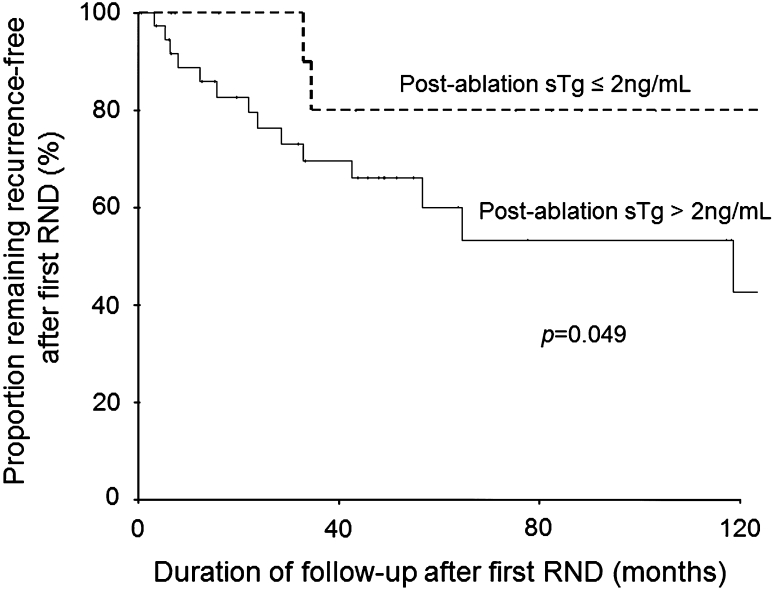
Those with postablation sTg levels of ≤2 ng/mL had significantly higher BCR rate after the first RND (77.8 vs. 5.6 %, p < 0.001), overall BCR after one or more RNDs (77.8 vs. 9.3 %, p < 0.001), and better 5-year recurrence-free survival after the first RND (80.0 vs. 60.1 %, p = 0.049) than those with postablation sTg levels of >2 ng/mL. Overall BCR gradually decreased after each subsequent RND. Postablation sTg significantly correlated with postreoperation sTg (ρ = 0.509, p < 0.001). After adjusting for the number of metastatic lymph nodes excised at first RND and presence of extranodal extension, postablation sTg of ≤ 0.2 ng/mL was the only independent factor for BCR after one or more RNDs (odds ratio 37.0, 95 % confidence interval 5.68-250.0, p = 0.001).
Only a third of patients who underwent one or more RNDs for persistent/recurrent PTC had BCR afterward. Postablation sTg level was an independent factor for BCR. Completeness of the initial operation is important for the subsequent success of RND.
在持续性/复发性甲状腺乳头状癌(PTC)中,再次颈淋巴结清扫术(RND)达到生化完全缓解(BCR)(或术后刺激甲状腺球蛋白[sTg]<0.5ng/mL)的疗效尚不清楚。我们假设,消融后 sTg 水平越低,RND 后达到 BCR 的比例越高。本研究检测了 RND 后消融后 sTg 与 BCR 之间的相关性。
在接受 RND 的 199 例患者中,有 81 例符合条件。比较 RND 后消融后 sTg 水平(≤2ng/mL 和>2ng/mL)与 RND 后术后 sTg 水平的相关性。比较 RND 后达到 BCR 与未达到 BCR 的患者的临床病理特征、手术结果和随后的 RND。
在第一次 RND 后,消融后 sTg 水平≤2ng/mL 的患者 BCR 率显著更高(77.8%比 5.6%,p<0.001),总体上,一次或多次 RND 后达到 BCR 的患者比例更高(77.8%比 9.3%,p<0.001),第一次 RND 后 5 年无复发生存率更好(80.0%比 60.1%,p=0.049)。消融后 sTg 水平与术后 sTg 水平显著相关(ρ=0.509,p<0.001)。在调整了首次 RND 切除的转移性淋巴结数量和有无外侵犯后,消融后 sTg 水平≤0.2ng/mL 是一次或多次 RND 后达到 BCR 的唯一独立因素(比值比 37.0,95%置信区间 5.68-250.0,p=0.001)。
只有三分之一的接受一次或多次 RND 治疗持续性/复发性 PTC 的患者在随后达到了 BCR。消融后 sTg 水平是 BCR 的一个独立因素。初始手术的完整性对 RND 后的后续成功至关重要。