Department of Anthropology, University of Notre Dame, Notre Dame, Indiana, United States of America.
PLoS One. 2012;7(9):e41559. doi: 10.1371/journal.pone.0041559. Epub 2012 Sep 5.
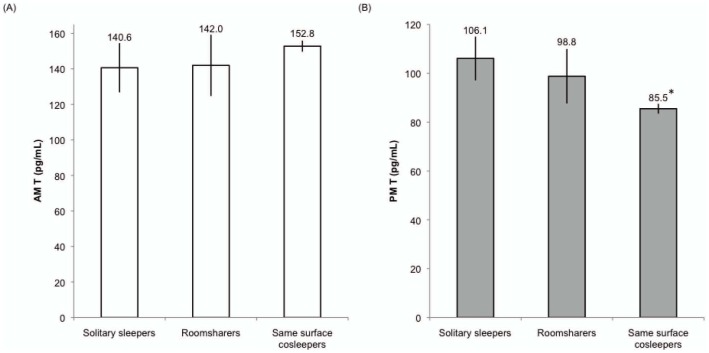
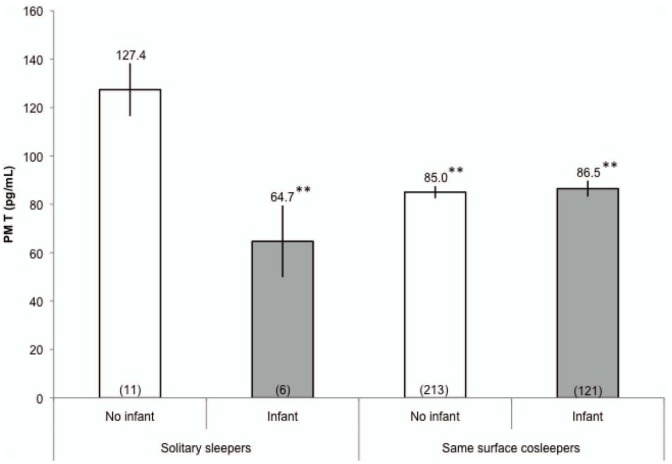
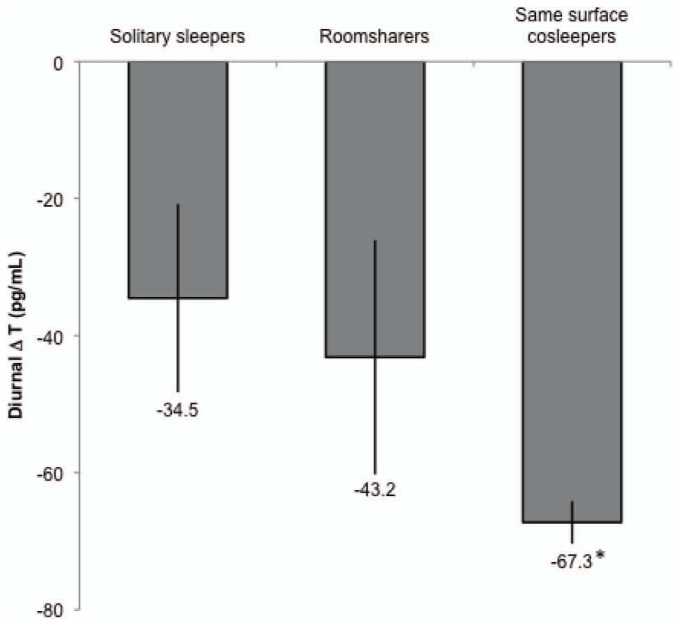
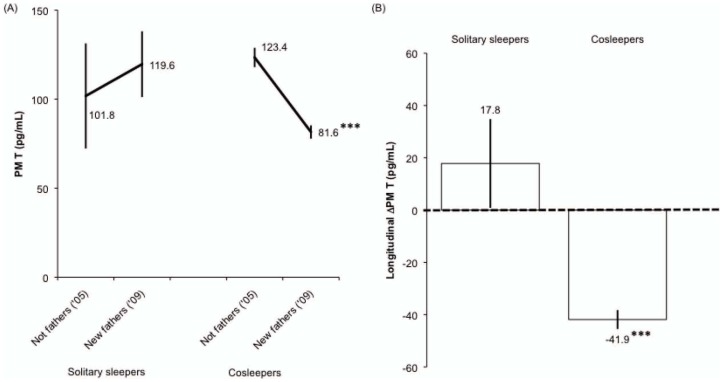
Because cross-species evidence suggests that high testosterone (T) may interfere with paternal investment, the relationships between men's transition to parenting and changes in their T are of growing interest. Studies of human males suggest that fathers who provide childcare often have lower T than uninvolved fathers, but no studies to date have evaluated how nighttime sleep proximity between fathers and their offspring may affect T. Using data collected in 2005 and 2009 from a sample of men (n = 362; age 26.0 ± 0.3 years in 2009) residing in metropolitan Cebu, Philippines, we evaluated fathers' T based on whether they slept on the same surface as their children (same surface cosleepers), slept on a different surface but in the same room (roomsharers), or slept separately from their children (solitary sleepers). A large majority (92%) of fathers in this sample reported practicing same surface cosleeping. Compared to fathers who slept solitarily, same surface cosleeping fathers had significantly lower evening (PM) T and also showed a greater diurnal decline in T from waking to evening (both p<0.05). Among men who were not fathers at baseline (2005), fathers who were cosleepers at follow-up (2009) experienced a significantly greater longitudinal decline in PM T over the 4.5-year study period (p<0.01) compared to solitary sleeping fathers. Among these same men, baseline T did not predict fathers' sleeping arrangements at follow-up (p>0.2). These results are consistent with previous findings indicating that daytime father-child interaction contributes to lower T among fathers. Our findings specifically suggest that close sleep proximity between fathers and their offspring results in greater longitudinal decreases in T as men transition to fatherhood and lower PM T overall compared to solitary sleeping fathers.
由于跨物种的证据表明,高睾丸激素(T)可能会干扰父爱投入,因此男性向育儿角色转变及其 T 水平变化的关系引起了越来越多的关注。研究表明,照顾子女的父亲通常比不参与照顾的父亲 T 水平更低,但迄今为止尚无研究评估父亲与子女夜间睡眠的接近程度如何影响 T。本研究利用了 2005 年和 2009 年在菲律宾宿雾市(人口 120 万)采集的一组男性(n=362;2009 年时的年龄为 26.0±0.3 岁)的数据,评估了父亲的 T 水平,其依据是他们是否与子女睡在同一表面(同睡者)、睡在不同表面但在同一房间(房间共享者)还是与子女分开睡(独自睡者)。该样本中绝大多数(92%)父亲报告实行同睡。与独自睡者相比,同睡者的晚间(PM)T 明显较低,且从醒来至晚间的 T 昼夜降幅也更大(均 p<0.05)。在基线(2005 年)时没有子女的男性中,在随访(2009 年)时为同睡者的父亲,在 4.5 年的研究期间,PM T 的纵向降幅明显更大(p<0.01),而独自睡者的降幅较小。在这些男性中,基线 T 不能预测随访时的睡眠安排(p>0.2)。这些结果与先前的研究结果一致,表明白天父亲与子女的互动有助于降低父亲的 T。我们的研究结果特别表明,父亲与子女之间的近距离睡眠接近度会导致父亲在向父亲角色转变期间 T 水平呈更大的纵向下降,且总体而言 PM T 比独自睡者更低。