Direction de la Politique Médicale, Assistance publique-Hôpitaux de Paris (AP-HP), Paris, France.
Antimicrob Resist Infect Control. 2012 Feb 13;1(1):9. doi: 10.1186/2047-2994-1-9.
Assistance Publique-Hôpitaux de Paris (APHP), the largest public health care institution in France (38 hospitals, 23,000 beds, serving 11.6 millions inhabitants) launched in 1993 a long term programme to control and survey multidrug resistant bacteria (MDR).
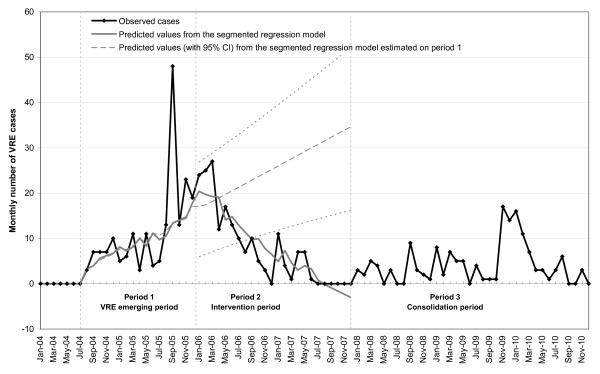
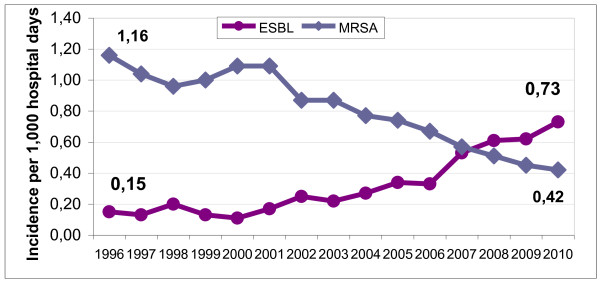
AP-HP MDR programme consisted in successive waves of actions: bundle measures to survey and control cross transmission of MRSA and extended-spectrum betalactamase producing enterobacteria (ESBL) in 1993, large campaign to promote the use of alcohol-based hand rub solution (ABHRS) in 2001, specific strategy to quickly control the spread of emerging MDR (vancomycin resistant Enterococcus, VRE; carbapenemase producing enterobacteria, CPE) in 2006, large campaign to decrease antibiotics consumption in 2006.Following this programme, the ABHRS consumption dramatically increased, the antibiotic consumption decreased by 10%, the incidence of MRSA, including MRSA bacteraemia, decreased by 2/3, all VRE and CPE events were rapidly controlled. However, the incidence of ESBL, mainly Klebsiella pneumoniae and Escherichia coli, that remained low and stable until 2003 increased markedly afterwards, justifying adapting our programme in the future.
A sustained and coordinated strategy can lead to control multidrug resistant bacteria at the level of a large multihospital institution.
巴黎公立医院集团(APHP)是法国最大的公立医疗机构(38 家医院,23000 张床位,服务 1160 万居民),于 1993 年启动了一项长期计划,以控制和监测多药耐药菌(MDR)。
AP-HP 的 MDR 计划包括连续几波行动:1993 年采取捆绑措施调查和控制耐甲氧西林金黄色葡萄球菌(MRSA)和产超广谱β-内酰胺酶的肠杆菌科细菌(ESBL)的交叉传播;2001 年大规模推广使用醇基手消毒剂(ABHRS);2006 年制定了快速控制新出现的 MDR(万古霉素耐药肠球菌,VRE;产碳青霉烯酶肠杆菌科细菌,CPE)传播的具体策略;2006 年大规模减少抗生素的使用。在该计划实施后,ABHRS 的消耗量大幅增加,抗生素消耗量减少了 10%,MRSA 的发病率(包括 MRSA 菌血症)下降了 2/3,所有 VRE 和 CPE 事件均迅速得到控制。然而,ESBL 的发病率(主要是肺炎克雷伯菌和大肠埃希菌)一直较低且稳定,直到 2003 年才显著增加,这表明我们未来需要调整计划。
持续协调的策略可以使大型多医院机构控制多药耐药菌。