Tălăpan Daniela, Rafila Alexandru
Microbiology Laboratory, National Institute of Infectious Diseases "Prof. Dr. Matei Balș", Bucharest, Romania.
Department of Microbiology, University of Medicine and Pharmacy "Carol Davila", Bucharest, Romania.
Infect Drug Resist. 2022 Jun 9;15:2959-2967. doi: 10.2147/IDR.S360048. eCollection 2022.
To determine the rate of carriage of multidrug-resistant organisms (MDROs) between 2015 and 2019 among patients admitted to the National Institute of Infectious Diseases "Prof. Dr. Matei Balș," from Bucharest, Romania.
Nasal, throat, and rectal/perirectal screening swabs were collected either immediately or during the first 24 hours of admission and sent to the microbiology laboratory where the following MDROs were identified: methicillin-resistant (MRSA), vancomycin-resistant enterococci (VRE), extended-spectrum -lactamase (ESBL)-producing Enterobacterales, carbapenem-resistant/carbapenemase-producing Enterobacterales (CRE/CPE), multidrug-resistant/extended drug-resistant (MDR/XDR-AB), and multidrug-resistant/extended drug-resistant (MDR/XDR-PA).
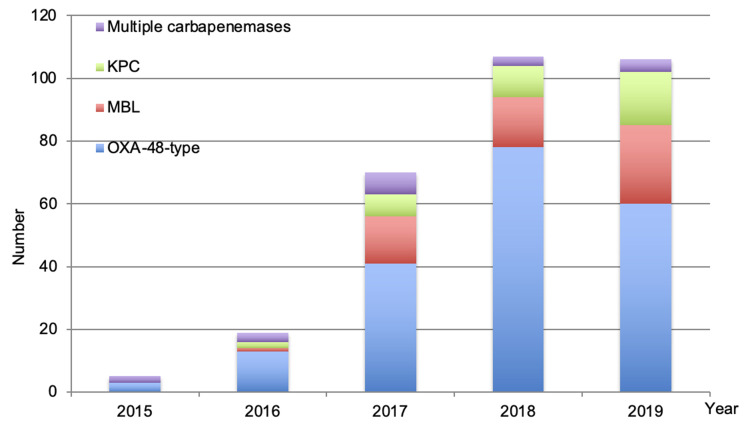
A total of 5083 unique patients were screened for MRSA and 5008 for VRE, ESBL/CRE/CPE, MDR/XDR-AB, and MDR/XDR-PA. MRSA was detected in 8.24% of patients, VRE in 17.67%, ESBL Enterobacterales in 25.85%, and CPE in 6.13%. MDR/XDR-AB was found in 1.59% and MDR/XDR-PA in 1.91% of patients. The rates of carriage increased between 2015 and 2019 for MRSA (7.23-7.6%), VRE (9-16.68%), CPE (1.15-6.77%), MDR/XDR-PA (1.15-1.91%), and MDR/XDR-AB (1.15-2.04%). OXA-48-type carbapenemase was predominant in (68.62%) and (89.47%). CPE bacteria other than and identified in our study carried mostly metallo-beta-lactamase (n = 28, 84.85%).
In this study, 37% of the unique patients screened over five years were found to be MDRO carriers. The proportion of VRE and CPE rectal carriers increased significantly between 2015 and 2019. The most frequently isolated carbapenemase was the OXA-48 type.
确定2015年至2019年间罗马尼亚布加勒斯特“马特伊·巴尔什教授”国家传染病研究所收治患者中多重耐药菌(MDROs)的携带率。
在入院后即刻或最初24小时内采集鼻、咽和直肠/直肠周围筛查拭子,并送至微生物实验室,在该实验室鉴定以下MDROs:耐甲氧西林金黄色葡萄球菌(MRSA)、耐万古霉素肠球菌(VRE)、产超广谱β-内酰胺酶(ESBL)的肠杆菌科细菌、耐碳青霉烯类/产碳青霉烯酶的肠杆菌科细菌(CRE/CPE)、多重耐药/广泛耐药鲍曼不动杆菌(MDR/XDR-AB)以及多重耐药/广泛耐药铜绿假单胞菌(MDR/XDR-PA)。
共对5083例独特患者进行了MRSA筛查,对5008例患者进行了VRE、ESBL/CRE/CPE、MDR/XDR-AB和MDR/XDR-PA筛查。8.24%的患者检测到MRSA,17.67%检测到VRE,25.85%检测到产ESBL肠杆菌科细菌,6.13%检测到CPE。1.59%的患者检测到MDR/XDR-AB,1.91%的患者检测到MDR/XDR-PA。2015年至2019年间,MRSA(7.23%-7.6%)、VRE(9%-16.68%)、CPE(1.15%-6.77%)、MDR/XDR-PA(1.15%-1.91%)和MDR/XDR-AB(1.15%-2.04%)的携带率有所上升。OXA-48型碳青霉烯酶在肺炎克雷伯菌(68.62%)和大肠埃希菌(89.47%)中占主导地位。在我们的研究中鉴定出的除肺炎克雷伯菌和大肠埃希菌之外的CPE细菌大多携带金属β-内酰胺酶(n = 28,84.85%)。
在本研究中,五年内筛查的独特患者中有37%被发现是MDRO携带者。2015年至2019年间,VRE和CPE直肠携带者的比例显著增加。最常分离出的碳青霉烯酶是OXA-48型。