Department of Hematology and Oncology, Children's Hospital of Soochow University, Suzhou, China.
Cancer Cell Int. 2012 Sep 8;12(1):40. doi: 10.1186/1475-2867-12-40.
The Real-time PCR Array System is the ideal tool for analyzing the expression of a focused panel of genes. In this study, we will analyze the gene expression profile of pediatric acute myeloid leukemia with real-time PCR arrays.
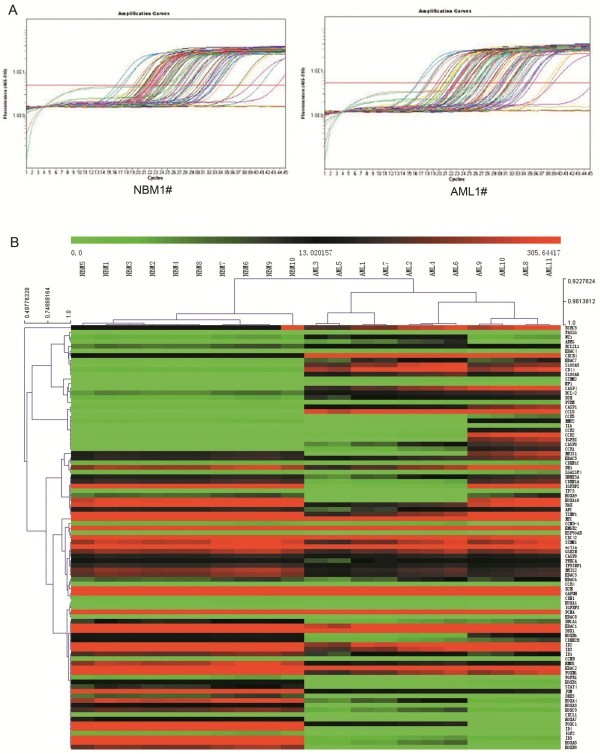
Real-time PCR array was designed and tested firstly. Then gene expression profile of 11 pediatric AML and 10 normal controls was analyzed with real-time PCR arrays. We analyzed the expression data with MEV (Multi Experiment View) cluster software. Datasets representing genes with altered expression profile derived from cluster analyses were imported into the Ingenuity Pathway Analysis Tool.
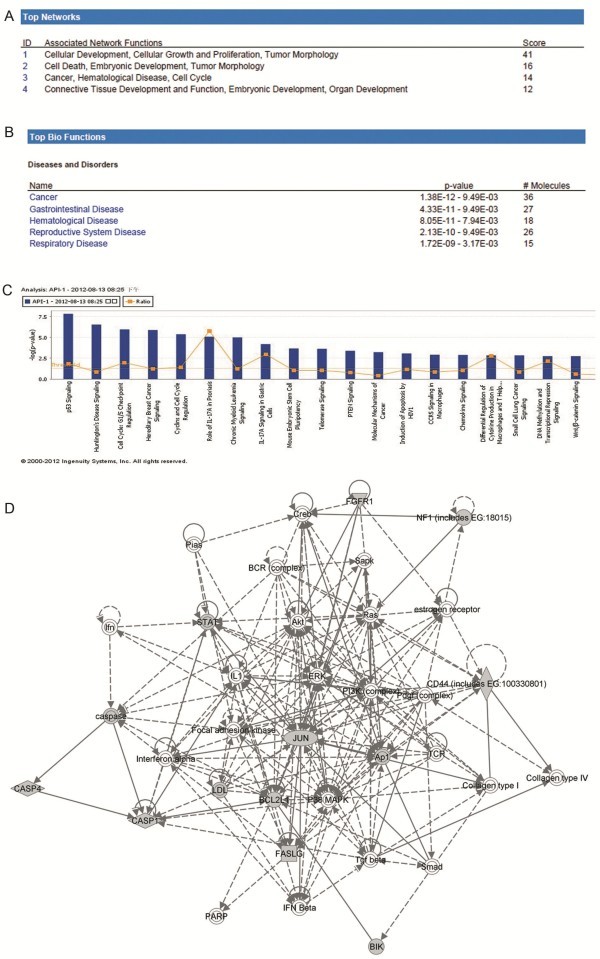
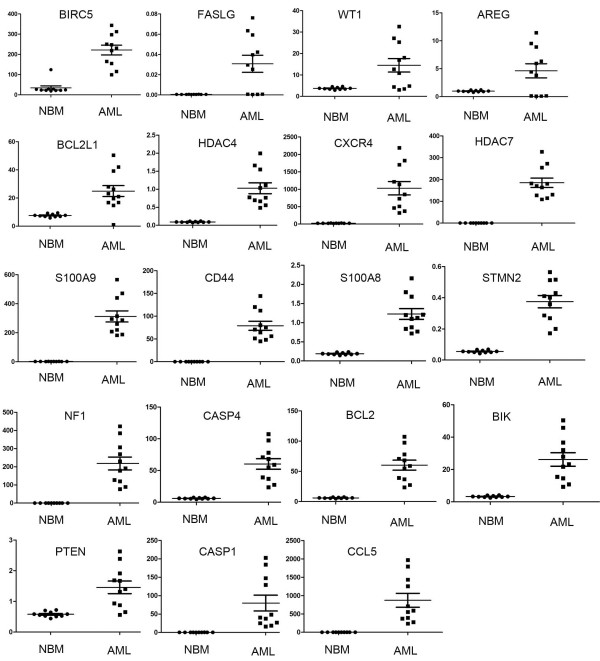
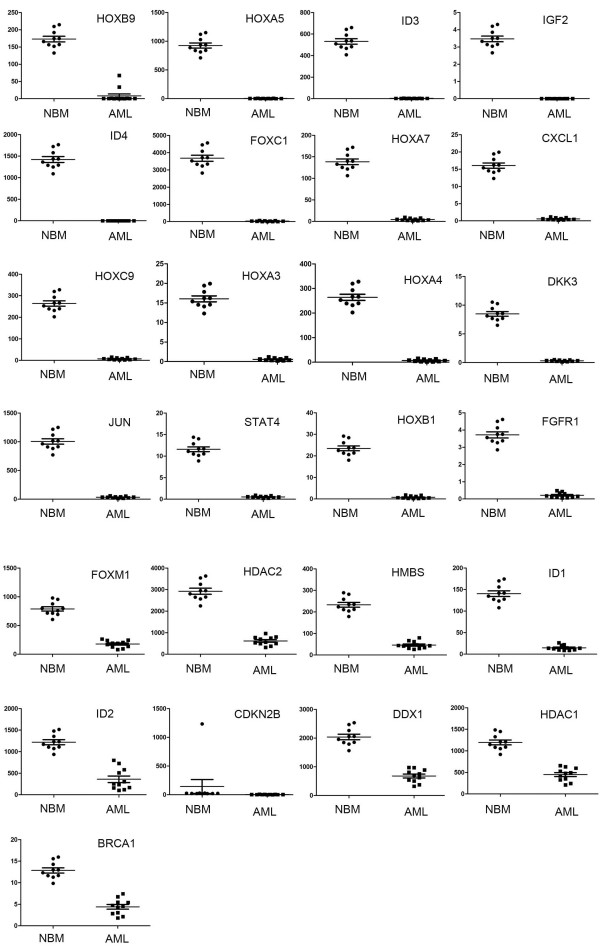
We designed and tested 88 real-time PCR primer pairs for a quantitative gene expression analysis of key genes involved in pediatric AML. The gene expression profile of pediatric AML is significantly different from normal control; there are 19 genes up-regulated and 25 genes down-regulated in pediatric AML. To investigate possible biological interactions of differently regulated genes, datasets representing genes with altered expression profile were imported into the Ingenuity Pathway Analysis Tool. The results revealed 12 significant networks. Of these networks, Cellular Development, Cellular Growth and Proliferation, Tumor Morphology was the highest rated network with 36 focus molecules and the significance score of 41. The IPA analysis also groups the differentially expressed genes into biological mechanisms that are related to hematological disease, cell death, cell growth and hematological system development. In the top canonical pathways, p53 and Huntington's disease signaling came out to be the top two most significant pathways with a p value of 1.5E-8 and2.95E-7, respectively.
The present study demonstrates the gene expression profile of pediatric AML is significantly different from normal control; there are 19 genes up-regulated and 25 genes down-regulated in pediatric AML. We found some genes dyes-regulated in pediatric AML for the first time as FASLG, HDAC4, HDAC7 and some HOX family genes. IPA analysis showed the top important pathways for pediatric AML are p53 and Huntington's disease signaling. This work may provide new clues of molecular mechanism in pediatric AML.
实时 PCR 阵列系统是分析重点基因表达谱的理想工具。在这项研究中,我们将使用实时 PCR 阵列分析儿科急性髓细胞白血病的基因表达谱。
首先设计和测试实时 PCR 阵列。然后,使用实时 PCR 阵列分析 11 例儿科 AML 和 10 例正常对照的基因表达谱。我们使用 MEV(多实验视图)聚类软件分析表达数据。从聚类分析中得出的代表基因表达谱改变的数据集被导入 Ingenuity 通路分析工具。
我们设计并测试了 88 对用于儿科 AML 中关键基因定量表达分析的实时 PCR 引物对。儿科 AML 的基因表达谱与正常对照明显不同;儿科 AML 中有 19 个基因上调,25 个基因下调。为了研究不同调节基因的可能生物学相互作用,将代表基因表达谱改变的数据集导入 Ingenuity 通路分析工具。结果显示 12 个显著网络。在这些网络中,细胞发育、细胞生长和增殖、肿瘤形态是评分最高的网络,有 36 个焦点分子,显著性评分为 41。IPA 分析还将差异表达基因分为与血液疾病、细胞死亡、细胞生长和血液系统发育相关的生物学机制。在顶级经典途径中,p53 和亨廷顿病信号通路分别以 1.5E-8 和 2.95E-7 的 p 值成为两个最重要的通路。
本研究表明,儿科 AML 的基因表达谱与正常对照明显不同;儿科 AML 中有 19 个基因上调,25 个基因下调。我们首次发现一些基因在儿科 AML 中被异常调节,如 FASLG、HDAC4、HDAC7 和一些 HOX 家族基因。IPA 分析显示,儿科 AML 的重要通路是 p53 和亨廷顿病信号通路。这项工作可能为儿科 AML 的分子机制提供新的线索。