McMaster University, Department of Psychiatry and Behavioral Neuroscience, Offord Centre for Child Studies, 1280 Main Street West, Chedoke Site, Patterson Building, Hamilton, ON L8S 3K1, Canada.
BMC Public Health. 2012 Sep 9;12:755. doi: 10.1186/1471-2458-12-755.
Overweight and obesity are steadily increasing worldwide with the greatest prevalence occurring in high-income countries. Many factors influence body mass index (BMI); however multiple influences assessed in families and individuals are rarely studied together in a prospective design. Our objective was to model the impact of multiple influences at the child (low birth weight, history of maltreatment, a history of childhood mental and physical conditions, and school difficulties) and family level (parental income and education, parental mental and physical health, and family functioning) on BMI in early adulthood.
We used data from the Ontario Child Health Study, a prospective, population-based study of 3,294 children (ages 4-16 years) enrolled in 1983 and followed up in 2001 (N = 1,928; ages 21-35 years). Using multilevel models, we tested the association between family and child-level variables and adult BMI after controlling for sociodemographic variables and health status in early adulthood.
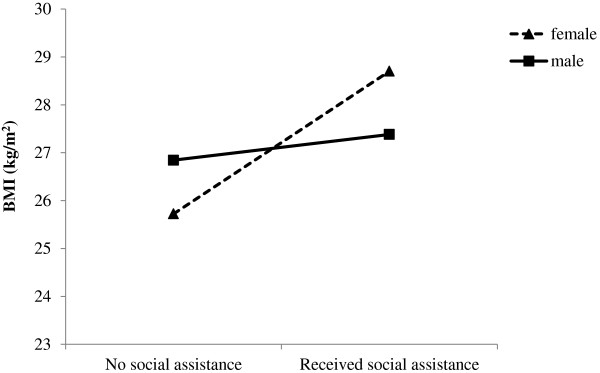
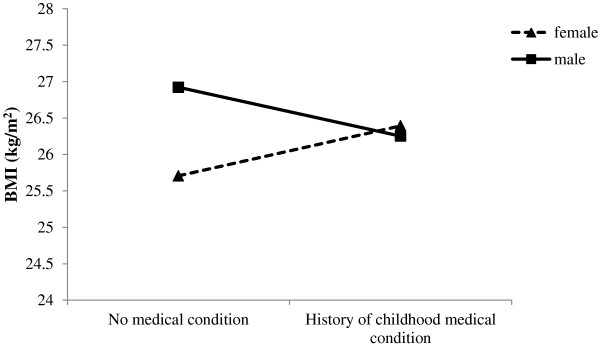
At the child level, presence of psychiatric disorder and school difficulties were related to higher BMI in early adulthood. At the family level, receipt of social assistance was associated with higher BMI, whereas family functioning, having immigrant parents and higher levels of parental education were associated with lower BMI. We found that gender moderated the effect of two risk factors on BMI: receipt of social assistance and presence of a medical condition in childhood. In females, but not in males, the presence of these risk factors was associated with higher BMI in early adulthood.
Overall, these findings indicate that childhood risk factors associated with higher BMI in early adulthood are multi-faceted and long-lasting. These findings highlight the need for preventive interventions to be implemented at the family level in childhood.
超重和肥胖在全球范围内稳步增加,高收入国家的患病率最高。许多因素会影响体重指数(BMI);然而,在家庭和个体中评估的多种影响因素很少在前瞻性设计中一起研究。我们的目的是建立模型,以评估儿童(低出生体重、虐待史、儿童期精神和身体状况史以及学校困难)和家庭层面(父母收入和教育程度、父母身心健康以及家庭功能)的多个因素对成年早期 BMI 的影响。
我们使用了安大略省儿童健康研究的数据,这是一项前瞻性的、基于人群的研究,涉及 3294 名儿童(4-16 岁),于 1983 年注册并在 2001 年进行了随访(N=1928;21-35 岁)。使用多水平模型,我们在控制了成年早期的社会人口统计学变量和健康状况后,检验了家庭和儿童层面的变量与成人 BMI 之间的关系。
在儿童层面,精神疾病和学校困难的存在与成年早期的 BMI 较高有关。在家庭层面,接受社会援助与较高的 BMI 相关,而家庭功能、父母为移民以及父母教育程度较高与较低的 BMI 相关。我们发现,性别调节了两个危险因素对 BMI 的影响:接受社会援助和儿童时期存在医疗状况。在女性中,但在男性中,这些危险因素的存在与成年早期较高的 BMI 相关。
总体而言,这些发现表明,与成年早期较高 BMI 相关的儿童时期危险因素是多方面且持久的。这些发现强调需要在儿童时期从家庭层面实施预防干预措施。