Universidade Federal de Pernambuco, Rua Antonio Rabelo 245, Madalena, Recife, PE, Brazil.
BMC Infect Dis. 2012 Sep 7;12:208. doi: 10.1186/1471-2334-12-208.
The delay in initiating treatment for tuberculosis (TB) in HIV-infected individuals may lead to the development of a more severe form of the disease, with higher rates of morbidity, mortality and transmissibility. The aim of the present study was to estimate the time interval between the onset of symptoms and initiating treatment for TB in HIV-infected individuals, and to identify the factors associated to this delay.
A nested case-control study was undertaken within a cohort of HIV-infected individuals, attended at two HIV referral centers, in the state of Pernambuco, Brazil. Delay in initiating treatment for TB was defined as the period of time, in days, which was greater than the median value between the onset of cough and initiating treatment for TB. The study analyzed biological, clinical, socioeconomic, and lifestyle factors as well as those related to HIV and TB infection, potentially associated to delay. The odds ratios were estimated with the respective confidence intervals and p-values.
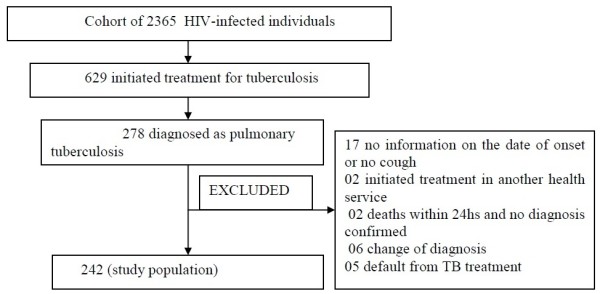
From a cohort of 2365 HIV-infected adults, 274 presented pulmonary TB and of these, 242 participated in the study. Patients were already attending 2 health services at the time they developed a cough (period range: 1 - 552 days), with a median value of 41 days. Factors associated to delay were: systemic symptoms asthenia, chest pain, use of illicit drugs and sputum smear-negative.
The present study indirectly showed the difficulty of diagnosing TB in HIV-infected individuals and indicated the need for a better assessment of asthenia and chest pain as factors that may be present in co-infected patients. It is also necessary to discuss the role played by negative sputum smear results in diagnosing TB/HIV co-infection as well as the need to assess the best approach for drug users with TB/HIV.
在感染 HIV 的个体中,结核病(TB)治疗的延迟可能导致疾病发展为更严重的形式,发病率、死亡率和传染性更高。本研究旨在估计 HIV 感染者中从症状出现到开始治疗 TB 的时间间隔,并确定与这种延迟相关的因素。
在巴西伯南布哥州的两个 HIV 转诊中心,对 HIV 感染者队列进行了嵌套病例对照研究。TB 治疗延迟定义为从咳嗽出现到开始治疗 TB 的时间,大于中位数的天数。该研究分析了可能与延迟相关的生物学、临床、社会经济和生活方式因素以及与 HIV 和 TB 感染相关的因素。使用相应的置信区间和 p 值估计比值比。
在 2365 名 HIV 感染的成年人中,有 274 人患有肺结核,其中 242 人参与了这项研究。患者在出现咳嗽时已经在 2 个卫生服务机构就诊(时间范围:1-552 天),中位数为 41 天。与延迟相关的因素包括:全身症状乏力、胸痛、使用非法药物和痰涂片阴性。
本研究间接表明了在 HIV 感染者中诊断 TB 的困难,并指出需要更好地评估乏力和胸痛等因素,这些因素可能存在于合并感染的患者中。还需要讨论痰涂片阴性结果在诊断 TB/HIV 合并感染中的作用,以及评估有 TB/HIV 的药物使用者的最佳方法的必要性。