Sarioglu Nurhan, Alpaydin Aylin Ozgen, Coskun Aysın Sakar, Celik Pınar, Ozyurt Beyhan Cengiz, Yorgancioglu Arzu
Celal Bayar University, Medical Faculty, Pulmonary Diseases, Manisa, Turkey.
Multidiscip Respir Med. 2010 Apr 30;5(2):84-91. doi: 10.1186/2049-6958-5-2-84.
Recently a multidimensional grading system based on the body mass index (B), degree of airflow obstruction (O), dyspnea (D) and exercise capacity (E) - the BODE index - has begun to be used increasingly for the evaluation of chronic obstructive pulmonary disease (COPD) patients. The aim of our study was to investigate the relationship between the BODE index and disease duration, annual exacerbation and hospitalization rates, health related quality of life and systemic inflammatory markers like C-reactive protein (CRP), tumor necrosis factor (TNF)-α and interleukin (IL)-8.
In 88 stable COPD patients we evaluated the body-mass index, pulmonary function tests, Modified Medical Research Council dyspnea scale and six-minute walk test (6 MWT). BODE scores were determined. Disease duration, number of exacerbations and hospitalization in the previous year were recorded. We also performed arterial blood gases analysis, administered the St. George's Respiratory Questionnaire (SGRQ) and measured serum levels of CRP, TNF-α, IL-8.
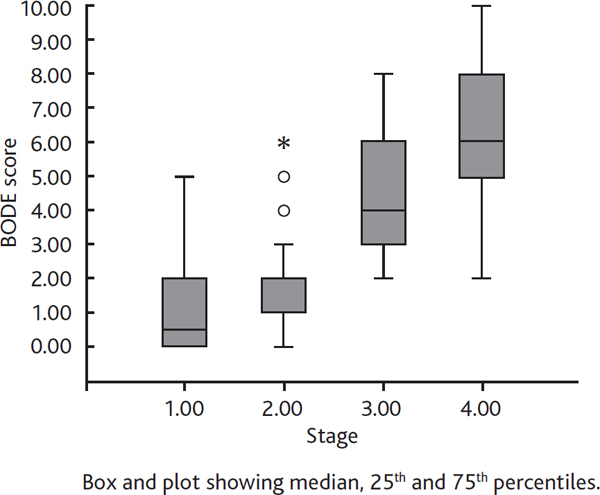
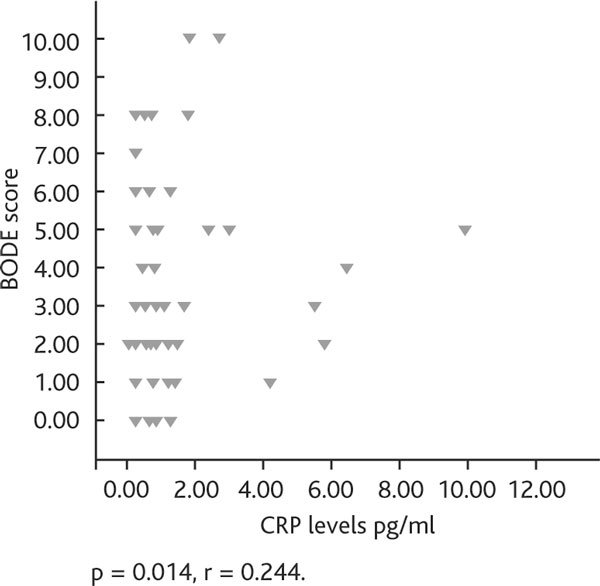
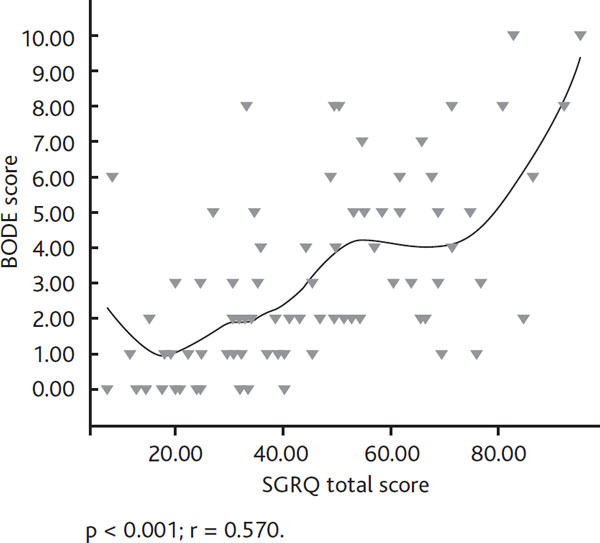
According to BODE score 52% of patients were BODE 1, 21% BODE 2, 15% BODE 3 and 12% were BODE 4. There was a significant relationship between BODE index and COPD stage as classified according to the Global Initiative for Chronic Obstructive Lung Disease (GOLD) (p < 0.001). Correlations between BODE score and disease duration (p = 0.011), number of exacerbations (p < 0.001) and hospitalizations (p < 0.001) in the last year were also observed. SGRQ symptom, activity, emotion scores and total scores were found to be significantly correlated to BODE (p < 0.001). Serum CRP levels and BODE were also correlated (p = 0.014); however, no correlation was found between serum levels of TNF-α and IL-8 and BODE.
As the BODE index shows a strong correlation with various prognostic and follow up parameters of COPD and systemic inflammation, its use should be considered for the evaluation of COPD patients.
最近,一种基于体重指数(B)、气流阻塞程度(O)、呼吸困难(D)和运动能力(E)的多维分级系统——BODE指数,已开始越来越多地用于评估慢性阻塞性肺疾病(COPD)患者。我们研究的目的是调查BODE指数与疾病持续时间、年度急性加重和住院率、健康相关生活质量以及全身炎症标志物如C反应蛋白(CRP)、肿瘤坏死因子(TNF)-α和白细胞介素(IL)-8之间的关系。
在88例稳定期COPD患者中,我们评估了体重指数、肺功能测试、改良医学研究委员会呼吸困难量表和六分钟步行试验(6MWT)。确定BODE评分。记录疾病持续时间、上一年的急性加重次数和住院次数。我们还进行了动脉血气分析,发放了圣乔治呼吸问卷(SGRQ),并测量了血清CRP、TNF-α、IL-8水平。
根据BODE评分,52%的患者为BODE 1级,21%为BODE 2级,15%为BODE 3级,12%为BODE 4级。BODE指数与根据慢性阻塞性肺疾病全球倡议(GOLD)分类的COPD分期之间存在显著相关性(p < 0.001)。还观察到BODE评分与疾病持续时间(p = 0.011)、上一年的急性加重次数(p < 0.001)和住院次数(p < 0.001)之间的相关性。发现SGRQ症状、活动、情绪评分和总分与BODE显著相关(p < 0.001)。血清CRP水平与BODE也相关(p = 0.014);然而,未发现血清TNF-α和IL-8水平与BODE之间存在相关性。
由于BODE指数与COPD的各种预后和随访参数以及全身炎症显示出很强的相关性,因此在评估COPD患者时应考虑使用该指数。