Department of Pathology, Massachusetts General Hospital, Harvard Medical School, Boston, MA 02114, USA.
Transpl Immunol. 2012 Oct;27(2-3):107-13. doi: 10.1016/j.trim.2012.08.005. Epub 2012 Aug 30.
Chronic rejection leads to kidney allograft failure and develops in many kidney transplant recipients. One cause of chronic rejection, chronic antibody mediated rejection (CAMR), is attributed to alloantibodies. Maintenance immunosuppression including prednisone, mycophenolate mofetil (MMF) and calcineurin inhibitors may limit alloantibody production in some patients, but many maintain or develop alloantibody production, leading to CAMR. Therefore, no efficacious therapy to treat CAMR is presently available to prevent the progression of CAMR to kidney allograft failure.
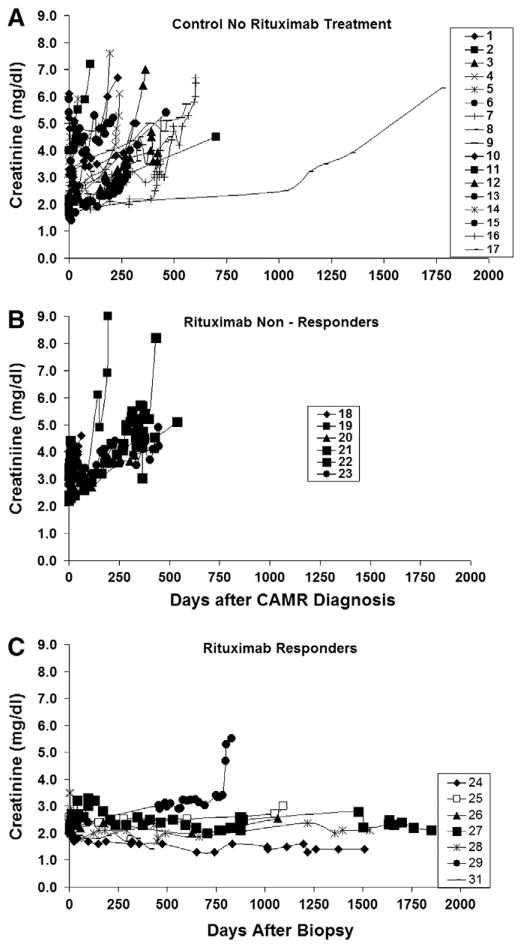
DESIGN, SETTING, PARTICIPANTS, AND MEASUREMENTS: We performed a retrospective review of 31 subjects with CAMR, of which 14 received Rituximab and 17 subjects did not. Response to Rituximab was defined as decline or stabilization of serum creatinine for at least one year. Data reviewed included demographic, clinical, allograft, post-transplant, and pathological variables. Pathological variables in the diagnostic allograft biopsy were scored according to Banff criteria.
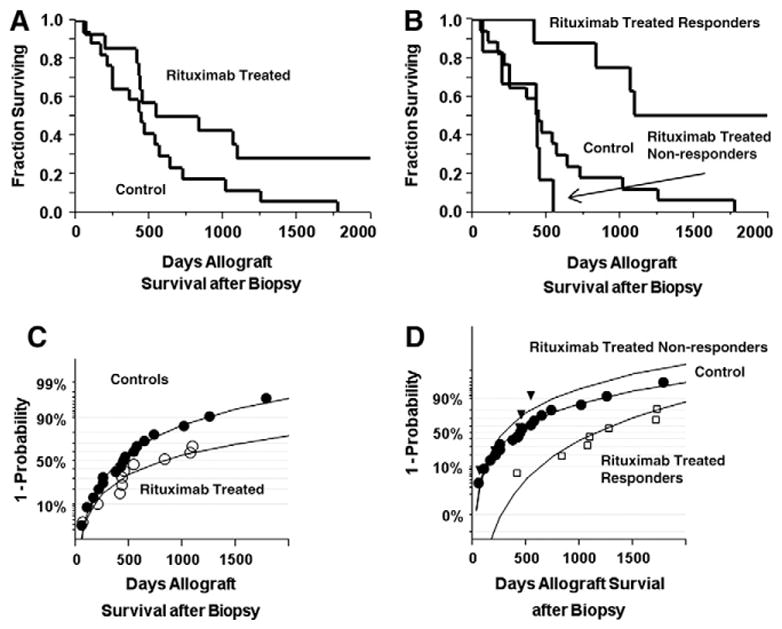
The median survival time (MST) for allografts in the control group was 439 days, and for the Rituximab treated group was 685 days. The Rituximab group was dichotomous with 8 subjects showing a medial survival time of 1180 days, and 6 subjects having a median survival time of 431 days. The MST for the responders was statistically significant from the non-responders and controls. No pathological parameter distinguished any subset of subjects.
These data show that Rituximab followed by standard maintenance immunosuppression shows a therapeutic effect in the treatment of CAMR, which is confined to a subset of treated subjects, not identifiable a priori.
慢性排斥反应导致肾移植失败,在许多肾移植受者中发展。慢性抗体介导的排斥反应(CAMR)是慢性排斥反应的一个原因,归因于同种异体抗体。包括泼尼松、霉酚酸酯(MMF)和钙调神经磷酸酶抑制剂在内的维持性免疫抑制可能会限制一些患者同种异体抗体的产生,但许多患者仍保持或产生同种异体抗体,导致 CAMR。因此,目前尚无有效的治疗方法可用于治疗 CAMR,以防止其进展为肾移植失败。
设计、地点、参与者和测量:我们对 31 例 CAMR 患者进行了回顾性研究,其中 14 例接受了利妥昔单抗治疗,17 例未接受治疗。利妥昔单抗的反应定义为血清肌酐至少稳定下降一年。审查的数据包括人口统计学、临床、移植物、移植后和病理变量。根据 Banff 标准对诊断性移植活检中的病理变量进行评分。
对照组的中位存活时间(MST)为 439 天,利妥昔单抗治疗组为 685 天。利妥昔单抗组分为两组,8 例患者的 MST 为 1180 天,6 例患者的 MST 为 431 天。应答者的 MST 与无应答者和对照组有统计学意义。没有病理参数可以区分任何亚组的患者。
这些数据表明,利妥昔单抗联合标准维持性免疫抑制治疗在 CAMR 的治疗中具有疗效,但仅限于一部分接受治疗的患者,这些患者事先无法识别。