Department of Child and Adolescent Studies, Faculty of Social and Behavioural Sciences, Utrecht University, PO Box 80.140, 3508 TC Utrecht, The Netherlands.
Prev Sci. 2012 Dec;13(6):594-604. doi: 10.1007/s11121-012-0286-1.
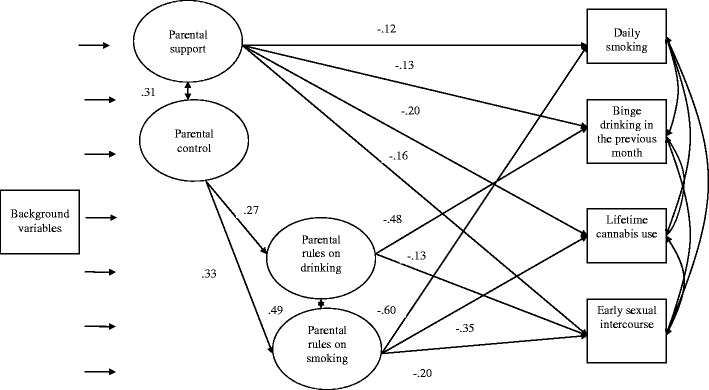
Previous research has provided considerable support for idea that increased parental support and control are strong determinants of lower prevalence levels of adolescent risk behavior. Much less is known on the association between specific parenting practices, such as concrete rules with respect to smoking and drinking and adolescent risk behavior. The present paper examined whether such concrete parental rules (1) have an effect on the targeted behaviors and (2) predict other, frequently co-occurring, risk behaviors (i.e., cannabis use and early sexual intercourse). These hypotheses were tested in a nationally representative sample of 12- to 16-year-old adolescents in the Netherlands. We found that both types of rules were associated with a lower prevalence of the targeted behaviors (i.e., smoking and drinking). In addition, independent of adolescent smoking and drinking behaviors, parental rules on smoking predicted a lower prevalence of cannabis use and early sexual intercourse, and parental rules on alcohol use also predicted a lower prevalence of early sexual intercourse. This study showed that concrete parental rule setting is more strongly related to lower levels of risk behaviors in adolescents compared to the more general parenting practices (i.e., support and control). Additionally, the effects of such rules do not only apply to the targeted behavior but extend to related behaviors as well. These findings are relevant to the public health domain and suggest that a single intervention program that addresses a limited number of concrete parenting practices, in combination with traditional support and control practices, may be effective in reducing risk behaviors in adolescence.
先前的研究为以下观点提供了充分的支持,即增加父母的支持和控制是青少年风险行为发生率较低的强有力决定因素。但对于具体的育儿实践(例如有关吸烟和饮酒的具体规定)与青少年风险行为之间的关联,人们知之甚少。本文研究了这些具体的父母规定(1)是否对目标行为有影响,以及(2)是否可以预测其他经常同时发生的风险行为(即大麻使用和早期性行为)。这些假设在荷兰对 12 至 16 岁的全国代表性青少年样本中进行了检验。我们发现,这两种类型的规定都与目标行为(即吸烟和饮酒)的发生率较低有关。此外,独立于青少年吸烟和饮酒行为,关于吸烟的父母规定可以预测大麻使用和早期性行为的发生率较低,而关于饮酒的父母规定也可以预测早期性行为的发生率较低。本研究表明,与更普遍的育儿实践(即支持和控制)相比,具体的父母规定与青少年较低的风险行为水平更相关。此外,这些规定的效果不仅适用于目标行为,而且还适用于相关行为。这些发现与公共卫生领域有关,表明针对少数具体的父母养育实践的单一干预计划,结合传统的支持和控制实践,可能对减少青少年的风险行为有效。