• 文献检索
  • 文档翻译
  • 深度研究
  • 学术资讯
  • Suppr Zotero 插件Zotero 插件
  • 邀请有礼
  • 套餐&价格
  • 历史记录
应用&插件
Suppr Zotero 插件Zotero 插件浏览器插件Mac 客户端Windows 客户端微信小程序
定价
高级版会员购买积分包购买API积分包
服务
文献检索文档翻译深度研究API 文档MCP 服务
关于我们
关于 Suppr公司介绍联系我们用户协议隐私条款
关注我们

Suppr 超能文献

核心技术专利:CN118964589B侵权必究
粤ICP备2023148730 号-1Suppr @ 2026

文献检索

告别复杂PubMed语法,用中文像聊天一样搜索,搜遍4000万医学文献。AI智能推荐,让科研检索更轻松。

立即免费搜索

文件翻译

保留排版,准确专业,支持PDF/Word/PPT等文件格式,支持 12+语言互译。

免费翻译文档

深度研究

AI帮你快速写综述,25分钟生成高质量综述,智能提取关键信息,辅助科研写作。

立即免费体验

增强运动表现的视觉反馈以促进脑卒中后行走康复:一项先导随机对照试验研究方案。

Augmented visual feedback of movement performance to enhance walking recovery after stroke: study protocol for a pilot randomised controlled trial.

机构信息

Bioengineering Department, University of Strathclyde, Glasgow, UK.

出版信息

Trials. 2012 Sep 11;13:163. doi: 10.1186/1745-6215-13-163.

DOI:10.1186/1745-6215-13-163
PMID:22967674
原文链接:https://pmc.ncbi.nlm.nih.gov/articles/PMC3541174/
Abstract

BACKGROUND

Increasing evidence suggests that use of augmented visual feedback could be a useful approach to stroke rehabilitation. In current clinical practice, visual feedback of movement performance is often limited to the use of mirrors or video. However, neither approach is optimal since cognitive and self-image issues can distract or distress patients and their movement can be obscured by clothing or limited viewpoints. Three-dimensional motion capture has the potential to provide accurate kinematic data required for objective assessment and feedback in the clinical environment. However, such data are currently presented in numerical or graphical format, which is often impractical in a clinical setting. Our hypothesis is that presenting this kinematic data using bespoke visualisation software, which is tailored for gait rehabilitation after stroke, will provide a means whereby feedback of movement performance can be communicated in a more meaningful way to patients. This will result in increased patient understanding of their rehabilitation and will enable progress to be tracked in a more accessible way.

METHODS

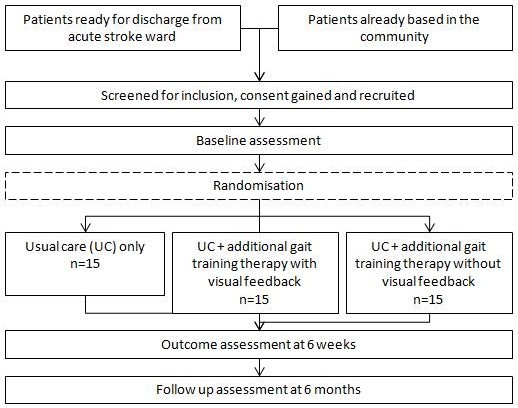
The hypothesis will be assessed using an exploratory (phase II) randomised controlled trial. Stroke survivors eligible for this trial will be in the subacute stage of stroke and have impaired walking ability (Functional Ambulation Classification of 1 or more). Participants (n = 45) will be randomised into three groups to compare the use of the visualisation software during overground physical therapy gait training against an intensity-matched and attention-matched placebo group and a usual care control group. The primary outcome measure will be walking speed. Secondary measures will be Functional Ambulation Category, Timed Up and Go, Rivermead Visual Gait Assessment, Stroke Impact Scale-16 and spatiotemporal parameters associated with walking. Additional qualitative measures will be used to assess the participant's experience of the visual feedback provided in the study.

DISCUSSION

Results from the trial will explore whether the early provision of visual feedback of biomechanical movement performance during gait rehabilitation demonstrates improved mobility outcomes after stroke and increased patient understanding of their rehabilitation.

TRIAL REGISTRATION

Current Controlled Trials ISRCTN79005974.

摘要

背景

越来越多的证据表明,使用增强的视觉反馈可能是一种治疗中风的有效方法。在当前的临床实践中,运动表现的视觉反馈通常仅限于使用镜子或视频。然而,这两种方法都不理想,因为认知和自我形象问题会分散或困扰患者,而且他们的运动可能会被衣服或有限的视角遮挡。三维运动捕捉具有提供临床环境中客观评估和反馈所需的精确运动学数据的潜力。然而,此类数据目前以数字或图形格式呈现,在临床环境中通常不切实际。我们的假设是,使用专为中风后步态康复设计的定制可视化软件呈现这些运动学数据,将为以更有意义的方式向患者传达运动表现反馈提供一种手段。这将增加患者对康复的理解,并使进展以更易访问的方式进行跟踪。

方法

该假设将通过一项探索性(二期)随机对照试验进行评估。有资格参加这项试验的中风幸存者将处于中风的亚急性期,且步行能力受损(功能性步行分类为 1 或更高)。参与者(n=45)将被随机分为三组,以比较在地面物理治疗步态训练中使用可视化软件与强度匹配和注意力匹配的安慰剂组和常规护理对照组的效果。主要结果测量指标是步行速度。次要结果测量指标是功能性步行分类、计时起立行走测试、Rivermead 视觉步态评估、中风影响量表-16 和与步行相关的时空参数。将使用额外的定性措施来评估参与者对研究中提供的视觉反馈的体验。

讨论

试验结果将探讨在步态康复期间早期提供生物力学运动表现的视觉反馈是否能改善中风后的移动能力结果,并增加患者对康复的理解。

试验注册

当前对照试验 ISRCTN79005974。

https://cdn.ncbi.nlm.nih.gov/pmc/blobs/4b8a/3541174/f179e8752cf0/1745-6215-13-163-3.jpg

相似文献

1
Augmented visual feedback of movement performance to enhance walking recovery after stroke: study protocol for a pilot randomised controlled trial.增强运动表现的视觉反馈以促进脑卒中后行走康复:一项先导随机对照试验研究方案。
Trials. 2012 Sep 11;13:163. doi: 10.1186/1745-6215-13-163.
2
Visual cue training to improve walking and turning after stroke: a study protocol for a multi-centre, single blind randomised pilot trial.视觉线索训练改善中风后行走与转身能力:一项多中心、单盲随机试点试验的研究方案
Trials. 2013 Sep 3;14:276. doi: 10.1186/1745-6215-14-276.
3
Visually-guided gait training in paretic patients during the first rehabilitation phase: study protocol for a randomized controlled trial.首次康复阶段对偏瘫患者进行视觉引导步态训练:一项随机对照试验的研究方案
Trials. 2016 Oct 27;17(1):523. doi: 10.1186/s13063-016-1630-8.
4
Walking adaptability therapy after stroke: study protocol for a randomized controlled trial.中风后步行适应性治疗:一项随机对照试验的研究方案
Trials. 2016 Aug 26;17(1):425. doi: 10.1186/s13063-016-1527-6.
5
Cardiovascular rehabilitation soon after stroke using feedback-controlled robotics-assisted treadmill exercise: study protocol of a randomised controlled pilot trial.中风后早期使用反馈控制机器人辅助跑步机运动进行心血管康复:一项随机对照试验的研究方案
Trials. 2013 Sep 22;14:304. doi: 10.1186/1745-6215-14-304.
6
Three-Dimensional Balance Training Using Visual Feedback on Balance and Walking Ability in Subacute Stroke Patients: A Single-Blinded Randomized Controlled Pilot Trial.三维平衡训练对亚急性脑卒中患者平衡及步行能力的视觉反馈作用:单盲随机对照试验
J Stroke Cerebrovasc Dis. 2019 Apr;28(4):994-1000. doi: 10.1016/j.jstrokecerebrovasdis.2018.12.016. Epub 2019 Jan 3.
7
How to improve walking, balance and social participation following stroke: a comparison of the long term effects of two walking aids--canes and an orthosis TheraTogs--on the recovery of gait following acute stroke. A study protocol for a multi-centre, single blind, randomised control trial.如何改善中风后的行走、平衡和社交参与能力:两种助行器——手杖和矫形器 TheraTogs——对急性中风后步态恢复的长期效果比较。一项多中心、单盲、随机对照试验的研究方案。
BMC Neurol. 2012 Mar 30;12:18. doi: 10.1186/1471-2377-12-18.
8
Physical fitness training in Subacute Stroke (PHYS-STROKE)--study protocol for a randomised controlled trial.亚急性卒中的体能训练(PHYS-STROKE)——一项随机对照试验的研究方案
Trials. 2014 Feb 3;15:45. doi: 10.1186/1745-6215-15-45.
9
Wristband Accelerometers to motiVate arm Exercise after Stroke (WAVES): study protocol for a pilot randomized controlled trial.腕带式加速度计促进卒中后手臂运动(WAVES):一项试点随机对照试验的研究方案
Trials. 2016 Oct 21;17(1):508. doi: 10.1186/s13063-016-1628-2.
10
Visualisation to enhance biomechanical tuning of ankle-foot orthoses (AFOs) in stroke: study protocol for a randomised controlled trial.可视化增强脑卒中患者踝足矫形器(AFO)的生物力学调节:一项随机对照试验的研究方案。
Trials. 2011 Dec 5;12:254. doi: 10.1186/1745-6215-12-254.

引用本文的文献

1
Effect of Anterioposterior Weight-Shift Training with Visual Biofeedback in Patients with Step Length Asymmetry after Subacute Stroke.视觉生物反馈下的前后向重心转移训练对亚急性卒中后步长不对称患者的影响。
J Pers Med. 2023 Dec 18;13(12):1726. doi: 10.3390/jpm13121726.
2
From Molecule to Patient Rehabilitation: The Impact of Transcranial Direct Current Stimulation and Magnetic Stimulation on Stroke-A Narrative Review.从分子到患者康复:经颅直流电刺激和磁刺激对脑卒中的影响——叙述性综述。
Neural Plast. 2023 Feb 28;2023:5044065. doi: 10.1155/2023/5044065. eCollection 2023.
3
Effect of Treadmill Training with Visual Biofeedback on Selected Gait Parameters in Subacute Hemiparetic Stroke Patients.

本文引用的文献

1
Virtual reality for stroke rehabilitation.用于中风康复的虚拟现实技术。
Cochrane Database Syst Rev. 2011 Sep 7(9):CD008349. doi: 10.1002/14651858.CD008349.pub2.
2
Nature, timing, frequency and type of augmented feedback; does it influence motor relearning of the hemiparetic arm after stroke? A systematic review.自然性、时机、频率和增强反馈类型;它们是否会影响脑卒中后偏瘫上肢的运动再学习?系统评价。
Disabil Rehabil. 2010;32(22):1799-809. doi: 10.3109/09638281003734359.
3
The psychometric properties and clinical utility of measures of walking and mobility in neurological conditions: a systematic review.
跑步机训练结合视觉生物反馈对亚急性偏瘫脑卒中患者特定步态参数的影响。
Int J Environ Res Public Health. 2022 Dec 16;19(24):16925. doi: 10.3390/ijerph192416925.
4
A Taxonomy for Augmented and Mixed Reality Applications to Support Physical Exercises in Medical Rehabilitation-A Literature Review.用于支持医学康复中体育锻炼的增强现实和混合现实应用分类法——文献综述
Healthcare (Basel). 2022 Mar 30;10(4):646. doi: 10.3390/healthcare10040646.
5
Load Auditory Feedback Boosts Crutch Usage in Subjects With Central Nervous System Lesions: A Pilot Study.负荷听觉反馈促进中枢神经系统损伤患者的拐杖使用:一项初步研究。
Front Neurol. 2021 Jul 6;12:700472. doi: 10.3389/fneur.2021.700472. eCollection 2021.
6
Virtual Environment Rehabilitation for Patients with Motor Neglect Trial (VERMONT): A Single-Center Randomized Controlled Feasibility Trial.运动忽视患者的虚拟环境康复试验(VERMONT):一项单中心随机对照可行性试验。
Brain Sci. 2021 Apr 6;11(4):464. doi: 10.3390/brainsci11040464.
7
Treadmill training augmented with real-time visualisation feedback and function electrical stimulation for gait rehabilitation after stroke: a feasibility study.跑步机训练结合实时可视化反馈和功能性电刺激用于中风后步态康复的可行性研究
BMC Biomed Eng. 2019 Aug 22;1:20. doi: 10.1186/s42490-019-0020-1. eCollection 2019.
8
Immediate effects of a novel walking assist device with auxiliary illuminator on patients after acute strokes.一种带有辅助照明器的新型步行辅助装置对急性中风后患者的即时影响。
Hong Kong Physiother J. 2019 Dec;39(2):115-124. doi: 10.1142/S1013702519500100. Epub 2019 May 29.
9
Modification of knee flexion during walking with use of a real-time personalized avatar.使用实时个性化虚拟人对步行过程中的膝关节屈曲进行修正。
Heliyon. 2019 Nov 14;5(11):e02797. doi: 10.1016/j.heliyon.2019.e02797. eCollection 2019 Nov.
10
Effect of simultaneous proprioceptive-visual feedback on gait of children with spastic diplegic cerebral palsy.同时进行本体感觉-视觉反馈对痉挛型双侧瘫脑瘫患儿步态的影响。
J Musculoskelet Neuronal Interact. 2019 Dec 1;19(4):500-506.
神经疾病中行走和移动能力测量的心理测量学特性和临床实用性:系统评价。
Clin Rehabil. 2009 Nov;23(11):1018-33. doi: 10.1177/0269215509339004. Epub 2009 Sep 28.
4
Overground physical therapy gait training for chronic stroke patients with mobility deficits.针对有行动障碍的慢性中风患者进行地面物理治疗步态训练。
Cochrane Database Syst Rev. 2009 Jul 8;2009(3):CD006075. doi: 10.1002/14651858.CD006075.pub2.
5
Developing and evaluating complex interventions: the new Medical Research Council guidance.开发与评估复杂干预措施:医学研究理事会新指南
BMJ. 2008 Sep 29;337:a1655. doi: 10.1136/bmj.a1655.
6
Is stroke the most common cause of disability?中风是导致残疾最常见的原因吗?
J Stroke Cerebrovasc Dis. 2004 Jul-Aug;13(4):171-7. doi: 10.1016/j.jstrokecerebrovasdis.2004.06.003.
7
Extrinsic feedback for motor learning after stroke: what is the evidence?中风后运动学习的外在反馈:证据有哪些?
Disabil Rehabil. 2006;28(13-14):831-40. doi: 10.1080/09638280500534937.
8
Proposal and validation of a new functional ambulation classification scale for clinical use.一种用于临床的新型功能性步行分类量表的提议与验证
Arch Phys Med Rehabil. 2005 Jun;86(6):1234-8. doi: 10.1016/j.apmr.2004.11.016.
9
Stroke Impact Scale-16: A brief assessment of physical function.中风影响量表-16:身体功能的简短评估。
Neurology. 2003 Jan 28;60(2):291-6. doi: 10.1212/01.wnl.0000041493.65665.d6.
10
Task-specific physical therapy for optimization of gait recovery in acute stroke patients.针对急性中风患者优化步态恢复的特定任务物理治疗。
Arch Phys Med Rehabil. 1993 Jun;74(6):612-20. doi: 10.1016/0003-9993(93)90159-8.