Switzer Christopher H, Cheng Robert Y-S, Ridnour Lisa A, Glynn Sharon A, Ambs Stefan, Wink David A
Breast Cancer Res. 2012 Sep 12;14(5):R125. doi: 10.1186/bcr3319.
The Ets-1 transcription factor is a candidate breast cancer oncogene that regulates the expression of genes involved in tumor progression and metastasis. Ets-1 signaling has also been linked to the development of a basal-like breast cancer phenotype. We recently described a nitric oxide (NO)-induced gene signature that is associated with poor disease outcome in estrogen receptor-negative (ER-) breast cancer and contains both stem cell-like and basal-like components. Thus, we examined the role of Ets-1 in NO signaling and NO-induced phenotypes in ER- human breast cancer cells.
Promoter region analyses were performed on genes upregulated in inducible nitric oxide synthase (NOS2) high expressing tumors for Ets-binding sites. In vitro mechanisms were examined in human basal-like breast cancer cells lines. NO signaling effects were studied using either forced NOS2 expression or the use of a chemical NO-donor, diethlylenetriamine NONOate (DETANO).
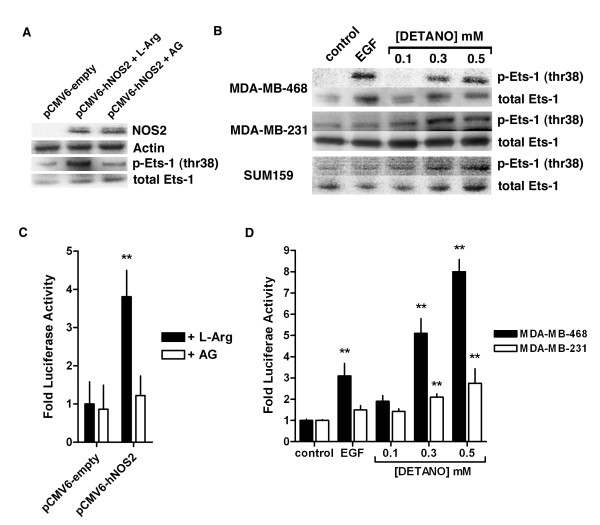
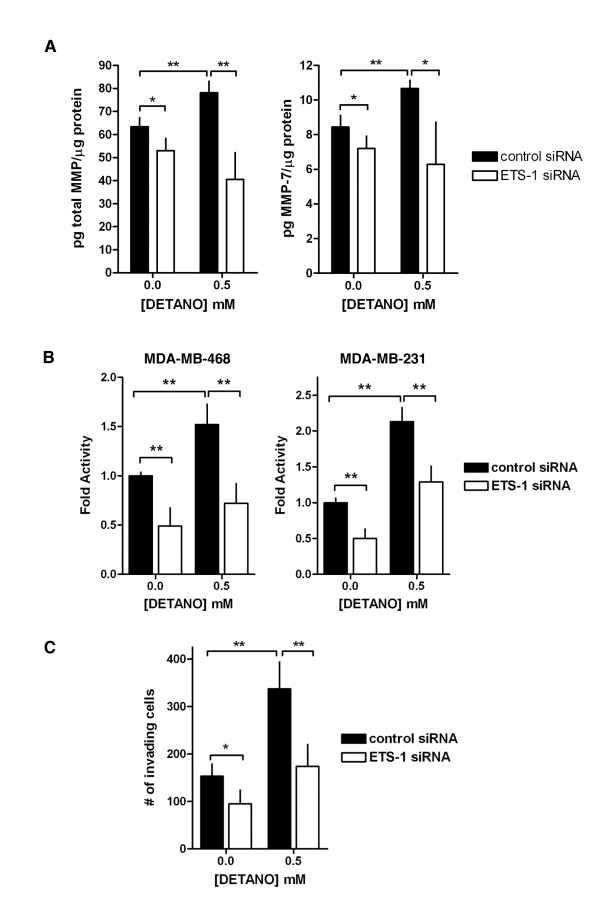
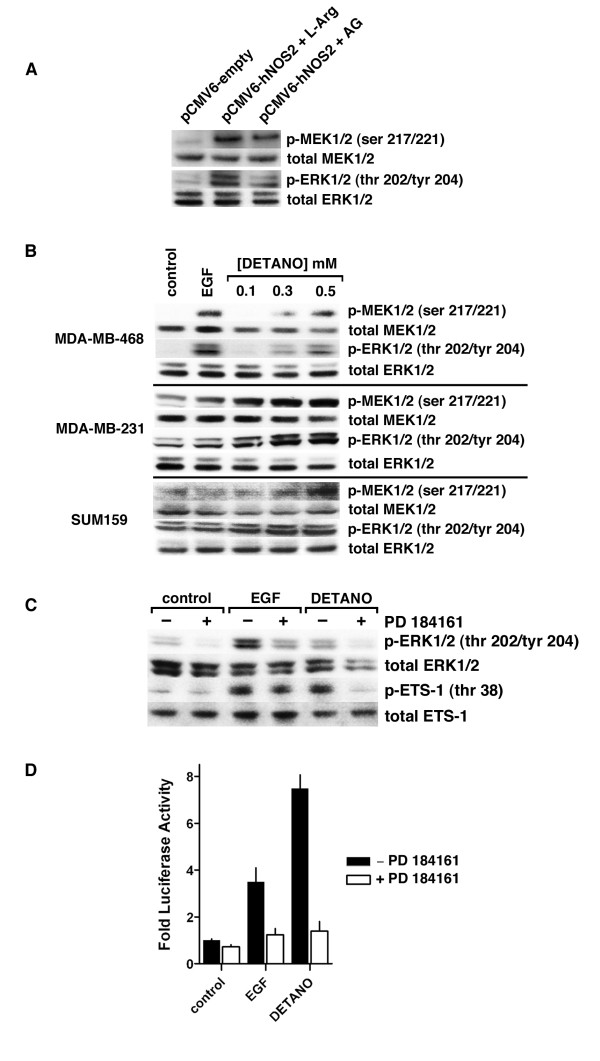
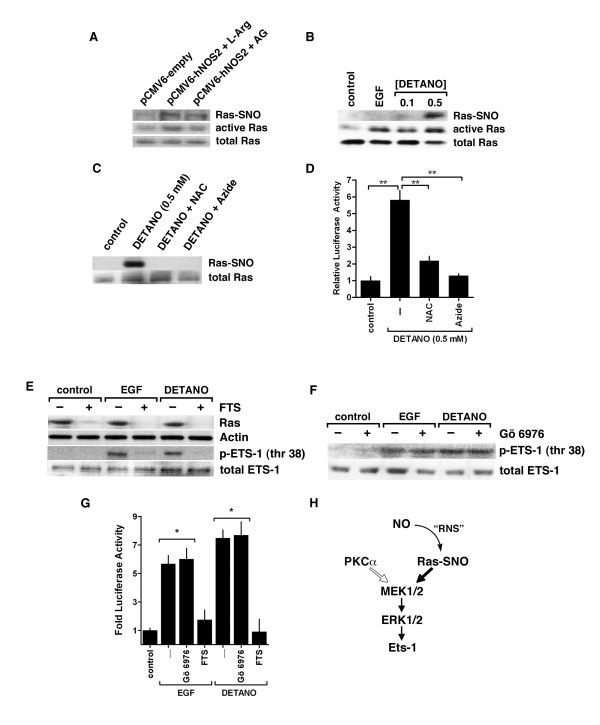
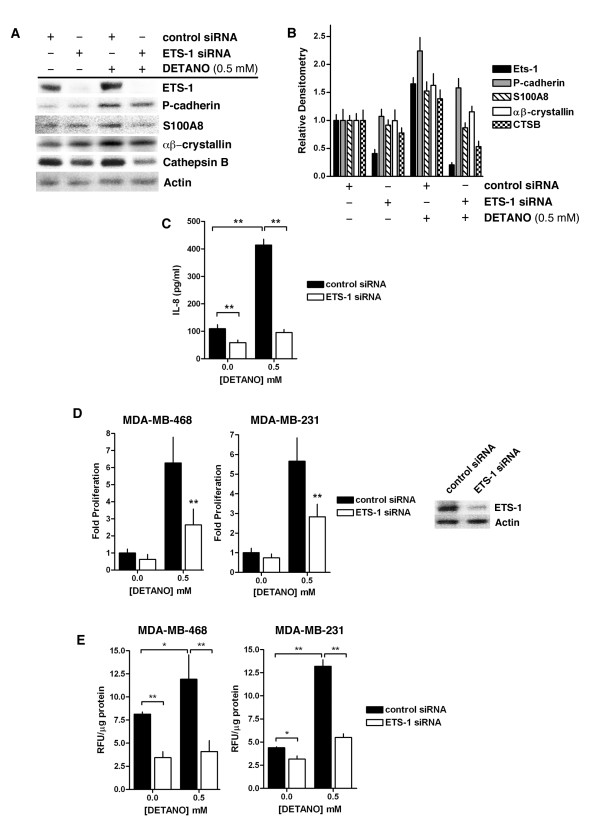
Promoter region analysis of genes that are up-regulated in human ER-negative breast tumors with high NOS2 expression revealed that the Ets-binding sequence is the only common promoter element present in all of these genes, indicating that Ets-1 is the key transcriptional factor down-stream of oncogenic NOS2-signaling. Accordingly, both forced NOS2 over-expression and exposure to NO-donors resulted in significant Ets-1 transcriptional activation in ER- breast cancer cells. Functional studies showed that NO activated Ets-1 transcriptional activity via a Ras/MEK/ERK signaling pathway by a mechanism that involved Ras S-nitrosylation. RNA knock-down of Ets-1 suppressed NO-induced expression of selected basal-like breast cancer markers such as P-cadherin, S100A8, IL-8 and αβ-crystallin. Additionally, Ets-1 knock-down reduced NO-mediated cellular proliferation, matrix metalloproteinase and cathepsin B activities, as well as matrigel invasion.
These data show that Ets-1 is a key transcriptional mediator of oncogenic NO signaling that promotes the development of an aggressive disease phenotype in ER- breast cancer in an Ets-1 and Ras-dependent manner, providing novel clues of how NOS2 expression in human breast tumors is functionally linked to poor patient survival.
Ets-1转录因子是一种潜在的乳腺癌致癌基因,可调节参与肿瘤进展和转移的基因表达。Ets-1信号传导也与基底样乳腺癌表型的发展有关。我们最近描述了一种一氧化氮(NO)诱导的基因特征,该特征与雌激素受体阴性(ER-)乳腺癌的不良疾病预后相关,并且包含干细胞样和基底样成分。因此,我们研究了Ets-1在ER-人乳腺癌细胞中NO信号传导和NO诱导表型中的作用。
对诱导型一氧化氮合酶(NOS2)高表达肿瘤中上调的基因进行启动子区域分析,以寻找Ets结合位点。在人基底样乳腺癌细胞系中研究体外机制。使用强制表达NOS2或使用化学NO供体二乙撑三胺 NONOate(DETANO)研究NO信号传导效应。
对NOS2高表达的人ER阴性乳腺肿瘤中上调基因的启动子区域分析表明,Ets结合序列是所有这些基因中唯一共同存在的启动子元件,表明Ets-1是致癌性NOS2信号传导下游的关键转录因子。因此,强制过表达NOS2和暴露于NO供体均导致ER-乳腺癌细胞中Ets-1转录显著激活。功能研究表明,NO通过涉及Ras S-亚硝基化的机制,经由Ras/MEK/ERK信号通路激活Ets-1转录活性。RNA敲低Ets-1可抑制NO诱导的某些基底样乳腺癌标志物的表达,如P-钙黏蛋白、S100A8、IL-8和αβ-晶状体蛋白。此外,敲低Ets-1可降低NO介导的细胞增殖、基质金属蛋白酶和组织蛋白酶B活性以及基质胶侵袭。
这些数据表明,Ets-1是致癌性NO信号传导的关键转录介质,以Ets-1和Ras依赖性方式促进ER-乳腺癌侵袭性疾病表型的发展,为人类乳腺肿瘤中NOS2表达与患者不良生存如何在功能上相关提供了新线索。