Department of Biochemistry, All India Institute of Medical Sciences (AIIMS), New Delhi, India.
Virol J. 2012 Sep 12;9:196. doi: 10.1186/1743-422X-9-196.
Analysis of human monoclonal antibodies (mAbs) developed from HIV-1 infected donors have enormously contributed to the identification of neutralization sensitive epitopes on the HIV-1 envelope glycoprotein. The third variable region (V3) is a crucial target on gp120, primarily due to its involvement in co-receptor (CXCR4 or CCR5) binding and presence of epitopes recognized by broadly neutralizing antibodies.
Thirty-three HIV-1 seropositive drug naive patients (18 males and 15 females) within the age range of 20-57 years (median = 33 years) were recruited in this study for mAb production. The mAbs were selected from EBV transformed cultures with conformationally constrained Cholera-toxin-B containing V3C (V3C-CTB) fusion protein. We tested the mAbs for their binding with HIV-1 derived proteins and peptides by ELISA and for neutralization against HIV-1 viruses by TZM-bl assays.
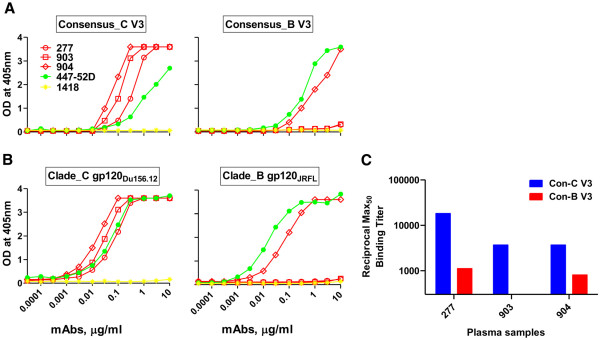
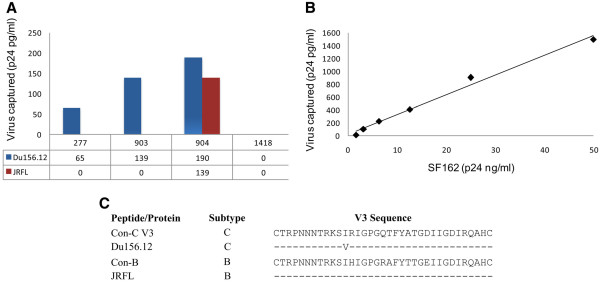
We isolated three anti-V3 mAbs, 277, 903 and 904 from the cells of different individuals. The ELISA binding revealed a subtype-C and subtype-A specific binding of antibody 277 and 903 while mAb 904 exhibited cross reactivity also with subtype-B V3. Epitope mapping of mAbs with overlapping V3 peptides showed exclusive binding to V3 crown. The antibodies displayed high and low neutralizing activity against 2/5 tier 1 and 1/6 tier 2 viruses respectively. Overall, we observed a resistance of the tier 2 viruses to neutralization by the anti-V3 mAbs, despite the exposure of the epitopes recognized by these antibodies on two representative native viruses (Du156.12 and JRFL), suggesting that the affinity of mAb might equally be crucial for neutralization, as the epitope recognition.
Our study suggests that the anti-V3 antibodies derived from subtype-C infected Indian patients display neutralization potential against tier 1 viruses while such activity may be limited against more resistant tier 2 viruses. Defining the fine epitope specificities of these mAbs and further experimental manipulations will be helpful in identification of epitopes, unique to clade C or shared with non-clade C viruses, in context of V3 region.
对源自 HIV-1 感染者的人源单克隆抗体(mAbs)进行分析,极大地促进了对 HIV-1 包膜糖蛋白上中和敏感表位的鉴定。第三可变区(V3)是 gp120 上的一个关键靶点,主要是因为它参与了共受体(CXCR4 或 CCR5)的结合,并且存在被广泛中和抗体识别的表位。
本研究招募了 33 名年龄在 20-57 岁之间(中位数=33 岁)的 HIV-1 血清阳性初治患者(18 名男性和 15 名女性)用于 mAb 产生。这些 mAbs 是从 EBV 转化的培养物中筛选出来的,这些培养物包含构象受限的霍乱毒素 B 含有 V3C(V3C-CTB)融合蛋白。我们通过 ELISA 检测 mAbs 与 HIV-1 来源的蛋白和肽的结合情况,并通过 TZM-bl 测定法检测 mAbs 对 HIV-1 病毒的中和作用。
我们从不同个体的细胞中分离出了三种抗 V3 mAb,277、903 和 904。ELISA 结合实验表明,抗体 277 和 903 具有针对亚型 C 和亚型 A 的特异性结合,而 mAb 904 也表现出与亚型 B V3 的交叉反应性。用重叠 V3 肽进行 mAb 表位作图显示,它们仅与 V3 冠结合。这些抗体对 2/5 层 1 和 1/6 层 2 病毒具有高和低中和活性。总的来说,我们观察到,尽管这些抗体识别的表位在两种代表性的天然病毒(Du156.12 和 JRFL)上暴露,但 tier 2 病毒对抗 V3 mAb 的中和作用具有抗性,这表明 mAb 的亲和力对中和作用同样至关重要,就像表位识别一样。
我们的研究表明,源自印度感染 C 型 HIV-1 的患者的抗 V3 抗体对 tier 1 病毒具有中和潜力,而这种活性可能对更具抗性的 tier 2 病毒有限。确定这些 mAb 的精细表位特异性,并进行进一步的实验操作,将有助于鉴定 V3 区特有的 clade C 或与非 clade C 病毒共享的表位。